




Tesla Stock Price Forecast: JPMorgan Sees SpaceX Acquiring Company at Up to 35% Premium, Stock Could Rebound to $420
TradingKey - After Elon Musk disclosed that SpaceX (SPCX) and Tesla (TSLA) have each formed special committees to discuss a potential merger, JPMorgan said a combination between the two companies still holds strong strategic rationale.
Regarding the transaction structure, JPMorgan expects that the potential merger could be led by SpaceX in an all-stock deal. The bank noted that SpaceX is currently valued at approximately $2 trillion, up about 10% from its initial public offering, and a higher equity valuation provides favorable conditions for it to execute an acquisition through stock issuance.
According to JPMorgan's calculations, based on Tesla's current market value, if a 30% to 35% premium—which the bank noted such transactions typically involve—is applied, the deal size would approach a "merger of equals," while still allowing Musk to retain over 50% of the voting rights in the combined entity.
JPMorgan believes there is room for synergy between SpaceX and Tesla in areas such as engineering talent, AI infrastructure, and the Terafab chip factory in Texas, providing a strategic basis for a potential merger.
The two companies already have commercial and capital ties. JPMorgan pointed out that SpaceX has purchased Tesla's Megapack energy storage batteries and Cybertruck; Tesla previously invested $2 billion in xAI, which has now become part of SpaceX. These ties indicate that a foundation for business cooperation already exists. From the perspective of potential financial impact, a merger could help streamline R&D, computing power, and related capital allocation.
Tesla's stock price currently stands at around $385. Based on JPMorgan's calculated premium of up to 35%, SpaceX could acquire the company at over $500 per share, which would boost Tesla's market capitalization to $2 trillion.
From a technical perspective, Tesla has returned to the upper bound of its recent consolidation zone and is holding above the 0.5 Fibonacci retracement level ($375.39), representing another upward push following a rebound from lower levels.
Looking at the broader structure, after the stock price peaked late last year, its highs moved lower over time. After rebounding to $453.40 in May, it fell again, bottoming out at $297.38 in late July. The subsequent recovery lifted the price center of gravity, but since September, trading has mostly hovered between $350 and $390, and the market is currently testing whether this consolidation can break out to the upside.
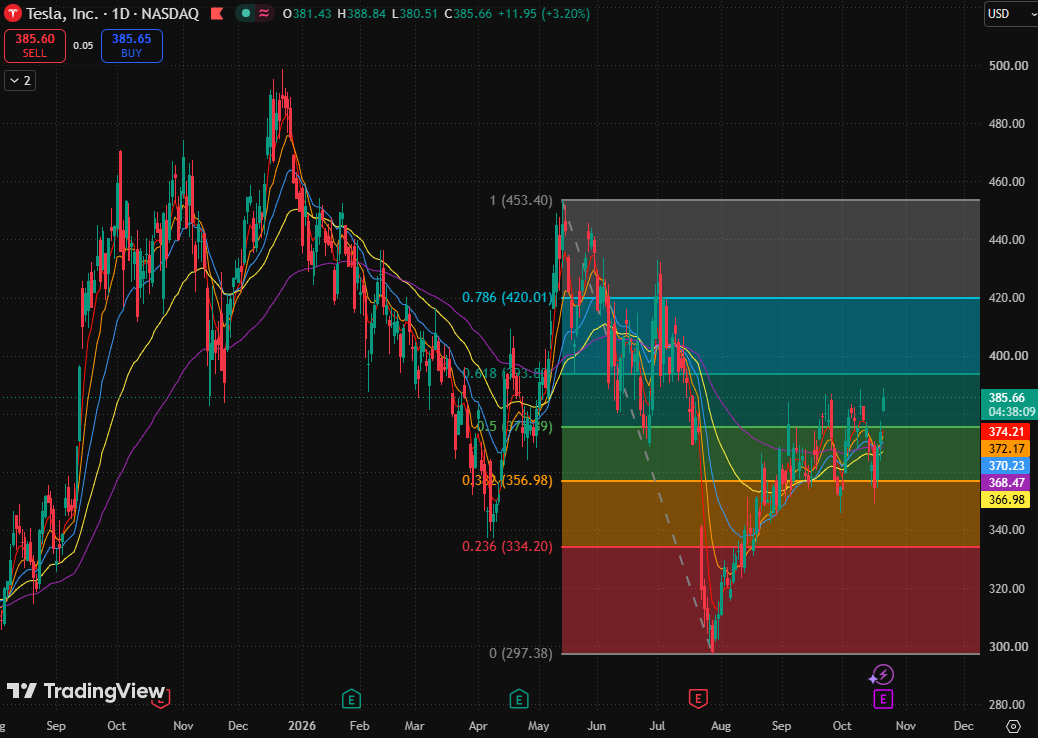
Tesla daily chart, Source: TradingView
Moving averages show a short-term bullish alignment, indicating improving recent momentum; however, the 80-day exponential moving average remains below the 160-day exponential moving average, and the medium- to long-term moving averages have yet to form a consistent bullish order. Although the stock price has returned above all moving averages, the moving averages themselves remain tightly clustered, and trend expansion will require subsequent price confirmation.
If the stock price firmly holds above $393.60 and defends this level on subsequent pullbacks, the rally could extend further to the 0.786 Fibonacci retracement level ($420); if the price fails to hold $375.39, the upward momentum will weaken, sending the price back inside the consolidation zone.
Recommended Articles


