



6 Signs of a Winning Stock, Each Shown by a Real Company
Key Points
Long-term stock winners share traits you can measure with simple tests.
No company aces every test, so the goal is finding businesses with at least one win.
Copart and Netflix pass their tests even though both stocks fell more than 35% over the past year.
- 10 stocks we like better than Netflix ›
Back on Dec. 27, 2010, I bought some Google stock at a split-adjusted $15.03 a share. The company has since renamed itself Alphabet (NASDAQ: GOOG) (NASDAQ: GOOGL), split its stock twice, and doubled down on artificial intelligence. On Oct. 16, 2026, the shares closed at $340.59.
That's a 2,166.1% gain in nearly 16 years. A $1,000 stake from that day would be worth about $22,661 now. I'd love to tell you I saw it all coming, but I did not predict the AI boom or YouTube's growth. What I saw was a business with traits that tend to show up in long-term winners. Those traits can be measured. Below are six of them, each paired with a company that clearly illustrates it and a specific test you can apply to any stock.
Missed AI’s "Act 1"? Act 2 Could Be 15x Bigger. Most investors think they missed the AI boat because they didn't buy Nvidia in 2005. But according to our analysts, we’re only at the end of "Act 1"—the R&D phase. "Act 2" is the global rollout. Continue »
Fair warning: a couple of these stocks have had a rotten year as of this writing. That's part of the lesson: don't sell a great stock in the inevitable dips.

Image source: Getty Images.
1. Patience and compounding: Coca-Cola
My test: 25 or more straight years of dividend raises, paid for with actual free cash flow.
Coca-Cola (NYSE: KO) is the stock market's slow cooker. Nothing much seems to happen for hours, and then dinner is ready. The company bumped its quarterly dividend from $0.51 to $0.53 this year, its 64th annual raise in a row. That streak is older than the moon landing.
The payout is backed by trailing free cash flow of about $14.3 billion, which lines up almost exactly with $14.4 billion in net income. The stock yields 2.4% and is up 32.9% this year, which is a wild ride by Coke's stable standards. Its 10-year price gain of 121% looks sleepy compared to the others, but that figure excludes dividends.
Reinvest those for a few decades and the slow cooker starts to look pretty clever. Coca-Cola's stock has quadrupled in price over the last 25 years, but the total return (with reinvested dividends) is about 8.3x:
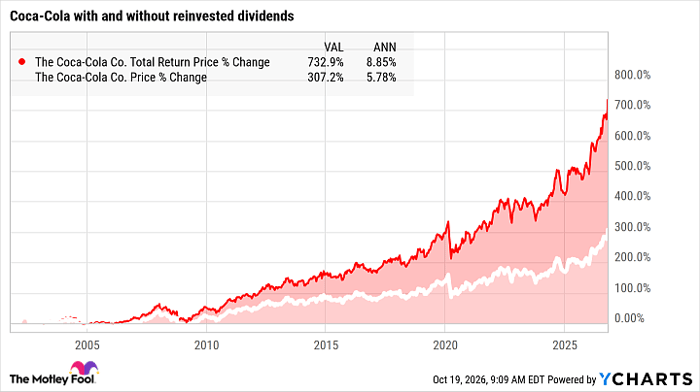
KO Total Return Price data by YCharts
2. High returns on invested capital: Alphabet
My test: Return on invested capital (ROIC) above 15%, year after year.
ROIC answers a simple question: if you hand this company a dollar, how much profit does it squeeze out of it each year? Alphabet's answer is about 32 cents, tops among these six. Its operating margin is 34% on roughly $446.6 billion of trailing revenue. Very few companies earn that kind of margin at that size.
3. Cash generation: Monster Beverage
My test: Free cash flow of at least 90% of net income, plus little or no debt.
Profits are an accountant's opinion; cash is a proven fact. Monster Beverage (NASDAQ: MNST) turned roughly $2.1 billion of net income into about $2.1 billion of free cash flow over the past year. That's a 99% conversion rate. It has zero debt, and its current assets cover current liabilities 3.7 times over.
Strong companies can fail this test during heavy back-end investment cycles. For example, Alphabet's free cash flow over the past year was about 22% of net income. Much of that gap comes from investment gains, including a big markup on its stake in Space Exploration Technologies when SpaceX went public.
Nice for the income statement, but you can't pay a dividend with an unrealized paper profit. Strip out the SpaceX equity gains, and Alphabet converts less than half of its remaining earnings into free cash, thanks to all that data center spending. It's still a great business, but Alphabet gets a failing grade on this particular test, at least for now.
4. A durable membership moat: Costco
My test: Membership renewal rates around 90% or higher.
Here's a somewhat strange business model. Costco Wholesale (NASDAQ: COST) barely makes money on the stuff it sells, with a 12.8% gross margin and a 3.9% operating margin. Its real product is the membership card, and customers pay for it before they buy a single rotisserie chicken.
And they keep paying. Costco ended fiscal 2026 with a 92.3% renewal rate in the U.S. and Canada and an 89.8% renewal rate worldwide. Paid memberships climbed to 84.1 million from 81.0 million a year earlier. Costco sells loyalty in bulk, too.
Ironically, Costco's stock isn't cheap. At 47.3 times trailing earnings, this is the priciest stock in my group of examples. That's the price of a world-class moat.
5. Owner-minded management: Copart
My test: Insiders own 5% or more, and the balance sheet carries little or no debt.
Copart (NASDAQ: CPRT) sells wrecked and used cars through online auctions. That's not glamorous. But insiders own 9% of the company, and debt is a rounding error at 1% of equity. Copart also holds about $4.5 billion in cash, or 17.4% of its $25.9 billion market cap. People who own a big slice of a company tend to run it as if they'll still own it in 20 years.
Now the uncomfortable part. Copart shares are down 37% over the past year and 24.6% over five years. Owner-minded managers can't always stop a stock from falling when the car market is shrinking. They just make it more likely the company exits a slump with its balance sheet intact.
Over the past 10 years, Copart's stock has risen 310%. I'll be watching to see whether management puts that cash to work while the shares are cheaper.
6. Reinvestment runway: Netflix
My test: This is a multi-part checkup. ROIC above 20%, revenue growth above 10% a year, and profits going back into the business instead of out the door as dividends.
A company with a long runway can reinvest its profits at high rates of return for many years. Netflix (NASDAQ: NFLX) pays no dividend. Most of its spare cash goes back into shows, movies, and new ways to keep you on the couch. It earns 31.1% on invested capital, and revenue has grown 12.6% a year over five years.
Netflix's stock didn't get the memo. Shares are down 41.5% over the past year and trade at 18.5 times forward earnings. The PEG ratio of 0.86 is the lowest in this group. Either the market sees trouble the numbers haven't shown yet, or the runway is on sale. Both possibilities deserve study.
Spoiler alert: I'm still a Netflix bull in 2026.
Putting the tests together
None of these companies ace every test:
- Alphabet is failing on cash conversion right now.
- Coca-Cola's price chart is a snooze without dividends.
- Monster has never paid a penny of dividends.
- Copart and Netflix pass their own tests but have lost value over the past year.
- Costco generates a lot of cash but also has $7.3 billion in long-term debt.
That's fine. The purpose of these tests is to identify businesses with sufficient strengths to weather rough stretches. My Google shares had plenty of those, and I'm glad I never sold during any of them.
Should you buy stock in Netflix right now?
Before you buy stock in Netflix, consider this:
The Motley Fool Stock Advisor analyst team just identified what they believe are the 10 best stocks for investors to buy now… and Netflix wasn’t one of them. The 10 stocks that made the cut could produce monster returns in the coming years.
Consider when Netflix made this list on December 17, 2004... if you invested $1,000 at the time of our recommendation, you’d have $380,363!* Or when Nvidia made this list on April 15, 2005... if you invested $1,000 at the time of our recommendation, you’d have $1,315,732!*
Now, it’s worth noting Stock Advisor’s total average return is 919% — a market-crushing outperformance compared to 211% for the S&P 500. Don't miss the latest top 10 list, available with Stock Advisor, and join an investing community built by individual investors for individual investors.
See the 10 stocks »
*Stock Advisor returns as of October 19, 2026.
Anders Bylund has positions in Alphabet and Netflix. The Motley Fool has positions in and recommends Alphabet, Copart, Costco Wholesale, Monster Beverage, and Netflix. The Motley Fool has a disclosure policy.
Recommended Articles


