




History Says a Stock Market Correction Is Coming Eventually. Here's the Good News for Investors.
Key Points
There are smart tweaks to make to your portfolio if you expect a correction soon.
Corrections are also great opportunity to load up on quality investments at lower prices.
- These 10 stocks could mint the next wave of millionaires ›
A stock market correction is definitely coming. Eventually.
In fact, I don't think a correction -- a decline of at least 10% -- is imminent. It might be, but at the moment, the economy looks strong, and the market has weathered the spike in energy prices resulting from the ongoing war in the Persian Gulf. Plus, calling market tops and bottoms is a mug's game. And one I'm not interested in.
Missed Nvidia in 2009? This Rare Signal Is Flashing Again. In 2009, a "Double Down" signal flashed for a little-known chipmaker called Nvidia. For the first time in years, that same "Total Conviction" signal is flashing for a company 1/100th the size of Nvidia. Continue »
That said, a correction will happen eventually. And it will be caused by geopolitical tensions, spiking oil prices, stock overvaluations, rising interest rates, spiking bond yields, disappointing economic data or corporate earnings, or runaway inflation... or a combination of several of these.
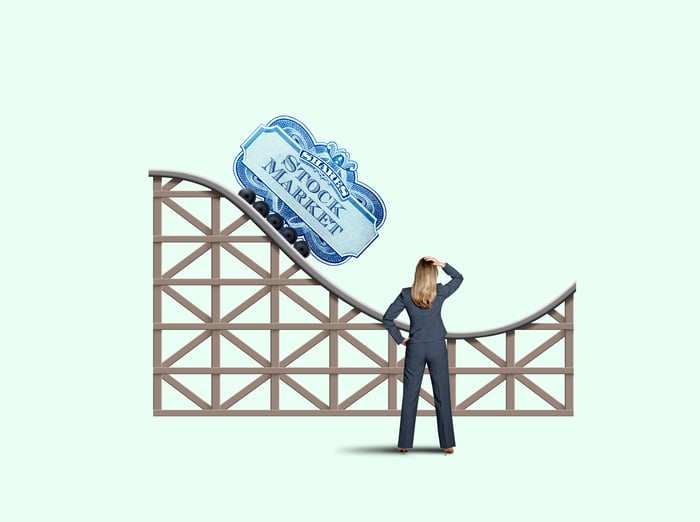
Image source: Getty Images.
Because they can be caused by so many things, corrections are relatively common. They occur, on average, every 2.2 years. And the average market decline is 21% (including bear markets, defined as corrections of more than 20%). In fact, there was a market correction just last year, after the Trump administration announced tariffs on U.S. trading partners, which the president called "Liberation Day." There was a correction in 2022 that was due to aggressive rate hikes by the Federal Reserve in response to spiking inflation.
Here's the good news for investors. The U.S. stock market recovered from each of those corrections and went on to post new highs. And most corrections don't last very long. The average length is about 115 days, according to Yardeni Research. Of course, bear markets can last longer.
What should investors do to prepare for the next correction?
Because I've been writing about the U.S. economy and financial markets for three decades, friends and relatives often ask me whether a market correction is coming and what to do. I tell them it definitely is, though it's impossible to know when.
As to what they should do, my rule of thumb is that if you're within three years of retirement, when you may need to begin liquidating your assets for money to live on, it's time to become more defensive. Because while the market will eventually recover from any correction or crash, it could take a few years, and you don't want to be selling stocks when they're down.
Becoming more defensive means increasing your allocation to bonds and other safe assets. Also, within your stock portfolio, increase your allocation to defensive sectors like healthcare, utilities, and consumer staples. Consumers will continue to spend on all three, no matter what the economy and the market are doing. You may also want to add non-correlated assets to your portfolio, i.e., those that don't move with the overall market. Those include real estate, precious metals, and commodities.
If you're not within three years of retirement, stick with your investment plan through the market's ups and downs. You absolutely don't want to panic sell if the market is cratering. That will result in ugly losses. And there's no need to sustain them. Most of your stocks will recover.
Accumulating cash is also a good idea
You do, however, want a diversified portfolio with money allocated to both stocks and bonds, as well as liquid assets such as savings, money market funds, and other cash equivalents. Ideally, you want to have enough cash to cover three to six months of expenses, though I realize that's not easy.
The key to diversification in your portfolio is rebalancing. If, say, you did very well with investments in "Magnificent Seven" stocks and, as a result, they rose from 10% of your portfolio to 30%, you want to rebalance so that they're back to 10%. A portfolio with a high concentration in any one stock or sector is high-risk.
Finally, corrections can be huge investment opportunities, too. Many savvy investors look forward to them because they know that other investors will panic-sell their stocks, allowing smarter investors to pick them up at a discount. You want to be the former, not the latter.
Missed Nvidia in 2009? This Rare Signal Is Flashing Again
In 2009, a "Double Down" signal flashed for a little-known chipmaker called Nvidia. If you’d invested $5,000 then, you’d be sitting on $2,941,927 today.*
Now, for the first time in years, that same "Total Conviction" signal is flashing for a company 1/100th the size of Nvidia. It’s a key player in the $1.8 trillion space race, and with the stock recently sitting 20% off its highs, the window to get in early is closing fast.
Continue »
*Stock Advisor returns as of October 13, 2026.
The Motley Fool has a disclosure policy.
Recommended Articles


