




2 Energy Dividend Stocks to Buy in August for Steady Income
Key Points
Energy Transfer has increased its dividend for the 19th consecutive quarter.
Energy Transfer is structured as a master limited partnership, so investors will receive a Schedule K-1 form to file during tax time.
Chevron has increased its annual dividend for 39 consecutive years.
- 10 stocks we like better than Energy Transfer ›
This has been a good year so far for the energy sector. S&P 500 energy companies are collectively up 32.7% as of the start of August, leading all other sectors. Energy companies aren't known for tech-like growth, but they're heavyweights when it comes to dividends.
If you're looking to add a couple of dividend stocks to your portfolio this month, Energy Transfer (NYSE: ET) and Chevron (NYSE: CVX) are good options to consider.
Where to invest $1,000 right now? Our analyst team just revealed what they believe are the 10 best stocks to buy right now, when you join Stock Advisor. See the stocks »
Image source: The Motley Fool.
The lucrative pipeline company
Energy Transfer is a pipeline company with close to 140,000 miles of infrastructure that transports different kinds of products like crude oil and natural gas. It has a lucrative business model that functions like a tollbooth.
Companies set up long-term contracts (in most cases) with Energy Transfer, paying volume-based fees to use their pipelines. It works in Energy Transfer's favor because once the pipelines and infrastructure are in place, it has relatively low ongoing expenses.
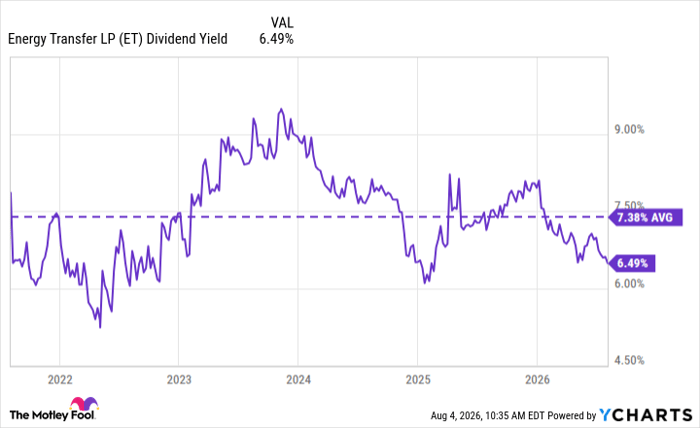
Energy Transfer is a good option for investors looking for consistently high yields. Its current yield is 6.5%, more than 6 times what you'd currently get from an S&P 500 ETF. And it recently increased its dividend (it calls them cash distributions) for the 19th consecutive quarter.
ET Dividend Yield data by YCharts
As a pipeline operator, Energy Transfer is largely immune from changes in commodity prices because its revenue is tied to volume, not market prices. This helps ensure business remains stable and consistent and the cash flow keeps rolling. You shouldn't have to second-guess the stability of the dividend.
A key thing to note about Energy Transfer is that the company is structured as a master limited partnership (MLP). That means during tax time, the company will send you a Schedule K-1 form that you'll use when you file your taxes. It's nothing overly complicated, but just an extra step that's worth knowing beforehand.
One of the top energy powerhouses
While Energy Transfer only operates pipelines (referred to as the midstream), Chevron is a fully integrated energy company that has its hands in every stage of the pipeline. It drills for oil, transports it, and sells finished products like gasoline, but its main profit-maker is oil and gas production.
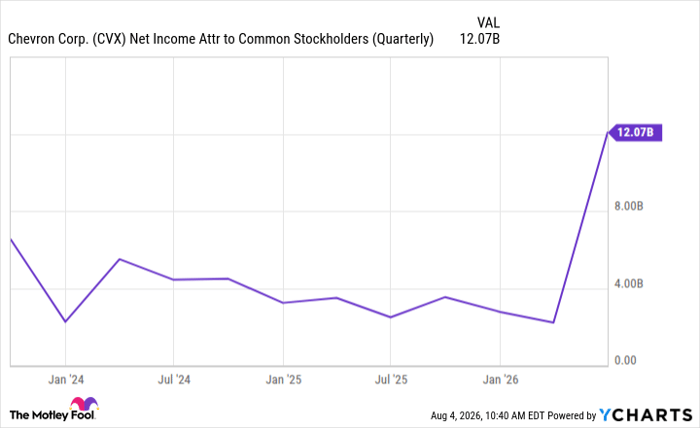
Chevron has long been a financial powerhouse, but the conflict in the Middle East and the surge in global energy prices sent profits skyrocketing (even prompting President Donald Trump to say the company was making "too much money"). In the second quarter, its net income increased by nearly 385% year over year to $12.1 billion.
CVX Net Income Attr to Common Stockholders (Quarterly) data by YCharts
This current high likely won't be the long-term norm for Chevron, but investors don't have to question its ability to maintain its dividend. Its $15.4 billion in adjusted free cash flow handily covered the $3.5 billion it paid out in dividends in Q2.
Chevron's current quarterly dividend is $1.78, but you can count on it increasing over time. It has 39 consecutive years of dividend increases under its belt, and with the company known for being shareholder-friendly, you can bet it'll prioritize ensuring that the streak continues.
Should you buy stock in Energy Transfer right now?
Before you buy stock in Energy Transfer, consider this:
The Motley Fool Stock Advisor analyst team just identified what they believe are the 10 best stocks for investors to buy now… and Energy Transfer wasn’t one of them. The 10 stocks that made the cut could produce monster returns in the coming years.
Consider when Netflix made this list on December 17, 2004... if you invested $1,000 at the time of our recommendation, you’d have $396,758!* Or when Nvidia made this list on April 15, 2005... if you invested $1,000 at the time of our recommendation, you’d have $1,300,820!*
Now, it’s worth noting Stock Advisor’s total average return is 939% — a market-crushing outperformance compared to 211% for the S&P 500. Don't miss the latest top 10 list, available with Stock Advisor, and join an investing community built by individual investors for individual investors.
See the 10 stocks »
*Stock Advisor returns as of August 5, 2026.
Stefon Walters has no position in any of the stocks mentioned. The Motley Fool has positions in and recommends Chevron. The Motley Fool has a disclosure policy.
Recommended Articles


