




XPRIZE Founder Says SpaceX Will Be First $10 Trillion Company as Musk Endorses; Can Five Business Units Support Valuation?
TradingKey - XPRIZE Foundation founder Peter Diamandis posted on social media platform X, expressing strong optimism for SpaceX and predicting that the company will become the first to reach a $10 trillion market capitalization. Subsequently, Elon Musk reposted the article with a "rocket launch" emoji.
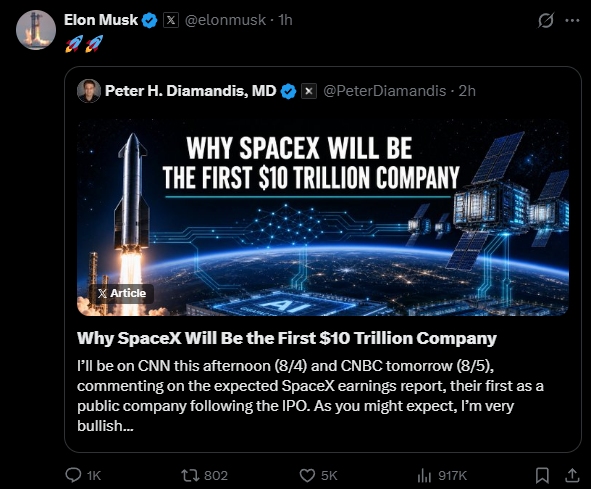
Source: X
Peter believes that the market has yet to truly understand SpaceX. It is not a single business, but a five-layer system integrated by satellite communications, AI computing power, chip manufacturing, rocket launches, and vertical integration.
The first layer is Starlink. It is evolving from a satellite internet service provider into a global communications infrastructure. With the advancement of direct-to-cell satellite technology, satellite communications is no longer just a backup plan for remote areas, but could become a vital supplement to terrestrial networks.
The second layer is AI computing power. According to market rumors of partnerships, SpaceX has entered the AI infrastructure market through data centers and computing power leasing. More importantly, the speed at which Musk's companies deploy large-scale GPU clusters has demonstrated execution capabilities that set them apart from traditional cloud vendors. If orbital computing plans materialize in the future, SpaceX's upside potential will be further unlocked.
The third layer is chips. Musk's proposed Terafab plan targets building in-house AI chip capacity. If it can achieve a closed-loop system of "self-developed chips, computing power deployment, rocket launching, and satellite hosting," SpaceX will no longer be merely a buyer of computing power, but will master the entire supply chain.
The fourth layer is still the rocket business. Falcon 9 has significantly reduced orbital entry costs, and Starship aims to push costs even lower. As the barrier to entering space continues to fall, SpaceX will not just be selling transport services, but the gateway to the entire space economy.
The true core lies in the fifth layer: vertical integration. SpaceX simultaneously owns rockets, satellites, terrestrial networks, and potential AI computing platforms, whereas other companies can typically only manage a single link. This synergy is the core logic behind its high valuation.
Of course, SpaceX is still investing heavily, making short-term losses inevitable. However, what the market needs to ask may not be how much money it is currently making, but who has the capability to simultaneously bet on communications, computing power, chips, and space transportation, and connect them into a single system. If this flywheel starts spinning, SpaceX's value should not be dictated solely by its next earnings report.
As of press time, SpaceX ( SPCX) shares rose over 6% to $121. SpaceX is reportedly scheduled to release its first quarterly earnings report since its listing after the market closes today.
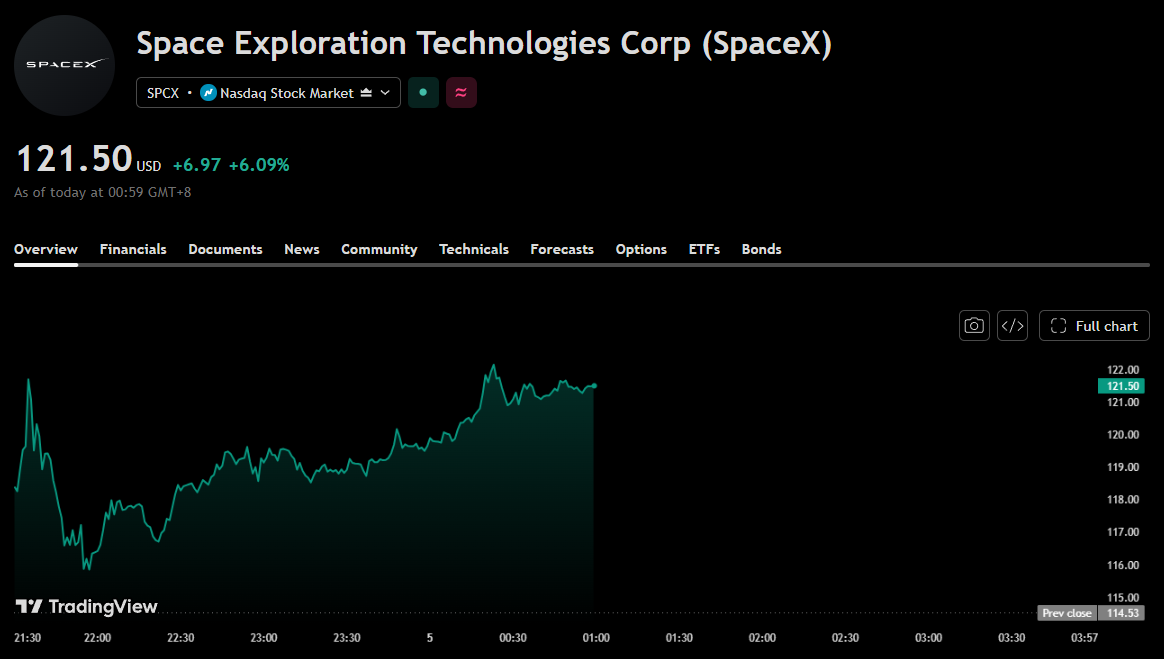
Source: TradingView
Recommended Articles


