




Asian Stocks Are Down 10% From June Highs. That Could Be Bad News for This Semiconductor Index.
Key Points
The iShares Semiconductor ETF has declined by almost 23% since June 22.
This ETF represents a highly concentrated investment in just 30 companies in a volatile industry.
Investors who are worried about chip stocks might want to choose a broader tech ETF.
- 10 stocks we like better than iShares Trust - iShares Semiconductor ETF ›
Semiconductor stocks are going through a global sell-off. Investors have become worried that major artificial intelligence (AI) hyperscalers won't get enough out of the money they've spent on AI data centers and infrastructure. In case AI hyperscalers scale back on their AI capex, this would reduce sky-high demand for semiconductors and memory chips.
Some of these investor concerns about semiconductor stocks can be seen in Asian stock markets, where many of the world's leading semiconductor and memory chip companies are located. Asian stocks have benefited from the AI boom. But according to Bloomberg, the MSCI Asia Pacific index has declined by about 10% since its June 22 all-time high. More than 20% of this index consists of three major chip stocks from Taiwan and South Korea.
Missed Nvidia in 2009? This Rare Signal Is Flashing Again. In 2009, a "Double Down" signal flashed for a little-known chipmaker called Nvidia. For the first time in years, that same "Total Conviction" signal is flashing for a company 1/100th the size of Nvidia. Continue »
Since June 22, shares of other leading semiconductor stocks around the globe have also dropped. Taiwan Semiconductor Manufacturing shares are down about 13.8%, Holland's ASML Holding has declined by about 14.4%, America's Nvidia is down about 6.4%, and the iShares MSCI South Korea ETF is down by 26.4%.
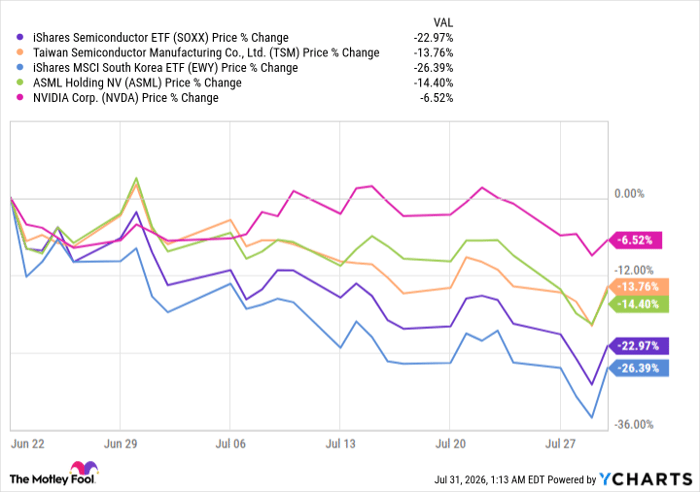
SOXX data by YCharts
The iShares Semiconductor ETF (NASDAQ: SOXX) is another name on this list. Since June 22, its share price has fallen even more than Asian stocks: about 22.9%. Let's look at this semiconductor ETF to see if it's a good buy for long-term investors -- or if investors should stay away for now.

Image source: Getty Images.
SOXX: 30 stocks, 10 years of 36.6% annualized returns
The iShares Semiconductor ETF holds a portfolio of 30 stocks that are focused on the semiconductor value chain, including companies that benefit from AI capital investments. The top five stocks in this ETF are:
- Nvidia: 8.93% of the fund
- Advanced Micro Devices: 8.26%
- Broadcom: 8.22%
- Micron Technology: 7.55%
- Intel: 5.12%
The fund mostly owns U.S stocks, although Taiwan Semiconductor Manufacturing is one of its top 10 holdings.
In the past few years, the iShares Semiconductor ETF has delivered massive returns. As of June 30, its past year total return was a whopping 169.6%. It's also delivered annualized returns of 56.9% for the past three years, 34.5% for the past five years, and 36.6% for the past 10 years.
But can these supercharged returns continue? If the AI boom keeps driving strong demand for semiconductors, maybe. But if demand levels off, semiconductors could return to a boom-and-bust cycle as a lower-priced, lower-margin commodity product.
Why buy SOXX... or not
Is now a good time or a bad time to buy semiconductor stocks? It depends on what you believe. If you think the recent sell-off in AI stocks and semiconductor names was just a temporary dip, and that the semiconductor industry has a bright future even if the AI trade slows down, buying the iShares Semiconductor ETF could be a good move for long-term investors.
But if you're worried that the AI trade is overvalued or that semiconductors have been on a one-time, unsustainable winning streak, you might not want to take such a concentrated position in just 30 stocks in a historically volatile sector. Buying one of the best Nasdaq ETFs could be a better choice.
Should you buy stock in iShares Trust - iShares Semiconductor ETF right now?
Before you buy stock in iShares Trust - iShares Semiconductor ETF, consider this:
The Motley Fool Stock Advisor analyst team just identified what they believe are the 10 best stocks for investors to buy now… and iShares Trust - iShares Semiconductor ETF wasn’t one of them. The 10 stocks that made the cut could produce monster returns in the coming years.
Consider when Netflix made this list on December 17, 2004... if you invested $1,000 at the time of our recommendation, you’d have $386,727!* Or when Nvidia made this list on April 15, 2005... if you invested $1,000 at the time of our recommendation, you’d have $1,232,139!*
Now, it’s worth noting Stock Advisor’s total average return is 906% — a market-crushing outperformance compared to 208% for the S&P 500. Don't miss the latest top 10 list, available with Stock Advisor, and join an investing community built by individual investors for individual investors.
See the 10 stocks »
*Stock Advisor returns as of August 3, 2026.
Ben Gran has no position in any of the stocks mentioned. The Motley Fool has positions in and recommends ASML, Advanced Micro Devices, Broadcom, Intel, Micron Technology, Nvidia, Taiwan Semiconductor Manufacturing, and iShares Trust-iShares Semiconductor ETF. The Motley Fool has a disclosure policy.
Recommended Articles


