




Not Micron, Not Sandisk. This Chip Stock Could Be the Biggest Winner of the AI Memory Boom
Key Points
Lam Research recently reported solid results, and its guidance points toward significant acceleration in growth.
The healthy spending on memory manufacturing equipment will be a long-term tailwind for the company.
Lam stock can surge impressively over the next three years considering its solid bottom-line growth potential.
- 10 stocks we like better than Lam Research ›
Micron Technology and Sandisk have benefited significantly from the memory chip boom over the past year, as the demand for the dynamic random-access memory (DRAM) and NAND flash storage chips they manufacture has significantly exceeded supply.
Of course, investors have been rotating out of memory stocks lately, as evidenced by the 27% decline in the Roundhill Memory ETF over the past month. Both Micron and Sandisk have witnessed significant pullbacks in their stock prices over this period. However, the artificial intelligence (AI)-fueled memory chip demand isn't going to fade away any time soon.
Missed Nvidia in 2009? This Rare Signal Is Flashing Again. In 2009, a "Double Down" signal flashed for a little-known chipmaker called Nvidia. For the first time in years, that same "Total Conviction" signal is flashing for a company 1/100th the size of Nvidia. Continue »
According to Deloitte, the memory crunch is unlikely to ease until 2029. While that's great news for both Micron and Sandisk, there is another company that's benefiting from the incredible memory demand -- Lam Research (NASDAQ: LRCX). Let's look at the reasons why this semiconductor stock could become the biggest winner of the AI-driven memory boom.

Image source: Getty Images.
The memory boom has given Lam Research a big shot in the arm
Lam Research sells the equipment that allows Micron and Sandisk to manufacture DRAM and NAND flash chips. The company also serves the foundry and logic end markets, though 46% of its revenue comes from sales of memory manufacturing equipment.
Deloitte estimates that the three largest memory makers in the world -- Samsung, SK Hynix, and Micron -- are going to increase their combined capital expenditure by a whopping 340% between 2024 and 2027. In all, the three companies could increase their capex to $146 billion in 2027 from $58 billion in 2025.
This explains why Lam Research has been experiencing robust growth. The company's revenue increased by 26% year over year in the recently concluded fiscal 2026 (which ended on June 28) to $23.2 billion. Its net income jumped by 35% year over year to $7.26 billion. It ended the fiscal year with a 30% year-over-year increase in Q4 revenue, indicating accelerating growth.
Lam Research expects $8.1 billion in revenue for the current quarter, along with non-GAAP earnings per share of $2.15. That points to a year-over-year increase of 52% in revenue, while adjusted earnings are projected to jump by nearly 71%. So, Lam seems on track to clock much faster growth during the current fiscal year, and it won't be surprising to see it sustain such terrific momentum over the long run as well.
We have already seen that memory capex could jump to $146 billion next year. This figure could keep soaring in the long run, as the memory shortage is expected to persist into the next decade, according to SK Hynix. That's why Micron recently hiked its U.S. capex budget by $50 billion to $250 billion through 2035.
On the other hand, South Korea is reportedly planning an enormous $880 billion investment in semiconductors and AI data centers over the next decade, backed by Samsung and SK Hynix. So, Lam Research is sitting on a massive addressable market as memory makers and semiconductor manufacturers spend heavily to boost production capacity.
All this explains why Bank of America is projecting wafer fab equipment (WFE) spending to hit $250 billion in 2028 and $292 billion in 2030. The points discussed above suggest that Lam's addressable market will continue growing beyond the decade, and that's precisely why I think this AI stock is poised for impressive long-term gains.
The company's growth potential points toward healthy stock price upside
Lam's revenue forecast for the first quarter of fiscal 2027 points toward a significant acceleration in growth. Analysts were expecting $7.09 billion in revenue from the company in the current quarter, along with earnings per share of $1.83. However, it blew past those expectations, a trend that's likely to continue over the long run as its addressable opportunity expands.
After all, Lam sells its equipment to the likes of Taiwan Semiconductor Manufacturing, Samsung, Micron, and others, all of whom are increasing their capex. So, it is easy to see why analysts have become bullish about Lam's growth prospects following its latest quarterly report.
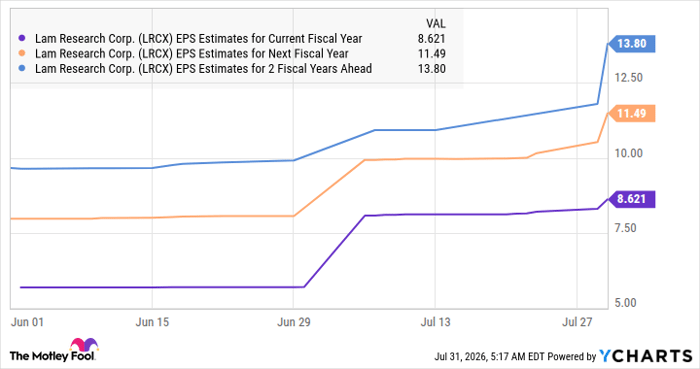
Data by YCharts
Assuming Lam's earnings per share jump to $13.80 after three years and it trades at 33 times earnings at that time, in line with the tech-laden Nasdaq-100 index's average earnings multiple, its stock price could reach $455. That's a potential 50% upside from current levels. However, don't be surprised to see the company do much better than that, as it could deliver a stronger-than-expected earnings jump amid robust capital spending, which could lead the market to reward it with a premium valuation.
Should you buy stock in Lam Research right now?
Before you buy stock in Lam Research, consider this:
The Motley Fool Stock Advisor analyst team just identified what they believe are the 10 best stocks for investors to buy now… and Lam Research wasn’t one of them. The 10 stocks that made the cut could produce monster returns in the coming years.
Consider when Netflix made this list on December 17, 2004... if you invested $1,000 at the time of our recommendation, you’d have $394,601!* Or when Nvidia made this list on April 15, 2005... if you invested $1,000 at the time of our recommendation, you’d have $1,197,093!*
Now, it’s worth noting Stock Advisor’s total average return is 895% — a market-crushing outperformance compared to 206% for the S&P 500. Don't miss the latest top 10 list, available with Stock Advisor, and join an investing community built by individual investors for individual investors.
See the 10 stocks »
*Stock Advisor returns as of July 31, 2026.
Harsh Chauhan has no position in any of the stocks mentioned. The Motley Fool has positions in and recommends Lam Research, Micron Technology, and Taiwan Semiconductor Manufacturing. The Motley Fool has a disclosure policy.
Recommended Articles


