




Prediction: Micron Stock Will Be Worth This Much by Late 2027 (Hint: The Time to Buy Is Now)
Key Points
Micron has emerged as a key beneficiary of the artificial intelligence (AI) infrastructure boom.
Hyperscalers are spending unprecedented sums on high bandwidth memory (HBM) solutions for AI data centers.
Despite Micron's soaring stock price, shares still trade for a reasonable valuation.
- 10 stocks we like better than Micron Technology ›
Micron Technology (NASDAQ: MU) has delivered extraordinary returns so far this year. As of this writing (July 24), Micron stock has surged 224% in 2026 -- making it the second-best performer in the Nasdaq-100. Its gains over the last year are even more striking, as shares have ballooned over 740% from roughly $104 to a current price of $924.
These gains have been powered by the emerging memory supercycle, in which unprecedented demand for high bandwidth memory (HBM) has outstripped supply -- driving both chip volumes and pricing sharply higher. But what if I told you Micron's rally may still have room to run?
Missed Nvidia in 2009? This Rare Signal Is Flashing Again. In 2009, a "Double Down" signal flashed for a little-known chipmaker called Nvidia. For the first time in years, that same "Total Conviction" signal is flashing for a company 1/100th the size of Nvidia. Continue »
Even after substantial momentum has already been priced in, the secular underpinnings of the artificial intelligence (AI) memory market suggest that investors who buy Micron stock today could capture meaningful additional upside through late next year.
Image source: The Motley Fool.
What is the AI memory supercycle?
The AI memory boom is rooted in the explosive growth of generative AI models. Training and inference workloads for large language models (LLMs) require vast quantities of HBM stacked on top of graphics processors from Nvidia and Advanced Micro Devices. Unlike conventional DRAM, this specialized memory delivers extreme data rates and capacity density, creating a bottleneck that only a small number of producers have proven to relieve.
Micron is one of the three global suppliers capable of manufacturing advanced HBM at scale, with SK Hynix and Samsung being its primary competition. The company is aggressively diversifying its manufacturing footprint to capture incremental design wins even while the supply remains constrained across the industry.
Is Memory cyclical or secular?
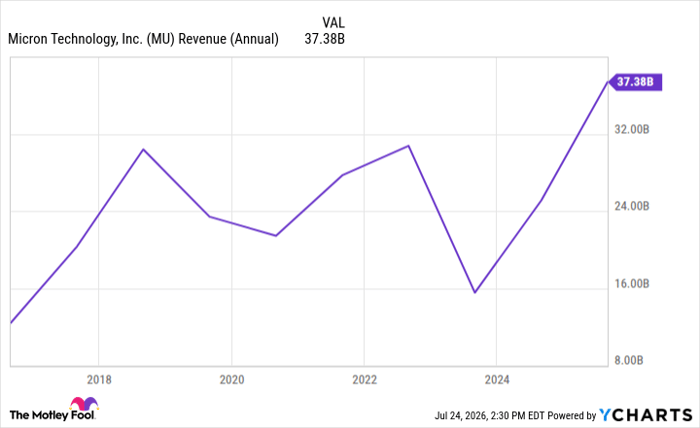
Memory has long been a cyclical business. Scaling capacity tends to arrive in waves, producing periods of oversupply that ultimately lead to commoditized pricing, followed by shortages that send both revenue and margins soaring again. Micron's own history illustrates this pattern: Annual revenue swung from $30 billion in fiscal 2018 down to $15.5 billion in 2023 before rebounding again in 2025.
MU Revenue (Annual) data by YCharts.
AI is rewriting this script entirely. Memory demand is no longer driven by just consumer electronics or PC refresh cycles. Rather, memory chips now directly touch the multiyear capital expenditure (capex) programs from the AI hyperscalers. Micron is taking advantage of big tech's accelerating infrastructure by locking in long-term supply agreements that stretch into 2027 and beyond. This grants the company both pricing power and a level of revenue visibility never seen before.
Looking even further ahead, new generations of AI models should grow in parameter count and context length. This means next-generation applications in autonomous systems, robotics, and more will require incremental memory bandwidth and capacity. As the hyperscalers increase their infrastructure budgets to support larger systems, Micron's unit volumes and average selling prices should keep expanding.
What could Micron stock be worth next year?
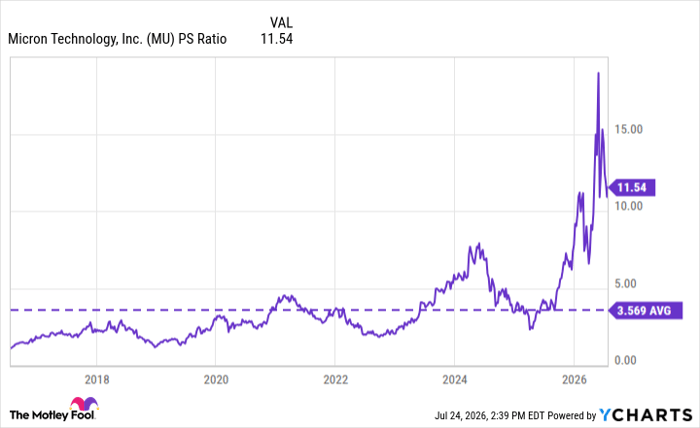
Micron's fiscal year ends in late August. Wall Street's consensus estimate for Micron's fiscal 2027 revenue is approximately $239 billion. Currently, Micron stock trades at a price-to-sales (P/S) multiple of 11.5 -- more than triple its 10-year average.
With that said, analysts are split on how robust the company's growth will be beyond this point as new capacity comes online and memory producers scale their supply to better match demand shortages. While the current premium is arguably justified by the scale of the AI infrastructure era, smart investors understand that Micron need not maintain this multiple for its stock to continue soaring.
MU PS Ratio data by YCharts. PS Ratio = price-to-sales ratio.
Even if Micron's P/S multiple normalizes to a more moderate range of between 8x and 10x, the sheer growth in the company's top line can still produce substantial share price appreciation. Applying this to Micron's 2027 revenue estimates derives an implied market capitalization between $1.9 trillion and $2.4 trillion. Compared to the company's current market value of $1.1 trillion, these outcomes translate into gains of between 72% and 118% by the time fiscal 2027 results are published.
The combination of durable revenue growth and a reasonable P/S multiple leaves room for Micron to deliver meaningful valuation expansion for investors willing to look past the momentum already embedded in the price.
Should you buy stock in Micron Technology right now?
Before you buy stock in Micron Technology, consider this:
The Motley Fool Stock Advisor analyst team just identified what they believe are the 10 best stocks for investors to buy now… and Micron Technology wasn’t one of them. The 10 stocks that made the cut could produce monster returns in the coming years.
Consider when Netflix made this list on December 17, 2004... if you invested $1,000 at the time of our recommendation, you’d have $377,990!* Or when Nvidia made this list on April 15, 2005... if you invested $1,000 at the time of our recommendation, you’d have $1,269,518!*
Now, it’s worth noting Stock Advisor’s total average return is 896% — a market-crushing outperformance compared to 206% for the S&P 500. Don't miss the latest top 10 list, available with Stock Advisor, and join an investing community built by individual investors for individual investors.
See the 10 stocks »
*Stock Advisor returns as of July 27, 2026.
Adam Spatacco has positions in Nvidia. The Motley Fool has positions in and recommends Advanced Micro Devices, Micron Technology, and Nvidia. The Motley Fool has a disclosure policy.
Recommended Articles


