




US Market Close: Major Indexes Mixed as Apple Overtakes Nvidia; Nasdaq Composite Index Falls for Fourth Day as Chip Stocks Lead Declines While Software Shares Rise
TradingKey - Nvidia's advancement of an AI infrastructure deal totaling $750 billion and the successful listing of Chinese memory manufacturer ChangXin both hit AI hardware stocks. The three major US stock indexes ended mixed, with memory and chip stocks leading the declines, while cloud providers and software stocks rose against the trend.
At the close, the Dow Jones Industrial Average rose 0.51% to 52,210.08; the Nasdaq Composite Index fell 0.18% to 24,932.08; the S&P 500 Index rose 0.02% to 7,413.18.
Tech Stock Performance
SanDisk (SNDK) fell 11.02% to $1,278.23.
Analysts at Counterpoint Research stated that the more highly standardized commodity DRAM and NAND markets may be impacted by Chinese memory manufacturers, and the industry's competitive landscape and investment logic are undergoing structural changes. Meanwhile, due to extremely high technical barriers, High Bandwidth Memory (HBM) will remain monopolized by Micron (MU), Samsung, and SK Hynix (SKHY) over the next few years.
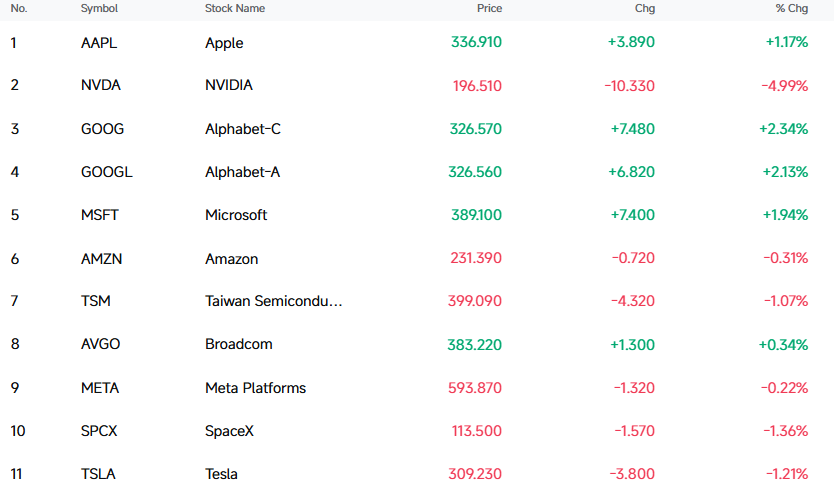
Among mega-cap tech stocks, Google (GOOGL) rose 2.13%, Microsoft (MSFT) rose 1.94%, Apple (AAPL) rose 1.17%, and Broadcom (AVGO) rose 0.34%; on the downside, Nvidia (NVDA) fell 4.99%, SpaceX (SPCX) fell 1.36%, Tesla (TSLA) fell 1.21%, Amazon (AMZN) fell 0.31%, and Meta Platforms (META) fell 0.22%.
[Source: FutuBull]
The Philadelphia Semiconductor Index fell 2.23% to close at 11,544.88 points. Among its 30 constituents, 21 declined and 9 advanced.
Memory stocks led the declines, with SanDisk (SNDK) down 11.02%, SK Hynix (SKHY) down 7.47%, Western Digital (WDC) down 4.21%, Seagate Technology (STX) down 4.07%, and Micron Technology (MU) down 2.25%.
Chip stocks took a hit, with ASML (ASML) down 5.80%, AMD (AMD) down 5.17%, and Nvidia (NVDA) down 4.99%.
Corporate News
CME Group Launches Near-24-Hour Single-Stock Futures, Covering Hot Stocks Like SpaceX and Micron
CME Group has officially launched single-stock futures products, offering a new tool for investors to trade core popular stocks like SpaceX and Nvidia through near-24-hour trading hours, margin leverage mechanisms, and simpler trading rules, while also serving as an important strategic business move to counter the impact of overseas perpetual futures products. On Monday, CME Group officially rolled out cash-settled single-stock futures covering 55 U.S. stocks, alongside micro contracts on 22 underlying assets. This marks the exchange's official entry into this niche market, providing investors with a channel to conduct leveraged long or short operations around the clock.
Amazon Plans to Apply to FCC to Launch 5,105 Satellites
Amazon has officially submitted an application to the U.S. Federal Communications Commission (FCC), planning to launch up to 5,105 internet satellites to build a direct-to-device (D2D) space network. According to the filing, Amazon's target users for this initiative are those who are "unserved or underserved" by existing wireless networks. It also includes emergency scenarios like search and rescue, as well as remote construction sites, fleets, supply chains, and other areas beyond the reach of terrestrial signals.
Nvidia Invests in Ilya Sutskever's New AI Lab to Expand Its Computing Power Footprint
According to The Wall Street Journal, Nvidia is investing in an artificial intelligence lab founded by former OpenAI Chief Scientist Ilya Sutskever. This long-term partnership will not only boost the startup's ability to access computing power but also help Nvidia fend off competitors. Nvidia has made a "significant" investment, though the specific investment terms of the deal are currently unclear. Under the agreement, Safe Superintelligence, the company founded by Sutskever, will gain substantial access to Nvidia's flagship GPU hardware—on a scale large enough to increase the company's computing resources by "an order of magnitude." According to people familiar with the matter, the company previously relied primarily on Google's TPU chips.
Industry and Macro News
Trump: Limited Window for Iran Negotiations; Military Action Will Resume If Talks Break Down
U.S. President Trump said that the U.S. is in deep negotiations with Iran, but the window for negotiations is limited and Iran will not be given much time. Trump warned that if negotiations break down, the U.S. will resume "powerful" military operations. Trump stated that he decided to suspend attacks on Iran because mediators requested an opportunity for negotiations. At the mediators' request, he agreed to provide an opportunity for talks, adding that he believes the Iranians want to reach a deal.
China Reportedly Starts Mass Production of Immersion DUV Lithography Machines
According to The Information, a state-backed enterprise in Shanghai, China, has started mass production of immersion DUV lithography machines, with plans to produce 5 units this year and expand output to 20 units next year. Although mass production is still in its early stages, it has already triggered market concerns over ASML's monopoly. Under the U.S.-led export control regime, ASML has been banned from exporting its most advanced EUV lithography machines to China, and sales of its most advanced DUV models to China have also been restricted.
Citi: Fed Rate Hike Alarm Sounded, Small-Caps Could Be Hardest Hit
Citi stated that even if interest rates are kept unchanged this week, the probability of a rate hike in September is already as high as 70%. Against this backdrop, Citi suggests that investors buy put options on the Russell 2000 Index ETF (IWM) as the best "bulletproof vest" to defend against policy risks. Citi's analysis indicates that following the index reconstitution in June, the Russell 2000 Index has shed some highly volatile targets, and its implied volatility is currently at a low level, which means lower hedging costs for options. Since small-cap stocks are more sensitive to economic data and credit environments, once the Federal Reserve delivers hawkish signals, these assets will exhibit stronger cyclical downward pressure compared to large-cap tech stocks.
Macquarie: US-Iran Deal Before Midterm Elections May Lead to Oil Oversupply Risk
Macquarie Group analysts said that as Washington faces growing pressure to end the conflict with Iran, with less than 100 days until the midterm elections, the oil market could shift back to an oversupply by the end of the year. A de-escalation of the conflict is expected to ease tensions, allowing Middle Eastern oil flows to resume, and Macquarie believes that oil inventories will begin to build up again. The potential pre-election de-escalation could involve concessions from both sides, including the imposition of transit fees in the Strait of Hormuz, an outcome viewed as "inevitable."
Recommended Articles


