




Will Helios Be the Catalyst AMD's Stock Needs to Hit a $1 Trillion Market Cap in 2026?
Key Points
AMD's growth rate has been accelerating in recent quarters.
Its new Helios rack-scale system may help take market share from Nvidia.
The stock needs to rise roughly 28% to get to a $1 trillion valuation.
- 10 stocks we like better than Advanced Micro Devices ›
Last week was a big one for Advanced Micro Devices (NASDAQ: AMD) as it launched Helios, its rack-scale system that's designed for artificial intelligence (AI). The company already has some large tech companies lined up for it, including Microsoft and Meta Platforms.
Shares of AMD have already been flying high this year as investors have been bullish about the company's products potentially serving as viable alternatives to Nvidia's, with hopes that Helios may help take significant market share from the tech giant. Could the launch of Helios be what's needed for AMD's stock to rise even higher and for it to join the trillion-dollar club this year?
Missed Nvidia in 2009? This Rare Signal Is Flashing Again. In 2009, a "Double Down" signal flashed for a little-known chipmaker called Nvidia. For the first time in years, that same "Total Conviction" signal is flashing for a company 1/100th the size of Nvidia. Continue »

Image source: Getty Images.
AMD's growth rate has been improving, but it may need to go into another gear
There's a lot of excitement around Helios, but what may matter most to investors is what the company's numbers and guidance look like when AMD releases earnings next week. AMD's growth rate has been picking up in recent years, but the company may need to do more to convince investors it deserves a higher valuation.
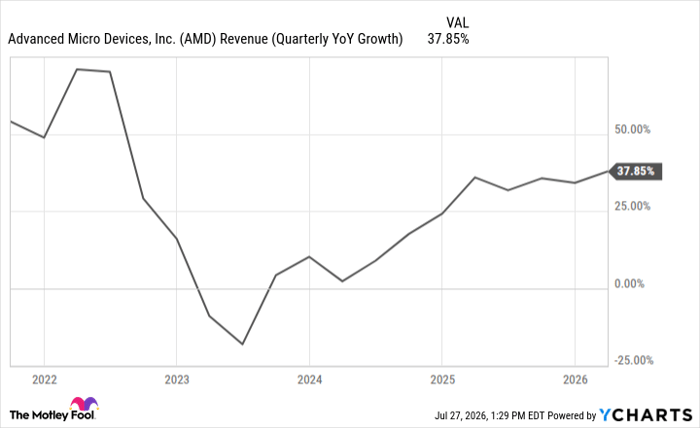
AMD Revenue (Quarterly YoY Growth) data by YCharts
While 38% growth is impressive, I would expect to see far better numbers for a stock trading at more than 160 times trailing earnings, as AMD is; investors are already pricing in high expectations for future growth.
Any guidance AMD releases in this upcoming quarter may be too early to suggest if demand for Helios is in line with expectations just yet. But later this year, that will certainly be a key growth metric for investors to watch.
Will AMD's stock hit a $1 trillion valuation in 2026?
For AMD to reach $1 trillion in market cap this year, it will need to rise by approximately 28% from today's valuation of roughly $780 billion. It's not unreasonable for that to happen, given how hot the tech stock has been, but it's not a scenario I think is likely, given its high valuation and the rising concerns investors have about AI stocks of late.
Based on its current valuation, I think there's a stronger bearish case to be made for why AMD stock can go lower than a bullish one, and why it can go higher. I don't think AMD will get to $1 trillion this year, but it is a possibility in the long run. A lot, however, will depend on how well Helios performs and how much market share AMD ends up taking from Nvidia.
For long-term investors, AMD can still be a good buy, but it may require a best-case scenario for the stock to hit $1 trillion in market cap this year.
Should you buy stock in Advanced Micro Devices right now?
Before you buy stock in Advanced Micro Devices, consider this:
The Motley Fool Stock Advisor analyst team just identified what they believe are the 10 best stocks for investors to buy now… and Advanced Micro Devices wasn’t one of them. The 10 stocks that made the cut could produce monster returns in the coming years.
Consider when Netflix made this list on December 17, 2004... if you invested $1,000 at the time of our recommendation, you’d have $377,990!* Or when Nvidia made this list on April 15, 2005... if you invested $1,000 at the time of our recommendation, you’d have $1,269,518!*
Now, it’s worth noting Stock Advisor’s total average return is 896% — a market-crushing outperformance compared to 206% for the S&P 500. Don't miss the latest top 10 list, available with Stock Advisor, and join an investing community built by individual investors for individual investors.
See the 10 stocks »
*Stock Advisor returns as of July 27, 2026.
David Jagielski, CPA has no position in any of the stocks mentioned. The Motley Fool has positions in and recommends Advanced Micro Devices, Meta Platforms, Microsoft, and Nvidia. The Motley Fool has a disclosure policy.
Recommended Articles


