




Kevin Warsh's Federal Reserve Just Issued an 11-Word Warning to Wall Street. Here's What History Says Comes Next.
Key Points
The Fed is worried that years of above-target inflation could cause Americans to permanently expect higher prices, potentially triggering a dangerous wage-price spiral.
History shows that once inflation expectations become entrenched -- as they did in the 1970s -- fixing the problem requires painful rate hikes that can crush the economy.
- 10 stocks we like better than S&P 500 Index ›
Last month, the Federal Reserve wrapped its first meeting with Jerome Powell's replacement, Kevin Warsh, at its head. The target rate remained unchanged at 3.5% to 3.75%, and the minutes, released a few weeks after the meeting, mostly read the way Federal Reserve minutes always do -- very dry.
But within them was an 11-word warning that investors should pay attention to now. Years of above-target inflation "could begin to affect inflation expectations and wage- and price-setting decisions." That may be dry central-banker language, but it could have major ramifications for the S&P 500 (SNPINDEX: ^GSPC).
Missed Nvidia in 2009? This Rare Signal Is Flashing Again. In 2009, a "Double Down" signal flashed for a little-known chipmaker called Nvidia. For the first time in years, that same "Total Conviction" signal is flashing for a company 1/100th the size of Nvidia. Continue »
Here's how.
Why the Fed is worried about inflation expectations
The Fed's 2% inflation target works because people believe in it. When they stop believing, inflation starts feeding itself -- workers push for raises to stay ahead of prices, and businesses raise prices to cover the bigger paychecks. The cycle repeats.
Economists call this a wage-price spiral. Once people expect higher prices, it becomes self-fulfilling.
Now, we've had several years of inflation well above 2% -- the Consumer Price Index was more than double that in May at 4.2%. Though June's reading (released after the meeting in question) fell to 3.5%, there's a real threat that the public may be starting to adjust, believing that inflation is here to stay.
Many businesses have told the Fed they're under real pressure and are weighing how much of the rising costs to pass along to customers.
The 1970s wage-price spiral: a cautionary tale
In the 1970s, after a decade of extremely hot inflation and half-measures, the public simply assumed prices would keep climbing and set wages and prices accordingly. The job of finally stopping the vicious cycle fell to Fed chair Paul Volcker.
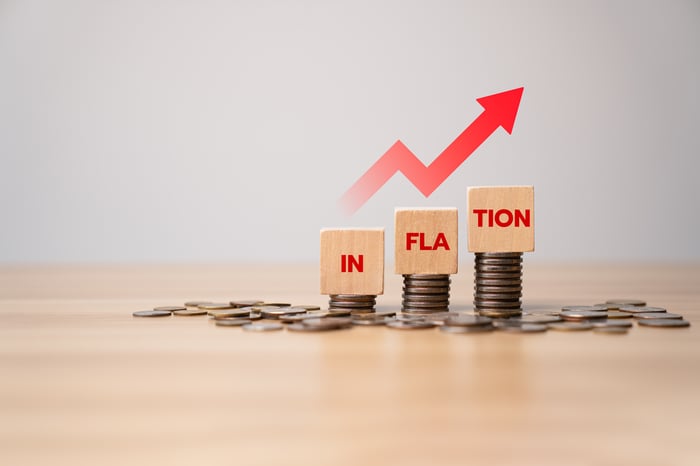
Image source: Getty Images.
The Volcker Fed pushed the federal funds rate to 20% in 1981, causing a recession as unemployment climbed to 10.8%, the worst since the Great Depression. It worked, though. Inflation fell from more than 14% in 1980 to 3.5% a few years later.
Researchers later concluded that roughly half of that improvement came from something more abstract than the numbers themselves -- people simply started believing the Fed could actually get control of runaway prices.
Why the 2022 inflation spike didn't become a crisis
Compare this to what happened in 2022. Inflation topped 7%, but the Fed hiked fast, and expectations barely budged. While inflation never returned to below the 2% target, no spiral ever formed, and the economy -- the stock market too -- was much better for it.
The lesson from all this history is pretty simple, if you ask me: move while people still believe you, or pay the price later.
How rate hikes could derail the AI boom
Here's the twist for today's market, though -- things might be a bit trickier. We don't need 20% rates to do damage this time around. Today's economy is wired for cheap debt, with a substantial amount of it propping up the all-important artificial intelligence (AI) build-out.
Data centers are being financed with the expectation of refinancing at better rates that may not come. Remember, these are projects that might not generate revenue for years. And to boot, much of that money flows through private credit -- loans made by investment funds rather than banks -- a relatively new market that has yet to be battle-tested.
If the Fed waits too long, it may be forced to hike rates by more than the market can handle. With an increase of even 1% or 2%, the refinancing math on all that borrowing could break and seriously deflate an historically pricey stock market -- one heavily concentrated on the singular theme of AI.
What this means for investors right now
The Fed knows this history all too well, and that's why, although it decided to hold off this time around, I think we are likely to see a rate hike before the year's end, especially now that the Iran war has reignited.
While a hike isn't what most investors are hoping for, in my view, it's better to get ahead of the issue. Problems like this one are a lot cheaper to fix early.
Should you buy stock in S&P 500 Index right now?
Before you buy stock in S&P 500 Index, consider this:
The Motley Fool Stock Advisor analyst team just identified what they believe are the 10 best stocks for investors to buy now… and S&P 500 Index wasn’t one of them. The 10 stocks that made the cut could produce monster returns in the coming years.
Consider when Netflix made this list on December 17, 2004... if you invested $1,000 at the time of our recommendation, you’d have $377,990!* Or when Nvidia made this list on April 15, 2005... if you invested $1,000 at the time of our recommendation, you’d have $1,269,518!*
Now, it’s worth noting Stock Advisor’s total average return is 896% — a market-crushing outperformance compared to 206% for the S&P 500. Don't miss the latest top 10 list, available with Stock Advisor, and join an investing community built by individual investors for individual investors.
See the 10 stocks »
*Stock Advisor returns as of July 27, 2026.
Johnny Rice has no position in any of the stocks mentioned. The Motley Fool has no position in any of the stocks mentioned. The Motley Fool has a disclosure policy.
Recommended Articles


