




Fed Chair Kevin Warsh Faces a Committee Where 9 of 19 Members Are Signaling Higher Interest Rates This Year
Key Points
The Fed's recent dot plot report indicated that about half of voting members favor a rate hike by year-end.
That kind of split creates real uncertainty about the direction of interest rates for the first time in several quarters.
Here are a few ideas on how you might want to position your portfolio for an uncertain Fed.
- These 10 stocks could mint the next wave of millionaires ›
In June, the Federal Reserve left its benchmark rate unchanged for the sixth consecutive meeting. Whether that streak extends to seven meetings when the Fed meets July 28-29 is a real mystery.
Based on the Fed's dot plot report released last month, nine of the 19 policymakers say that they predict at least one rate hike before the end of 2026. Six of them supported two rate hikes by year-end. It was only a few months ago that no one expected a rate hike. Now, the nearly 50/50 split within the committee makes it very unclear whether holding or hiking is going to be the path for the remainder of the year.
Where to invest $1,000 right now? Our analyst team just revealed what they believe are the 10 best stocks to buy right now, when you join Stock Advisor. See the stocks »
The annualized inflation rate dropped to 3.5% in June, removing some immediate pressure from the Fed's policy choices. But the ongoing Iran war has pushed oil prices back to around $100 a barrel. That could very well mean the lower inflation reading is only a temporary blip.
New Fed Chair Kevin Warsh has been clear that he has "no tolerance" for high inflation and has vowed to bring it back down toward the Fed's 2% target.
That would support the case for a rate hike, perhaps as early as this week, but it's far from a done deal.
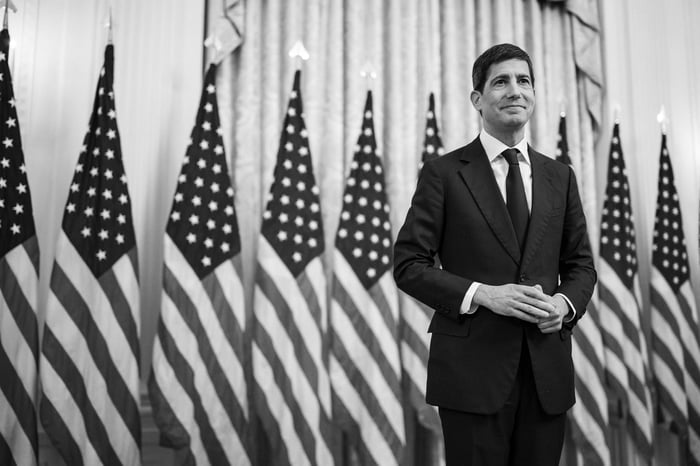
Federal Reserve Chair Kevin Warsh. Official White House Photo by Daniel Torok.
How should you handle the Fed's uncertainty in your portfolio?
Anybody still positioned for rate cuts in the future probably needs to revisit their portfolio. Even if there isn't a hike, the Fed has provided little indication that it's preparing to cut rates at any point for the foreseeable future.
In isolation, that could mean reducing exposure to things like long-term Treasuries and growth stocks. Rate-sensitive categories like small caps and real estate could also be at some risk.
For investors who want something less rate-sensitive within fixed income, funds like the iShares 0-3 Month Treasury Bond ETF (NYSE: SGOV) or the Vanguard Short-Term Treasury ETF (NASDAQ: VGSH) could be worth a look. Those funds avoid most interest rate risk, but would also see any Fed rate hikes get priced into their yields relatively quickly.
On the equity side, dividend and quality stocks are never a bad idea in environments like this. The Invesco S&P 500 Quality ETF (NYSEMKT: SPHQ) focuses on companies with healthy balance sheets and the ability to manage different economic cycles. The Schwab U.S. Dividend Equity ETF (NYSEMKT: SCHD) looks at balance sheet quality, dividend growth, and yield in building its 100-stock portfolio.
The overarching thing to remember is that the markets hate uncertainty. A lot of investors are still positioned for a continued tech rally. But it might be worth exercising a little caution right now.
Where to invest $1,000 right now
When our analyst team has a stock tip, it can pay to listen. After all, Stock Advisor’s total average return is 896%* — a market-crushing outperformance compared to 206% for the S&P 500.
They just revealed what they believe are the 10 best stocks for investors to buy right now, available when you join Stock Advisor.
See the stocks »
*Stock Advisor returns as of July 27, 2026.
David Dierking has positions in Schwab U.S. Dividend Equity ETF. The Motley Fool has positions in and recommends iShares Trust-iShares 0-3 Month Treasury Bond ETF. The Motley Fool has a disclosure policy.
Recommended Articles


