




Trump Administration Accuses Kimi K3 Parent Company Moonshot AI: Allegedly Illicitly Obtaining Nvidia Blackwell Chips, Massively Distilling US Models
TradingKey - Michael Kratsios, Director of the White House Office of Science and Technology Policy (OSTP), named Chinese AI company Moonshot AI on social media platform X, accusing it of acquiring servers equipped with Nvidia GB300 (Blackwell series) chips through Thailand to train its Kimi K3 model and building a "complex internal platform" to conduct large-scale distillation on U.S. models.
This is the second warning issued by the Trump administration regarding "intellectual property theft" by Chinese AI models in just two days. Just the day before, Treasury Secretary Bessent threatened to sanction Kimi; now, with the allegations disclosed alongside specific chip models, the strength of the signal has significantly escalated.
What Happened? The White House’s Two Layers of Allegations
Kratsios pointed out on X that Moonshot AI "obtained servers equipped with GB300s and accessed the GB300s in Thailand," which are highly likely used to train its AI models. The GB300 belongs to the Nvidia Blackwell generation, which the US strictly prohibits from being sold to Chinese companies. He also accused Moonshot AI of conducting large-scale distillation, stating that Moonshot AI developed a complex internal platform to carry out large-scale distillation targeting US models.
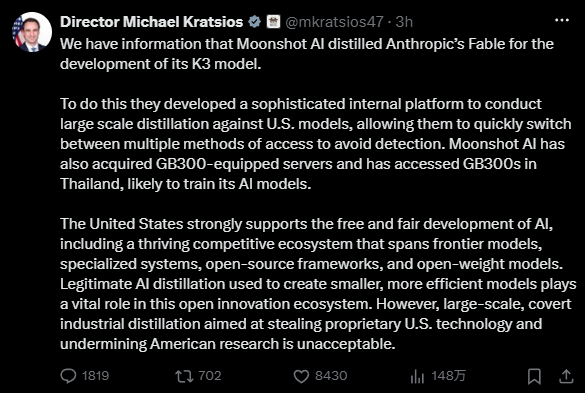
[Source: X]
Kratsios's chip allegations touch upon the core sensitive areas of US export controls.
The GB300 belongs to the Nvidia Blackwell series, a generation of products that the US strictly prohibits from being sold to Chinese companies. While the Trump administration allows the sale of certain H200 chips, it has consistently blocked the Blackwell series. In May this year, the Bureau of Industry and Security (BIS) of the US Department of Commerce issued a memorandum explicitly restricting the sale of advanced processors to subsidiaries of Chinese companies both inside and outside of China.
Kratsios implied that some companies may have exploited a loophole to ship advanced AI chips to the overseas subsidiaries of Chinese enterprises. However, an Nvidia spokesperson had previously refuted the "loophole" claim, emphasizing that "the company's ongoing operating premise is that no such loopholes exist." Nvidia declined to comment on Kratsios's latest post.
Market Implications: Kimi K3 Faces Sanctions Risk
For Moonshot AI, once officially placed on the sanctions list, its channels for acquiring Nvidia chips will be completely blocked, and the computing infrastructure required for AI model training will face a direct risk of supply disruption.
For Nvidia, regardless of whether the loophole exists, the White House's allegations could accelerate the further tightening of export control rules, affecting Nvidia's ability to control its chips in the gray market.
For the U.S. AI sector, the tech stock selloff triggered by the release of Kimi K3 proves that the narrative of low-cost Chinese models has a real, disruptive impact on the market.
Meanwhile, the White House's escalation of the dispute from "technological competition" to "national security + intellectual property theft" is equivalent to overlaying sanction risks on top of the original narrative. For investors relying on China's AI supply chain, uncertainty is intensifying rather than dissipating.
Recommended Articles


