




IBM Stock Steady at $213 Before Wednesday Earnings — 7% Options Swing
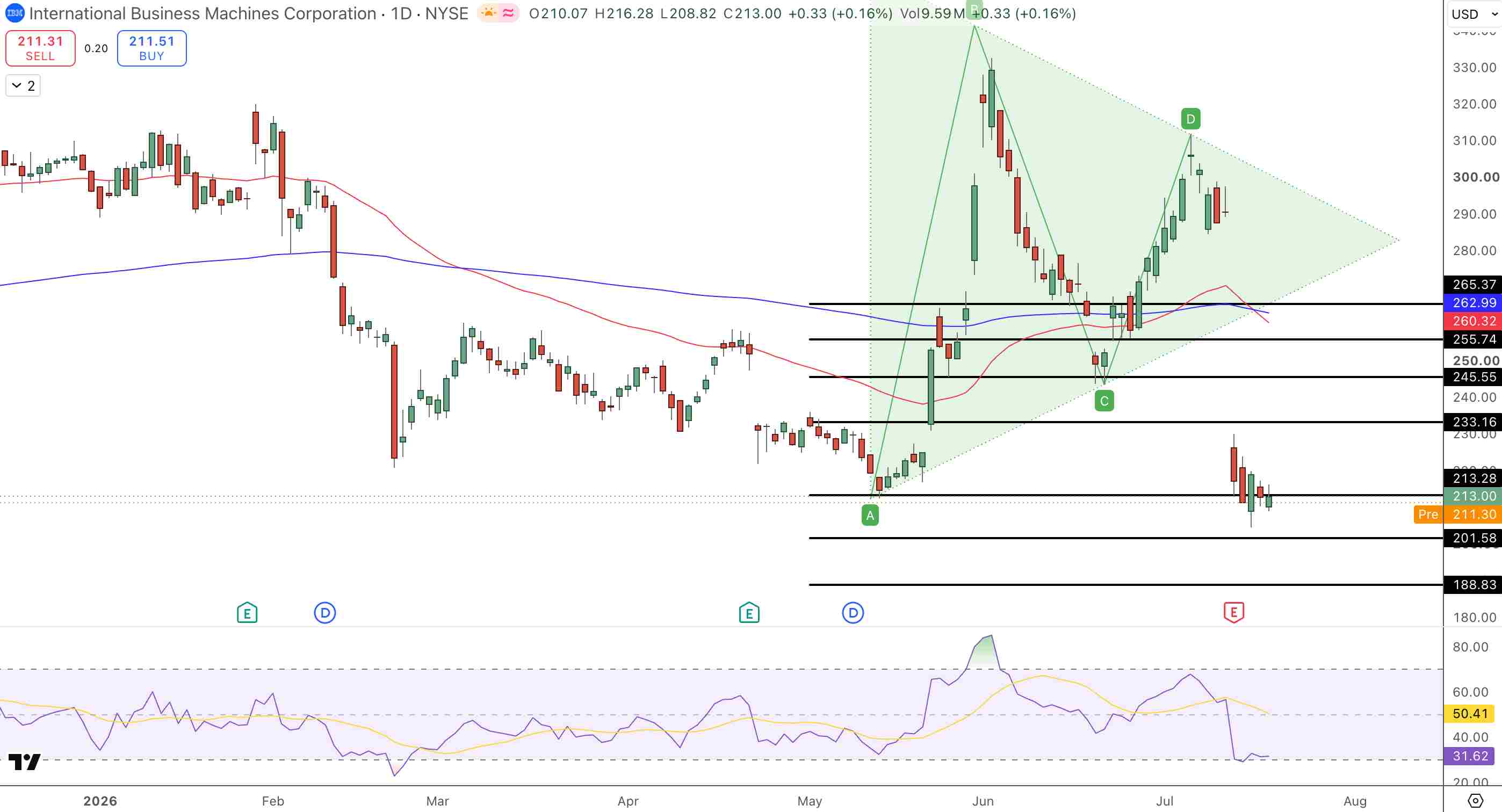
TradingKey - As of Tuesday, July 21, IBM (NYSE: IBM) is hovering around $213. The stock is up a bit for the day following last week's record selloff. Trading so far today has been relatively calm, with shares moving between $204.50 and $219.95 for most of the session and also up modestly in after-hours trading. The market seems to be in a holding pattern ahead of IBM's full Q2 earnings call on Wednesday, which starts at 5:00 PM ET. The stock is still about 35% below its high in June at $329.23. The options market is pricing in a move of about 7% either way after the earnings call. For investors, the focus is not just on Q2 revenue numbers but what the company's leaders have to say about the second half and whether any delayed deals will come in.
IBM Stock Is Stabilising — Investors Aren’t Ready to Commit
After last week's selloff, which marked IBM's worst day since 1968, trading has been slow today. IBM's stock opened near $210 today, and trading has remained in the $204.50 to $219.95 range for most of the session, suggesting the panic selling has ended. Trading volumes have also decreased, which is another indication the selling wave might have finished. The slight gain today in after-hours trading suggests there is buying interest, but most investors are waiting for the outcome of the earnings call to take a more significant position in the stock.
The 7% move expected by the options market does not mean the uncertainty is over; it simply means the uncertainty is being paused in favor of a binary event, leaving the fundamental questions unanswered.
A securities fraud investigation has been launched to assess whether IBM leadership made a misstatement regarding the company's deal pipeline strength before the July 14 warning, which further puts anything management states on Wednesday on heightened scrutiny. IBM CEO Arvind Krishna admitted the company had stumbled in the second quarter.
But the fraud investigation changes the question from whether this was an unintentional miss to whether investors were lied to about the pipeline strength. The difference between the two determines how much weight the market puts on what IBM leadership says during its earnings conference call versus ignoring it.
Last Week's Q2 Revenue Announcement Continues to Influence Market Sentiment
The reason why IBM stock remains in the headlines is last week's preliminary report. The company stated that Q2 revenue was $17.2 billion, some $660 million less than Wall Street expected and adjusted earnings per share of $2.93 against a consensus expectation of $3.01 to $3.02. Krishna acknowledged IBM had stumbled during the second quarter, explaining the miss as weak performance in three key business segments: software, which grew 5%, down from 11% last quarter; infrastructure, down 7%; and consulting, which was flat. This was a sharp reversal from the strong Q1 performance, where revenue came in at $15.92 billion, up 9.5% from a year earlier, and adjusted EPS came in 5.5% higher than analyst expectations.
The key reason cited for the Q2 miss is that enterprise customers prioritized purchasing AI servers, memory, and infrastructure equipment over the IBM software and consulting products, which resulted in the deferral or cancellation of a few large deals the company had been expecting to close in Q2.
The big question remains whether Q3 and Q4 will have these deals that were delayed in Q2 or if they represent a permanent budget reallocation away from the categories IBM sells in. Wednesday's earnings call will provide more clarity on this, which will determine if IBM will stick with its full-year constant-currency revenue growth forecast of more than 5% and about $1 billion of free cash flow improvement or make changes to the guidance.
Analysts Are Divided on IBM’s Outlook
Wall Street has been divided on what to expect next. JPMorgan lowered its price target on the stock to $235. Wedbush Securities analyst Dan Ives maintained his $350 price target on the stock and said the Q2 miss is a result of a bad quarter execution, not a bad AI strategy. Ives pointed to Q1 z17 mainframe revenue growth of 51% and total IBM generative AI bookings of $12.5 billion as a reason to stay optimistic.
Total AI bookings are an important data point for the bulls, which states if there is genuine enterprise demand building for IBM's AI platform in the pipeline even if software deals closed in Q2 came in short of expectations, the miss is more about timing and not a bad trend.
Out of 22 analysts who cover IBM, 14 rate the stock as a Buy or Strong Buy, 7 as a Hold, and 1 as Strong Sell. The average price target for IBM heading into the quarterly earnings call is $271. That means IBM stock is undervalued by $58 from the current $213 trading level. Bulls will argue IBM is cheap at $213 because the deal postponement will be temporary.
Bears will say Wall Street's price targets are too high and the budget shift is not a deferral, but a fundamental change in buying behavior. How IBM leadership answers the market questions regarding deal pipeline visibility, full-year guidance updates on the $17.2 billion Q2 revenue announcement, and Red Hat and watsonx revenue numbers will determine if the debate ends.
IBM Technical Outlook; Key Levels to Watch
Technically, $204 to $205 is the key support area, since that's a level not seen since before the rally, and a level that long-term buyers might buy. If that level holds, that adds weight to the idea that the selling has finished. $220 is the first resistance level to watch. $235 is the next, which is also where JPMorgan's revised price target is.
IBM Stock Price Chart - Source: Tradingview
A reclaim of $235 will start to repair the technical damage, and the 52-week high of $329.23 will become a relevant number only if guidance can be restored.
- Current price: ~$213.40. Session range $204.50 to $219.95. Down ~35% from $329.23 June high
- Wednesday earnings: Full Q2 report after close. Conference call 5:00 PM ET
- Q2 prelim: Revenue $17.2B ($660M miss). Adj EPS $2.93 (missed $3.01-3.02)
- Options pricing: ~7% move either direction before Wednesday's call
- Resistance: $220 (1st), $235 (JPMorgan target). Support: $204-$205 range
- Analyst split: Wedbush $350 (hold). JPMorgan $235. Average target ~$271. 14 Buy, 7 Hold, 1 Sell
Why Is IBM At $213 After The Q2 Prelims Were Known?
On July 14, IBM announced preliminary Q2 results: Revenue: $17.2B (missing the $17.86B estimate). Adjusted EPS: $2.93 (miss of $3.01-3.02). The stock price fell 25% that day. It's now $213. The price isn't waiting for the revenue or EPS numbers because those are known. It's waiting for Wednesday's 5:00 PM ET call to answer how many of the Q2 delays are already closed in July. It's also waiting for the guidance number: will it be held, or is it being cut? It's also waiting to hear what the Red Hat pipeline and watsonx AI software pipeline look like. All three factors determine whether $213 is a floor or a stop-off on a way down.
What's The Securities Fraud Investigation On IBM About?
After the July 14 collapse, an investigation was launched into whether IBM management lied about the strength of its pipeline before releasing the preliminary revenue warning. The case focuses on whether investors who bought and held IBM stock, based on the management's previous public statements, were misled about IBM's deal conversion rate. IBM stated that it is cooperating. This investigation will add a layer of extra scrutiny to the management commentary any time it makes forward-looking statements on Wednesday. Statements will be made about the strength of H2 2026 deals, and the case will investigate how well IBM characterised its deal pipeline before the Q2 warning.
Why Does Wedbush See $350, And JPMorgan Only $235?
Wedbush analyst Dan Ives kept his $350 target, believing that the Q2 miss was an execution issue on deal closing, not a fundamental change in enterprise demand for the company's AI strategy. Ives pointed to IBM's generative AI business of $12.5 billion in total bookings and Q1's 51% z17 mainframe growth, as evidence of a company on target. JPMorgan's $235 target reflects more concern that the budget switch to AI hardware is structural, rather than temporary. JPMorgan also sees continued weakness from IBM's software and consulting businesses as more budgets are switched to AI hardware. The guidance commentary on Wednesday will determine which framework the general market will adopt.
Bottom Line
IBM's stock is at $213, trading marginally higher on light volume, as the stock rests ahead of the full Q2 report and 5:00 PM ET conference call on Wednesday. Preliminary results are known: $17.2B in Q2 revenue, and adjusted EPS of $2.93. Those were misses. Still unknown is whether Q2's delayed deals will be closing in Q3. Will the company maintain its full-year guidance or will it cut it? What does the Red Hat pipeline look like? What does the watsonx pipeline look like heading into H2? Options are currently pricing in a 7% move in either direction ahead of Wednesday. Keep an eye on the $204 to $205 level. $220 will be the first resistance. The investigation into possible securities fraud adds an extra layer of scrutiny to whatever guidance and forward-looking statements are made by management Wednesday night.
Recommended Articles


