




3 ETFs That Could Build a Complete Investment Portfolio
Key Points
Start with a foundational, broad index fund like the SPDR S&P 500 ETF Trust or Vanguard S&P 500 ETF.
Add a fund that should benefit from a potential shift in style leadership toward dividend stocks.
After a stable foundation is in place, don’t be afraid to take on more aggressive growth holdings.
- 10 stocks we like better than SPDR S&P 500 ETF Trust ›
Most investors understand the point of diversifying a portfolio of stocks is reducing your overall risk. To this end, the Motley Fool recommends holding at least 50 individual stocks at any given time. The top potential problem with that plan? Not everybody has the time or inclination to pick or keep tabs on that many tickers.
Fortunately, there's a simple solution. That's exchange-traded funds, or ETFs, which are simply baskets of stocks bought and sold as a single unit. It's easy -- and instant -- diversification. You could be more than amply diversified with just three ETFs, in fact, without crimping any of your potential upside.
Where to invest $1,000 right now? Our analyst team just revealed what they believe are the 10 best stocks to buy right now, when you join Stock Advisor. See the stocks »
Here's a closer look at all three such funds below.
The foundation: SPDR S&P 500 ETF Trust
It won't come as any surprise to most veteran students of the stock market that your first best ETF pick is the SPDR S&P 500 ETF Trust (NYSEMKT: SPY), which of course mirrors the performance of the S&P 500. This cap-weighted index and fund holds 500 different names, encompassing over 80% of the entire U.S. market's total value. It is, for all intents and purposes, a proxy for the stock market itself.
No, you won't beat the market with this fund. You'll merely match its long-term performance. But that's ok. The odds of you outperforming the market by picking individual stocks or even most other funds are actually pretty low.
For perspective, Standard & Poor's reports that for any given time frame, about three-fourths of mutual funds available to U.S. investors underperform their benchmark index. And hedge funds' performances are even worse. This reliable underperformance suggests that the very effort to outperform the S&P 500 may be the very reason most of them don't do so.

Image source: Getty Images.
Whatever the reason, the statistical odds say you'll likely do better by not trying to beat the market but rather being satisfied with its overall long-term performance of an average gain of about 10% per year. Oh, and if you're a fan of Vanguard funds, the Vanguard S&P 500 ETF (NYSEMKT: VOO) will do just as well as SPY.
Low volatility value: Schwab U.S. Dividend Equity ETF
Once you've laid the foundation with the SPDR S&P 500 ETF Trust or the Vanguard S&P 500 ETF, it's time to add something that won't necessarily lead or lag the broad market but perform differently -- and at different times -- than the S&P 500 Index.
The Schwab U.S. Dividend Equity ETF (NYSEMKT: SCHD) fits the bill. It's technically a dividend ETF, and with a trailing yield of 3.3%, it's a pretty good one. Mostly though, the Schwab U.S. Dividend Equity ETF is a value fund that also happens to generate respectable income.
This is no trivial detail. Although growth stocks have more than justified their volatility in recent years with market-beating gains, the growth/value cycle will eventually favor value over growth again. Although, in theory, the aforementioned S&P 500 index funds inherently provide the balance that would make this shift moot, in reality the S&P 500 Index has become overweighted toward growth stocks.
When the tide finally turns, it will take an exaggerated toll on the overall index. You'll want to make a point of taking on a stake in value stocks to fully offset the headwind that will eventually blow against all the growth names within the S&P 500.
But you don't need dividend income right now in your life? That's ok. This is still a compelling holding even for growth-seeking investors specifically because it produces cash. As Warren Buffett reminds us, "Cash combined with courage in a time of crisis is priceless." You can have your cake and eat it too, so to speak, if you don't need to sell something while the market's down to fund the purchase of another beaten-down name.
Supercharged growth: State Street Technology Select Sector SPDR ETF
Last but not least, add the State Street Technology Select Sector SPDR ETF (NYSEMKT: XLK) to your list of ETFs that can help build a complete investment portfolio.
It's obviously at the opposite end of the same spectrum that Schwab's U.S. Dividend Equity ETF is on. Although not every technology name is a growth stock, most of them are. Given that technology companies are increasingly woven into more and more aspects of our daily lives, it's unlikely these names will stop being growth stocks anytime soon... if ever.
More to the point for investors, this sector's got the performance track record to merit sector-specific consideration. Over the past 20 years, XLK has roughly tripled the gains of the S&P 500, with or without dividends.
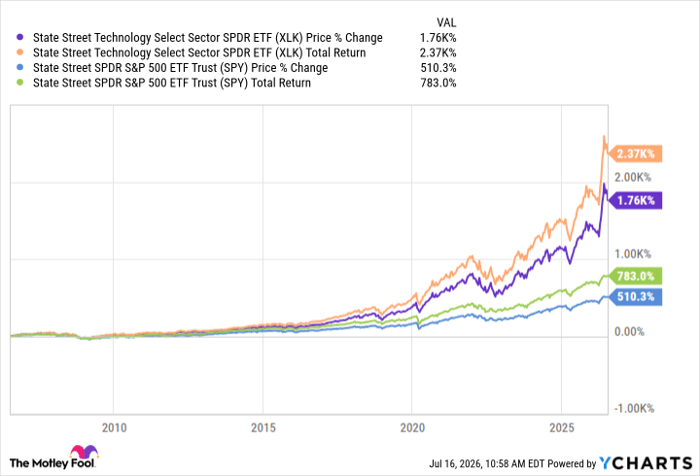
XLK data by YCharts.
As the adage goes, "Past performance is no guarantee of future results." Past performance is often a pretty good indication of what to reasonably expect in the future, though, particularly when the stocks in question are shares of companies creating a massive amount of sociocultural change.
In other words, owning a stake in the State Street Technology Select Sector SPDR ETF is a pretty good bet that tech companies are going to remain as important in the future as they are now. Even if the sector's leading names change, State Street will automatically make the necessary adjustments. Just brace for continued above-average volatility in the meantime.
By the way, the Invesco QQQ Trust (NASDAQ: QQQ), designed to mirror the Nasdaq-100, is a reasonable alternative to XLK. Just know that, while most are, not every single technology name you might want to own is listed on the Nasdaq exchange. Also know that -- again, while most are -- not every Nasdaq 100 constituent is a technology stock. It's still a good way to ramp up your exposure to the tech sector though.
Should you buy stock in SPDR S&P 500 ETF Trust right now?
Before you buy stock in SPDR S&P 500 ETF Trust, consider this:
The Motley Fool Stock Advisor analyst team just identified what they believe are the 10 best stocks for investors to buy now… and SPDR S&P 500 ETF Trust wasn’t one of them. The 10 stocks that made the cut could produce monster returns in the coming years.
Consider when Netflix made this list on December 17, 2004... if you invested $1,000 at the time of our recommendation, you’d have $371,842!* Or when Nvidia made this list on April 15, 2005... if you invested $1,000 at the time of our recommendation, you’d have $1,244,783!*
Now, it’s worth noting Stock Advisor’s total average return is 900% — a market-crushing outperformance compared to 207% for the S&P 500. Don't miss the latest top 10 list, available with Stock Advisor, and join an investing community built by individual investors for individual investors.
See the 10 stocks »
*Stock Advisor returns as of July 19, 2026.
James Brumley has no position in any of the stocks mentioned. The Motley Fool has positions in and recommends Vanguard S&P 500 ETF. The Motley Fool has a disclosure policy.
Recommended Articles


