




Energy Transfer Looks Poised to Outperform the S&P 500 in the Back Half of 2026
Key Points
Energy Transfer has crushed the S&P 500 so far this year.
Despite that, it still trades at a low valuation.
With several potential second-half catalysts, it has ample upside ahead.
- 10 stocks we like better than Energy Transfer ›
Energy Transfer (NYSE: ET) has gotten off to a strong start this year. It's up more than 24% year-to-date, significantly outperforming the nearly 9% rise in the S&P 500.
I expect the master limited partnership (MLP), which sends a Schedule K-1 Federal tax form, will continue to outperform in the back half of the year. Here's a look at what fueled its strong first half, and why the second half could be just as strong.
Missed Nvidia in 2009? This Rare Signal Is Flashing Again. In 2009, a "Double Down" signal flashed for a little-known chipmaker called Nvidia. For the first time in years, that same "Total Conviction" signal is flashing for a company 1/100th the size of Nvidia. Continue »

Image source: The Motley Fool.
Hitting the gas
Energy Transfer hit a speed bump last year. The MLP's earnings growth rate slowed considerably. Its adjusted earnings before interest, taxes, depreciation, and amortization (EBITDA) only rose 3.2% last year, down from the 10% compound annual growth rate it delivered from 2020 through 2024. Growth slowed due to weaker energy market conditions, fewer expansion project completions, and a lack of acquisitions. As a result of its slower growth, Energy Transfer's unit price slumped 15.8% last year.
This year, however, has been a different story. Energy Transfer currently expects to generate between $18.2 billion and $18.6 billion of adjusted EBITDA this year. That's 13.9% to 16.4% higher than last year. It's also higher than the pipeline company's initial forecast of $17.5 billion to $17.9 billion of adjusted EBITDA. Fueling the surge are stronger-than-expected energy market conditions driven by the war with Iran, expansion project completions, and acquisitions closed by its affiliated MLPs (Sunoco LP and USA Compression Partners). The MLP's reacceleration is helping drive its unit price higher.
Second-half catalysts
Despite the first-half surge in its unit price, Energy Transfer has the lowest valuation in its peer group:
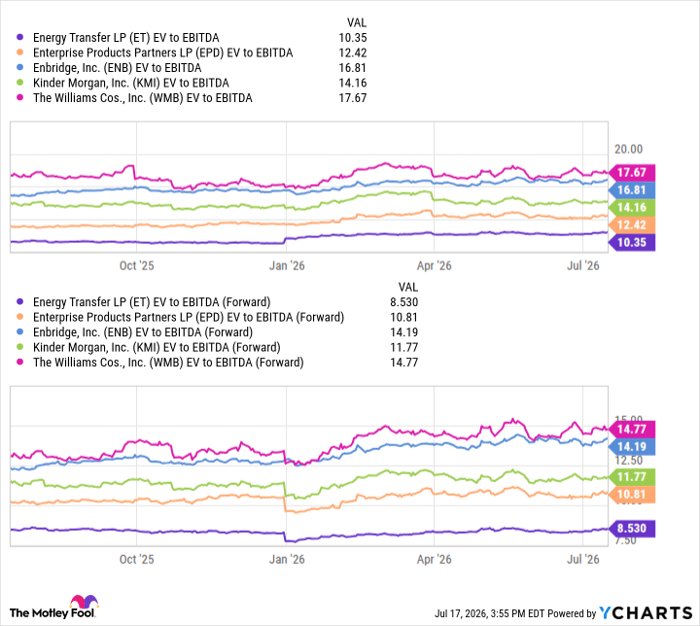
ET EV to EBITDA data by YCharts
That suggests it has more room to run, especially as it captures additional catalysts. One likely driver is further upward revisions to its 2026 financial guidance. Most oil market analysts expected that the Strait of Hormuz would have fully reopened by now, enabling oil to flow freely to the global economy. Instead, Iran has continued to attack ships trying to pass through the Strait, leading the U.S. to resume military operations against the country, including reimposing the Naval blockade. That should keep upward pressure on oil prices.
While Energy Transfer doesn't produce oil and has limited direct exposure to oil prices, it should still benefit from higher pricing. Higher prices will incentivize U.S. oil companies to drill more wells this year, increasing volumes across Energy Transfer's crude oil pipelines and export terminals. Additionally, its system helps move oil in and out of the Strategic Petroleum Reserve, which will likely continue to drain this year.
Energy Transfer will also likely secure additional expansion projects this year. The company has already approved several new growth projects, including a $600 million gas pipeline lateral to support new gas-fired power plants. Gas demand is surging due to AI data centers, which should enable Energy Transfer to capture additional expansion opportunities later this year.
Ample fuel to continue outperforming
Energy Transfer has crushed the S&P 500 through the first half of this year, driven by its accelerating growth. I think that outperformance will continue in the back half of this year, fueled by an improving valuation, upward guidance revisions, and new project approvals. That makes it a compelling investment right now even after its first-half surge.
Should you buy stock in Energy Transfer right now?
Before you buy stock in Energy Transfer, consider this:
The Motley Fool Stock Advisor analyst team just identified what they believe are the 10 best stocks for investors to buy now… and Energy Transfer wasn’t one of them. The 10 stocks that made the cut could produce monster returns in the coming years.
Consider when Netflix made this list on December 17, 2004... if you invested $1,000 at the time of our recommendation, you’d have $371,842!* Or when Nvidia made this list on April 15, 2005... if you invested $1,000 at the time of our recommendation, you’d have $1,244,783!*
Now, it’s worth noting Stock Advisor’s total average return is 900% — a market-crushing outperformance compared to 207% for the S&P 500. Don't miss the latest top 10 list, available with Stock Advisor, and join an investing community built by individual investors for individual investors.
See the 10 stocks »
*Stock Advisor returns as of July 19, 2026.
Matt DiLallo has positions in Energy Transfer. The Motley Fool has no position in any of the stocks mentioned. The Motley Fool has a disclosure policy.
Recommended Articles


