




Andy Jassy Said Amazon Isn't Investing $200 Billion in AI "On a Hunch." Amazon's Own Trainium Chip Business Is Already Running at a $20 Billion Annual Pace.
Key Points
Amazon's $200 billion in AI spending is supported by strong demand for its Trainium chips and contracted revenue.
Trainium's $20 billion annual revenue run rate suggests Amazon's AI investments are already paying off.
Custom AI chips could lower Amazon's long-term costs while strengthening its competitive cloud infrastructure advantage.
- These 10 stocks could mint the next wave of millionaires ›
When a company announces the largest single-year infrastructure spend in corporate history, investors are right to get nervous. Amazon (NASDAQ: AMZN) plans to pour roughly $200 billion into capital spending in 2026, most of it aimed at artificial intelligence (AI), and CEO Andy Jassy knows how that sounds.
His response was blunt: The company is not making that bet "on a hunch." The clearest evidence that he is telling the truth sits inside Amazon's own chip business.
Missed Nvidia in 2009? This Rare Signal Is Flashing Again. In 2009, a "Double Down" signal flashed for a little-known chipmaker called Nvidia. For the first time in years, that same "Total Conviction" signal is flashing for a company 1/100th the size of Nvidia. Continue »
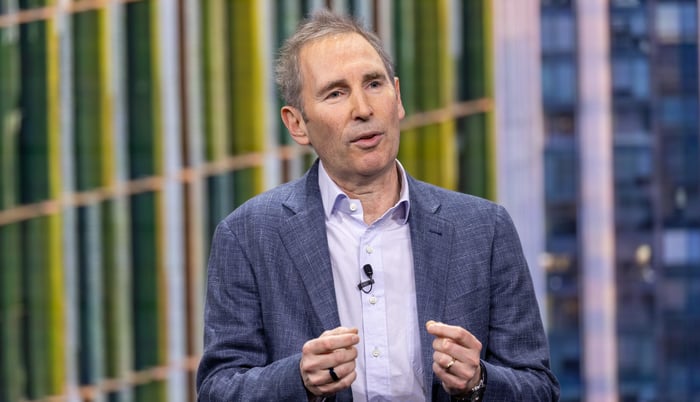
Amazon CEO Andy Jassy. Image source: Amazon.
The proof is in the chips
Amazon designs its own AI chips, led by a line called Trainium, and that custom silicon operation has quietly become a real business. It recently exited a quarter at an annual revenue pace above $20 billion, and this segment of the overall business is growing at triple-digit percentages. It is one of the fastest-scaling chip operations anywhere.
Even more telling is how much future demand is already locked in. Amazon says it has more than $225 billion in revenue commitments tied to Trainium alone, with major AI developers signing on for substantial capacity.
When customers commit that kind of money in advance, it tells you the spending is chasing real, contracted demand rather than a guess about what might sell someday. That is what Jassy is saying.
Why Trainium matters beyond the revenue
The chips do something else that helps the math work. Amazon's newer Trainium processors offer meaningfully better performance for the price than the third-party graphics chips most companies rent, and recent versions have largely sold out. By using its own silicon rather than buying everything from Nvidia, Amazon can lower its costs and widen its profit margins over time.
In other words, the $200 billion is not only about serving customers but also about building a cheaper, more controlled AI supply chain that Amazon owns end-to-end.
None of this makes the bet safe -- $200 billion is an extraordinary sum, and Amazon is counting on monetizing much of it in 2027 and beyond, so the payoff is not immediate. If AI demand cools or customers delay, that spending could weigh on profits. Competition from Nvidia and other cloud providers is fierce, and building chips is hard.
Amazon's AI spending is enormous, but it is backed by a chip business already running at a $20 billion pace and a mountain of pre-committed revenue. To me, that turns a scary headline number into something closer to a calculated bet. The spending still has to pay off, but Jassy has given investors real reasons to believe it is grounded in demand rather than hope.
Don’t miss this second chance at a potentially lucrative opportunity
Ever feel like you missed the boat in buying the most successful stocks? Then you’ll want to hear this.
On rare occasions, our expert team of analysts issues a “Double Down” stock recommendation for companies that they think are about to pop. If you’re worried you’ve already missed your chance to invest, now is the best time to buy before it’s too late. And the numbers speak for themselves:
- Nvidia: if you invested $1,000 when we doubled down in 2009, you’d have $526,675!*
- Apple: if you invested $1,000 when we doubled down in 2008, you’d have $63,609!*
- Netflix: if you invested $1,000 when we doubled down in 2004, you’d have $371,842!*
Right now, we’re issuing “Double Down” alerts for three incredible companies, available when you join Stock Advisor, and there may not be another chance like this anytime soon.
See the 3 stocks »
*Stock Advisor returns as of July 19, 2026.
Micah Zimmerman has no position in any of the stocks mentioned. The Motley Fool has positions in and recommends Amazon and Nvidia. The Motley Fool has a disclosure policy.
Recommended Articles


