




Could This Emerging Markets ETF Be a Better Way to Buy SK Hynix?
Key Points
SK Hynix ranks as the third-largest holding in the iShares MSCI Emerging Markets ETF, making up about 5.7% of the fund.
This emerging markets ETF holds 1,194 stocks and has delivered an annualized return of 10.17% over the past 23 years.
- 10 stocks we like better than iShares - iShares Msci Emerging Markets ETF ›
SK Hynix (NASDAQ: SKHY) is one of the hottest tech names on Wall Street. This South Korean memory chip stock is an important part of the global artificial intelligence (AI) boom, and it started trading on the Nasdaq last week. But even if you don't buy individual shares of SK Hynix, there's more than one way to include this AI chip stock in your portfolio.
Buying international exchange-traded funds (ETFs) can help you include this AI chip stock and other prominent semiconductor stocks as part of your investments. The iShares MSCI Emerging Markets ETF (NYSEMKT: EEM) offers exposure to SK Hynix and other stocks from up-and-coming economies around the world.
Where to invest $1,000 right now? Our analyst team just revealed what they believe are the 10 best stocks to buy right now, when you join Stock Advisor. See the stocks »
Let's look at how this emerging markets ETF can let you own some of the best international stocks, and find out whether it's a good choice for long-term investors.

Image source: Getty Images.
iShares MSCI Emerging Markets ETF (EEM): 1,194 stocks, SK Hynix makes up 5.7% of the fund
The iShares MSCI Emerging Markets ETF offers an easy way to own large- and mid-cap stocks from emerging markets in more than 10 countries. This fund holds 1,194 stocks. The top five markets represented in its holdings are Taiwan (27.8% of the fund), China (20.5%), South Korea (19.9%), India (11.6%), and Brazil (4.1%).
If you want to invest in SK Hynix and other Asian tech stocks that are benefiting from booming demand for semiconductors, AI data centers, and other AI infrastructure, this fund could be a good choice. The ETF's top five stock holdings are all major tech names from Taiwan, South Korea, and China:
- Taiwan Semiconductor Manufacturing (NYSE: TSM): 15.7% of the fund
- Samsung Electronics (OTC: SSNLF): 6.7%
- SK Hynix: 5.7%
- Tencent (OTC: TCEHY): 3.0%
- Alibaba Group (NYSE: BABA): 2.0%
As shown by its top five stock holdings, this is a tech-heavy ETF. Its top five sector holdings are information technology (41.8% of the fund), financials (19.6%), consumer discretionary (8.1%), communication (6.5%), and industrials (6.4%). The iShares MSCI Emerging Markets ETF has delivered average annual returns of 22.9% for the past three years and 45.1% for the past year.
Who should buy the iShares MSCI Emerging Markets ETF?
This international ETF has a few strong points in its favor. It's been around since April 2003 and over the past 23 years, has delivered average annual returns of 10.17%. Those are lower returns than what the S&P 500 index has delivered in the past 23 years, although the iShares MSCI Emerging Markets ETF has had a few long stretches of outperforming the U.S. benchmark:
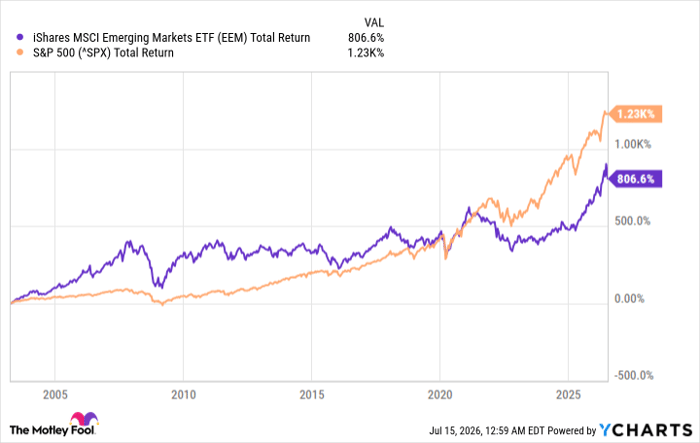
EEM Total Return Level data by YCharts
This emerging markets fund has been less volatile than the S&P 500 for the past three years, with an equity beta coefficient of 0.82. And it might be undervalued -- the emerging markets ETF's price-to-earnings (P/E) ratio of 19.50 represents about a 24% discount compared to the S&P 500 earnings multiple of 25.62.
But one drawback is that the fund charges a rather high expense ratio of 0.72%. And emerging market stocks can be risky, especially during times of a strengthening U.S. dollar or global crises like recent oil price shocks from the Iran war.
If you want an easy way to get exposure to SK Hynix stock (and other leading Asian AI stocks) without going all-in on individual shares, this emerging markets ETF is worth considering. But it doesn't rank among the best emerging markets ETFs -- other funds might offer better choices for long-term investors.
Should you buy stock in iShares - iShares Msci Emerging Markets ETF right now?
Before you buy stock in iShares - iShares Msci Emerging Markets ETF, consider this:
The Motley Fool Stock Advisor analyst team just identified what they believe are the 10 best stocks for investors to buy now… and iShares - iShares Msci Emerging Markets ETF wasn’t one of them. The 10 stocks that made the cut could produce monster returns in the coming years.
Consider when Netflix made this list on December 17, 2004... if you invested $1,000 at the time of our recommendation, you’d have $400,964!* Or when Nvidia made this list on April 15, 2005... if you invested $1,000 at the time of our recommendation, you’d have $1,272,955!*
Now, it’s worth noting Stock Advisor’s total average return is 930% — a market-crushing outperformance compared to 210% for the S&P 500. Don't miss the latest top 10 list, available with Stock Advisor, and join an investing community built by individual investors for individual investors.
See the 10 stocks »
*Stock Advisor returns as of July 17, 2026.
Ben Gran has no position in any of the stocks mentioned. The Motley Fool has positions in and recommends Taiwan Semiconductor Manufacturing and Tencent. The Motley Fool recommends Alibaba Group. The Motley Fool has a disclosure policy.
Recommended Articles


