




Here's Why the Latest Inflation Data Was Good News for Fed Chair Kevin Warsh and the Stock Market
Key Points
After squashing the last inflation surge from 2022, the Federal Reserve has cut interest rates six times since September 2024.
But the Fed's new chairman, Kevin Warsh, has warned interest rate hikes might be on the table, as elevated oil prices drive up the cost of everything from gas to groceries.
Rising interest rates can be very bad news for the stock market, but investors might be breathing a sigh of relief after seeing June's Consumer Price Index.
- 10 stocks we like better than S&P 500 Index ›
On May 15, Jerome Powell's term as Chairman of the U.S. Federal Reserve ended. He handed the reins to an experienced successor, Kevin Warsh, who previously worked on Wall Street and at the White House and even served five years on the Fed's Board of Governors from 2006 to 2011.
Warsh stepped into the chairmanship at a crucial moment for the American economy. The Consumer Price Index (CPI) measure of inflation rose at an accelerating pace in March, April, and May, driven by soaring oil prices amid the ongoing war in Iran. This forced Warsh to adopt a hawkish stance from the outset, warning Wall Street that interest rate hikes might be on the table.
Missed Nvidia in 2009? This Rare Signal Is Flashing Again. In 2009, a "Double Down" signal flashed for a little-known chipmaker called Nvidia. For the first time in years, that same "Total Conviction" signal is flashing for a company 1/100th the size of Nvidia. Continue »
The last time the Fed raised interest rates, the S&P 500 (SNPINDEX: ^GSPC) stock market index plunged into bear territory, so investors are understandably on edge. But on Wednesday, the U.S. Bureau of Labor Statistics released its June CPI report. Here's why it was good news for both Warsh and the stock market.

Federal Reserve Chairman Kevin Warsh. Image source: Official White House Photo by Daniel Torok.
A step in the right direction
The federal funds rate (overnight interest rate) has been on a roller-coaster ride over the last few years. The Fed gradually raised it from 0.1% in February 2022 to 5.3% in August 2023, just a year and a half later, to squash a CPI that had surged to 8% -- four times the central bank's 2% annual target.
After successfully bringing inflation down, the Fed started cutting the federal funds rate in September 2024, and it now sits at 3.6%, much to the relief of homeowners and stock market investors (more on that later).
But rising oil prices are threatening to undo that progress; a single barrel of West Texas Intermediate crude trades for around $80 at recent prices, 39% higher than where it started the year. Oil is an input cost for every product that travels by truck, boat, or plane, so consumers aren't just feeling the pinch at the gas pump; they're also feeling it at the grocery store and the mall.
When the war between the U.S. and Iran started in February, the CPI was hovering at an annualized rate of 2.4%, but it spiked to 4.2% by May, setting off alarm bells at the Fed. It cooled to 3.5% in June, which is good news, but it is still well above the central bank's 2% target, and upside risks remain, given that the war in the Middle East is still raging after multiple failed attempts to achieve peace.
According to CME Group's FedWatch tool, which calculates the probability of interest rate moves by analyzing the 30-Day Fed Funds futures market, there is still an 82% chance of at least one hike by December. In other words, Wall Street wants to see proof that the June CPI report was the start of a trend, not just a one-off, before it stops pricing in higher interest rates.
Low interest rates are better for the stock market
The S&P 500 delivered practically no return during the entirety of the Fed's last rate hiking cycle in 2022 and 2023. And within that period, it suffered a peak-to-trough decline of more than 20%, which constituted a technical bear market.
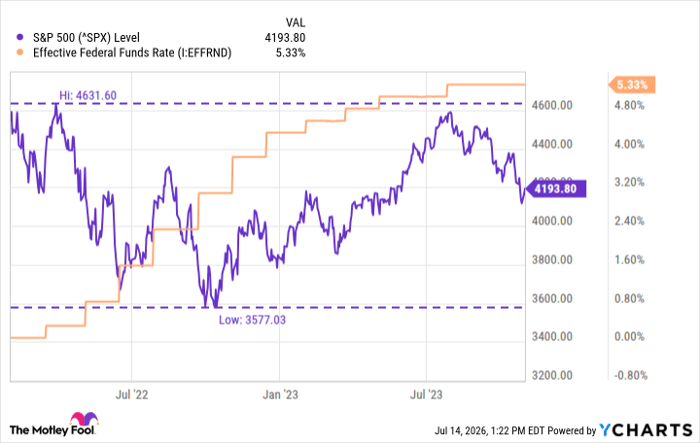
^SPX data by YCharts
There are a few reasons investors retreat from the stock market when interest rates rise. First, risk-free assets like cash and government Treasury bonds become attractive alternatives. Second, rising rates will reduce most companies' borrowing capacity, hampering their ability to invest in growth. Plus, the higher interest costs on the credit they can access negatively impact their earnings.
Third, rising rates force consumers to allocate more of their household budgets to debt repayments, leaving them with less money to spend on goods and services. This is another drag on corporate earnings.
As a result, while the June inflation report was certainly a step in the right direction, investors should pay close attention to the next two or three monthly prints to see if a downward trend is forming. If that proves to be the case, it could clear the way for more upside in the S&P 500, but the reverse might be true if the CPI starts ticking higher.
Should you buy stock in S&P 500 Index right now?
Before you buy stock in S&P 500 Index, consider this:
The Motley Fool Stock Advisor analyst team just identified what they believe are the 10 best stocks for investors to buy now… and S&P 500 Index wasn’t one of them. The 10 stocks that made the cut could produce monster returns in the coming years.
Consider when Netflix made this list on December 17, 2004... if you invested $1,000 at the time of our recommendation, you’d have $396,542!* Or when Nvidia made this list on April 15, 2005... if you invested $1,000 at the time of our recommendation, you’d have $1,299,961!*
Now, it’s worth noting Stock Advisor’s total average return is 931% — a market-crushing outperformance compared to 210% for the S&P 500. Don't miss the latest top 10 list, available with Stock Advisor, and join an investing community built by individual investors for individual investors.
See the 10 stocks »
*Stock Advisor returns as of July 15, 2026.
Anthony Di Pizio has no position in any of the stocks mentioned. The Motley Fool has positions in and recommends CME Group. The Motley Fool has a disclosure policy.
Recommended Articles


