




Investing $300 Per Month Could Eventually Build an Annual Dividend Income of $30,000 or More
Key Points
How much income your portfolio produces in retirement is largely a function of how much you can grow it before you retire.
Your investments while growing your nest egg will look very different than the income investments you’ll want to own in retirement.
In addition to solid dividend yields, also consider that you’ll want your retirement income to at least keep pace with inflation.
- 10 stocks we like better than Realty Income ›
Do you know you'll need investment income in the future even if you don't need it right now? That's basically what saving for retirement is.
And this simple idea raises a simple question: How much future income can you generate for every dollar you tuck away now? It depends on several factors, including how long you save, and what sort of return you achieve on your growth investments.
Missed Nvidia in 2009? This Rare Signal Is Flashing Again. In 2009, a "Double Down" signal flashed for a little-known chipmaker called Nvidia. For the first time in years, that same "Total Conviction" signal is flashing for a company 1/100th the size of Nvidia. Continue »
Just for some perspective, let's look at what a hypothetical (yet very realistic) $300 monthly investment might be capable of driving in retirement, given enough time.
Crunching the numbers
There are actually two key phases to our hypothetical number crunching. The first of these is the growth phase, during which we continually contribute to a fund that remains invested for growth rather than income. In our model, we'll simply invest in the overall market using the SPDR S&P 500 ETF Trust (NYSEMKT: SPY), which is built to mirror the performance of the S&P 500 index (SNPINDEX: ^GSPC). Assuming its long-term average annual return of 10% persists, in 30 years -- a fairly typical length for a career -- a $300 monthly investment in this ETF would leave you with a nest egg of $683,797:
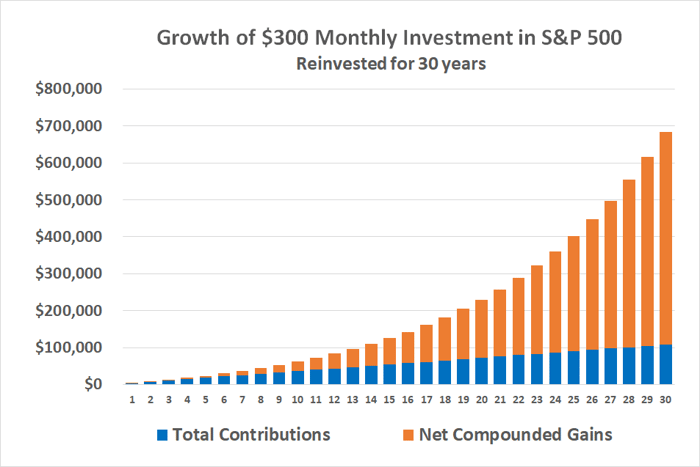
Data source: Calculator.net. Chart by author.
Notice that most of the gains materialize in just the last third of this savings period. The trick is just starting the last decade with as much invested capital as possible.
Then the second phase begins. That's the conversion of an investment largely meant for growth into an investment mostly meant to produce income. And here, your options are wide-ranging. Shares of beverage powerhouse Coca-Cola (NYSE: KO), for instance, currently yield 2.5%, and are backed by 64 consecutive years of dividend increases. The Schwab U.S. Dividend Equity ETF (NYSEMKT: SCHD) doesn't have nearly the same history and pedigree, but with its trailing yield of 3.3%, that $683,797 could produce more than $22,000 in annual dividend income.
If your chief concern is simply maximizing your cash flow with dividend payments that at least keep up with inflation, however, a pick like real estate investment trust (REIT) Realty Income (NYSE: O) is a fantastic all-around option. The REIT has not only paid monthly (yes, monthly) dividends like clockwork for decades now, but has raised its per-share payout every year for the past 31 years with an inflation-beating average annual increase of 4.1%.
Newcomers will be plugging in while its yield stands at 5.1%. At that yield, a $683,797 investment in Realty Income would generate yearly dividend income of $34,873. Not bad.
Small starts will still work, given enough time
There are other options, of course. And, you wouldn't want to commit your entire nest egg to a single ticker anyway.
The point is to simply illustrate what's possible -- and not just the sort of reliable dividend income you could achieve once you're done saving for retirement. Just as important is the fact that a relatively modest amount of money tucked away in a growth investment every month can end up being worth far more than you might realize, given enough time.
The chief challenge? Usually, it's just getting started. The sooner you do so, the better.
Should you buy stock in Realty Income right now?
Before you buy stock in Realty Income, consider this:
The Motley Fool Stock Advisor analyst team just identified what they believe are the 10 best stocks for investors to buy now… and Realty Income wasn’t one of them. The 10 stocks that made the cut could produce monster returns in the coming years.
Consider when Netflix made this list on December 17, 2004... if you invested $1,000 at the time of our recommendation, you’d have $395,679!* Or when Nvidia made this list on April 15, 2005... if you invested $1,000 at the time of our recommendation, you’d have $1,294,805!*
Now, it’s worth noting Stock Advisor’s total average return is 929% — a market-crushing outperformance compared to 211% for the S&P 500. Don't miss the latest top 10 list, available with Stock Advisor, and join an investing community built by individual investors for individual investors.
See the 10 stocks »
*Stock Advisor returns as of July 14, 2026.
James Brumley has positions in Coca-Cola. The Motley Fool has positions in and recommends Realty Income. The Motley Fool has a disclosure policy.
Recommended Articles


