




After Receiving $100 Million From the Trump Administration, Is Rigetti Computing Stock a Screaming Buy?
Key Points
The Department of Commerce is deploying $2 billion across nine quantum computing companies.
Rigetti Computing is set to receive $100 million in CHIPS Act funding over the next three years.
While support from the government adds some credibility to Rigetti, shares remain priced at historically high levels.
- 10 stocks we like better than Rigetti Computing ›
Last month, the Department of Commerce announced plans to invest up to $2 billion across nine quantum computing businesses over the next three years. Among these companies is Rigetti Computing (NASDAQ: RGTI), which is set to receive $100 million in CHIPS Act funding tied to certain research and development (R&D) milestones for its superconducting quantum systems.
This gives a level of credibility to Rigetti's technology and is a strategic alignment with national priorities related to artificial intelligence (AI).
Where to invest $1,000 right now? Our analyst team just revealed what they believe are the 10 best stocks to buy right now, when you join Stock Advisor. See the stocks »
Smart investors are asking whether this news alone makes the stock an immediate buy. A closer examination of the funding's purpose, its potential applications, and Rigetti's current valuation reveals a more nuanced picture.

Image source: Getty Images.
Why is the government investing in quantum computing stocks?
The Commerce Department's $100 million commitment to Rigetti is notable because it forms part of a broader effort to secure leadership in quantum AI technologies amid global competition. Unlike traditional grants, the underlying structure ties the funding to specific R&D milestones while giving the U.S. government an equity stake in Rigetti.
For the company, the capital arrives at an important moment since scaling up quantum processors increasingly demands hefty investment in hardware, error mitigation, and integration with classic computing systems. The CHIPS Act funding should help reduce reliance on dilutive equity raises from public markets.
Moreover, specifically choosing Rigetti among such a small cohort of recipients signals confidence from policymakers who view quantum computing as essential for economic competitiveness and security applications.
How will CHIPS Act funding help Rigetti?
Additional government funding could accelerate Rigetti's progress toward building fault-tolerant quantum architectures at scale. A successful outcome could enable hybrid quantum-classic solutions for crucial applications in drug discovery, financial services, energy modeling, and cryptography.
Beyond research, partnering with the government could strengthen the company's position in public sector and enterprise contracts, fostering ecosystem development around its full-stack approach. With that said, quantum computing remains in a pre-commercial phase where meaningful revenue growth is still years away.
Is Rigetti Computing stock a buy?
Rigetti's financial profile paints a high-risk, high-reward picture. Currently, the company has a market capitalization of roughly $7 billion with trailing-12-month sales of only $10 million. Under these parameters, the stock trades at a price-to-sales ratio (P/S) of nearly 700. Simply put, this multiple surpasses standard benchmarks even for high-growth technology companies in disruptive markets.
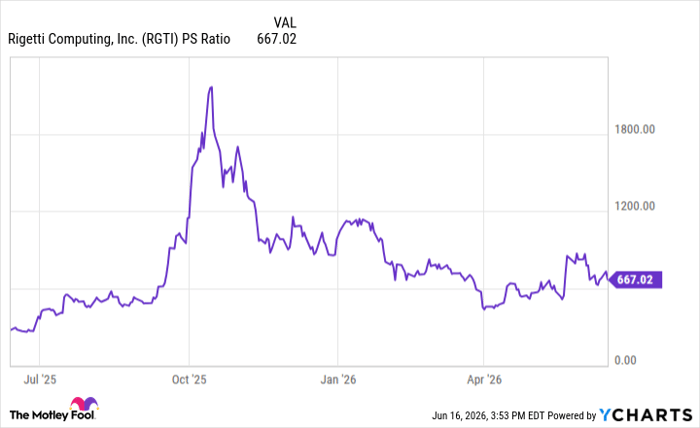
RGTI PS Ratio data by YCharts.
While financial support from the government adds a non-dilutive element to Rigetti's balance sheet, it does not alter the reality of the company's ongoing operating losses amid a modest sales base and a business model with heavy capital expenditures.
All told, the $100 million commitment from the federal government provides important strategic support and capital for the company's road map. At best, this funding potentially accelerates breakthroughs in scalable quantum hardware.
However, Rigetti's abnormally high valuation and early-stage fundamentals indicate that the funding alone does not justify buying the stock right now.
Should you buy stock in Rigetti Computing right now?
Before you buy stock in Rigetti Computing, consider this:
The Motley Fool Stock Advisor analyst team just identified what they believe are the 10 best stocks for investors to buy now… and Rigetti Computing wasn’t one of them. The 10 stocks that made the cut could produce monster returns in the coming years.
Consider when Netflix made this list on December 17, 2004... if you invested $1,000 at the time of our recommendation, you’d have $417,305!* Or when Nvidia made this list on April 15, 2005... if you invested $1,000 at the time of our recommendation, you’d have $1,293,148!*
Now, it’s worth noting Stock Advisor’s total average return is 936% — a market-crushing outperformance compared to 207% for the S&P 500. Don't miss the latest top 10 list, available with Stock Advisor, and join an investing community built by individual investors for individual investors.
See the 10 stocks »
*Stock Advisor returns as of June 20, 2026.
Adam Spatacco has no position in any of the stocks mentioned. The Motley Fool has no position in any of the stocks mentioned. The Motley Fool has a disclosure policy.
Recommended Articles


