




US Stocks Close: Nasdaq Rises 1.91%, Philadelphia Semiconductor Index Rises Over 6% to Record High, SpaceX Rallies Late to Erase Intraday Losses
TradingKey - On June 18 ET, the U.S. officially lifted its maritime blockade on Iran, boosting market sentiment. All three major indexes closed higher, with tech stocks leading the gains.
At the close, the Dow Jones Industrial Average rose 0.14% to 51,564.70 points; the Nasdaq Composite Index rose 1.91% to 26,517.93 points; the S&P 500 Index rose 1.08% to 7,500.58 points.
Tech stock performance
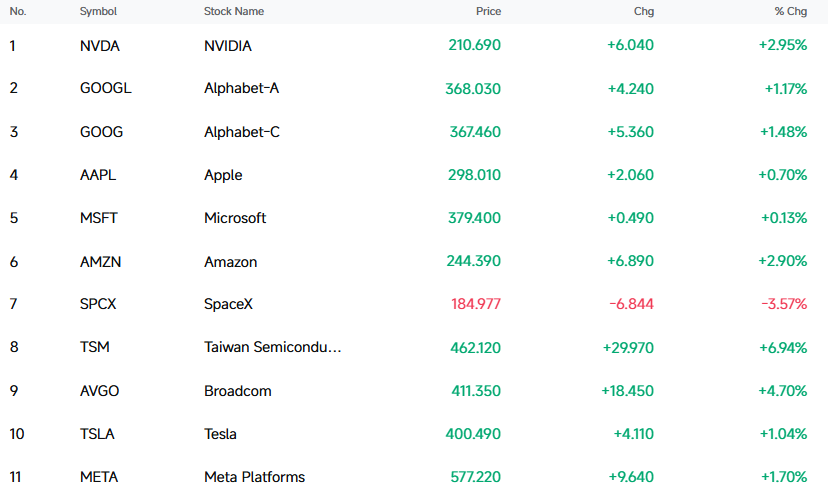
SpaceX (SPCX) surged in late trading to claw back most of its losses for the day, closing down 3.57% at $184.977, with a market capitalization of $2.43 trillion, making it the sixth-largest company by market value in the United States.
The market anticipates that SpaceX will merge with Tesla to build a tech behemoth spanning rockets, artificial intelligence, satellites, electric vehicles, robotics, energy, and social media. If the merger officially materializes, the combined entity's valuation would reach approximately $4 trillion. The president of SpaceX recently stated that there are synergies between the two companies, noting that the merger "could simplify Musk's management responsibilities," and pointing out clear business intersections in their futures: "There is undoubtedly room for synergy between the futures of Tesla and SpaceX."
Intel (INTC) closed up 10.64% at $133.99, hitting an intraday high of $135.48 to reach an all-time high.
U.S. President Donald Trump revealed that Apple has formally agreed to partner with Intel to locate the entire chip design and manufacturing chain within the United States. Trump stated that while the U.S. has always possessed world-class chip design capabilities, the manufacturing segment has long been lost overseas, which is the core reason why the current administration made rebuilding the domestic semiconductor supply chain a key priority upon taking office. In addition to breaking the news of the Apple-Intel partnership, he also reaffirmed the results of the government's support for Intel.
Among mega-cap tech stocks, only SpaceX recorded a decline. In terms of gains, TSMC (TSM) rose 6.94%, Broadcom (AVGO) rose 4.70%, NVIDIA (NVDA) rose 2.95%, Amazon (AMZN) rose 2.90%, Meta Platforms (META) rose 1.70%, Google (GOOGL) rose 1.17%, Tesla (TSLA) rose 1.04%, Apple (AAPL) rose 0.70%, and Microsoft (MSFT) rose 0.13%.
[Source: FutuBull]
The Philadelphia Semiconductor Index hit another all-time high, closing up 6.42% at 14,341.78 points, with all 30 of its components advancing.
Memory concept stocks led the gains, with SanDisk (SNDK) up 11.54%, Micron Technology (MU) up 8.70%, Western Digital (WDC) up 4.79%, and Seagate Technology (STX) up 0.39%.
U.S.-listed Chinese stocks mostly fell, with Legend Biotech (LEGN) shedding 16.68%, GDS Holdings (GDS) down 4.49%, KE Holdings (BEKE) down 3.93%, Trip.com (TCOM) down 3.48%, Kingsoft Cloud (KC) down 3.36%, Li Auto (LI) down 2.72%, and H World Group (HTHT) down 2.57%.
Corporate News
Amazon Joins the Ranks of Selling Self-Developed AI Chips to External Customers
Following in Google's footsteps, Amazon has officially joined the ranks of selling its self-developed AI chips to external customers. It plans to sell its Trainium AI accelerator chips to third-party enterprise data centers, further penetrating the global AI computing power market dominated by Nvidia. This also represents a key milestone in Amazon's comprehensive shift toward its AI strategy.
Trainium is the core self-developed AI hardware of Amazon Web Services (AWS). Since its launch in 2020, it has secured top-tier clients such as OpenAI and Anthropic through a cloud services model, locking in over $225 billion in cumulative revenue commitments. Currently, the third-generation product is essentially sold out, and the fourth-generation chip, expected to hit the market next year, has already garnered significant market attention. The CEO had previously signaled external chip sales in a shareholder letter, and the current negotiations mark the official implementation phase of this strategy.
SpaceX Plans to Issue at Least $20 Billion in Bonds to Refinance Bridge Loan
According to people familiar with the matter, SpaceX's partner investment banking team will hold investor conference calls as early as next week to discuss launching a bond offering plan following the company's record-breaking IPO.
Sources said the bond issuance is expected to be at least $20 billion, with investor communications starting as early as Monday; however, the plan and timeline are still subject to change. SpaceX plans to debut its investment-grade U.S. dollar bond issuance, with the proceeds used to refinance a $20 billion bridge loan maturing in September 2027.
SpaceX's IPO filings with the SEC show that as of March 31, the bridge loan accounted for the bulk of the company's $29.1 billion in long-term debt. Sources said Bank of America, Citigroup, JPMorgan Chase, Goldman Sachs, and Morgan Stanley jointly provided the bridge loan and will lead-manage the bond issuance.
Microsoft and Amazon Cloud Services Face Strict EU Antitrust Regulation
Microsoft's Azure and Amazon Web Services (AWS) are set to face strict antitrust regulation following a preliminary EU probe into monopoly power in the cloud computing market.
According to people familiar with the matter, the European Commission is expected to release its preliminary findings as early as next week, which are anticipated to indicate that AWS and Azure likely meet the criteria for regulation under the EU's Digital Markets Act (DMA). The EU is expected to make a final decision by the end of this year, though the timeline remains subject to change. If these tech giants' services ultimately fall under full DMA regulation, they will face a series of obligations, including interoperability requirements and restrictions on customer lock-in and self-preferencing practices.
CME Sues CFTC Over Approval of Perpetual Futures, Questioning Legality of Regulatory Clearance
CME Group has officially filed an administrative lawsuit in federal court against the CFTC and its chairman, seeking primarily to overturn the regulator's decision to approve the listing of crypto perpetual futures by Kalshi and Coinbase. CME argues that perpetual futures are essentially swap contracts, a stance the CFTC previously shared, and that approving them as futures represents an arbitrary decision that exceeds regulatory authority, requesting the court to also invalidate the associated policy documents.
As a core derivative in the crypto market, perpetual futures have no expiration date, support high leverage, and offer tax advantages, with total market trading volume climbing to $61.7 trillion last year. Previously concentrated on offshore platforms, the CFTC's opening is a key move by the Trump administration to establish the U.S. as the 'global crypto capital,' aimed at bringing modern derivatives trading into the domestic regulatory framework and preventing capital flight to offshore markets.
Anthropic Pledges to Address Security Risks of Mythos and Fable Models
According to media reports, Anthropic executives have submitted a formal proposal to U.S. Commerce Secretary Lutnick, promising to deepen cooperation with the White House to fully address security risks in its core large models 'Mythos' and 'Fable'—the primary reason these two high-performance models previously faced usage restrictions.
According to people familiar with the matter on Thursday, in ongoing remediation talks, Anthropic has committed to improving communication efficiency with the Trump administration and responding more quickly to any future security issues. Although negotiations are progressing smoothly, a concrete timeline for a complete resolution has not yet been finalized.
Industry & Macro News
US Lifts Maritime Blockade on Iran
US Central Command officially announced on social media that, in accordance with directives from President Trump, the United States has formally lifted the maritime blockade on all ports along the Iranian coast. Vessels transiting through the Arabian Gulf and the Gulf of Oman to Iranian ports can now navigate normally, and all prior maritime blockade measures have been halted. However, US military vessels have not withdrawn from these Middle Eastern waters; they will remain stationed in the region to monitor the full implementation of the memorandum of understanding signed between the US and Iran.
US Vice President Vance: Tankers Carrying Over 12 Million Barrels of Crude Oil Have Passed Through the Strait of Hormuz
Following the implementation of the US-Iran peace agreement, transit through the Strait of Hormuz is gradually recovering. US Vice President Vance disclosed that overnight, tankers carrying more than 12 million barrels of crude oil passed through the strait, marking a new high since the conflict began. Currently, both sides are fulfilling the terms of the agreement; Iran has not attacked transiting vessels for two consecutive days, and US Central Command has cleared over a dozen ships to proceed.
OPEC Says Global Oil Demand Has Not Peaked
OPEC released its annual World Oil Outlook, presenting a far more optimistic assessment of long-term oil demand than the market: global oil demand has not yet reached a growth inflection point, and against the backdrop of rising policy priorities for energy security and energy affordability, long-term demand will sustain robust expansion.
Policy shifts are the core underlying logic supporting demand. OPEC pointed out that many countries globally have adjusted their energy strategies, with previously aggressive carbon reduction and oil demand suppression targets being widely scaled back, postponed, or even canceled, as energy supply security and cost stability have become more central policy objectives. Against this backdrop, global oil demand is projected to rise to 113.3 million barrels per day by 2030 and reach 124.1 million barrels per day by 2050.
In terms of the supply and demand structure, long-term demand growth is highly concentrated in emerging markets, with India as the largest source of growth, and road transport, petrochemicals, and aviation serving as the three core growth sectors. On the supply side, a clear divergence has emerged: US shale oil production already peaked in 2025, and about half of the global demand growth over the next few years will be met by non-OPEC producers.
Goldman Sachs Interprets Warsh's Debut: US Treasury Short-End Volatility Amplifies While Long-End Policy Certainty Rises
The first Federal Reserve policy meeting under Warsh's leadership delivered a more hawkish signal than expected. Goldman Sachs Asset Management's latest analysis notes that this will profoundly reshape the behavior of the US Treasury yield curve: short-term rate volatility will rise significantly, while long-term price fluctuations will gradually narrow, driving an overall flattening of the curve.
Market expectations for rate hikes have undergone a rapid upward revision within two trading days. Prior to the decision, the market generally anticipated that the first rate hike would not occur until at least December; now, the probability of a September hike has surged past 80%, and the market has even priced in more than one hike for October. Goldman Sachs believes the core logic behind the amplified short-end volatility comes from two factors: first, Warsh has explicitly designated near-term inflation control as the primary policy objective, significantly increasing the uncertainty of the policy rate path; second, the Fed has officially weakened its forward guidance tool, making future policy highly dependent on real-time data, which further widens the room for short-term rate volatility.
Recommended Articles


