




Tech ETFs Are Doing Something Unprecedented Right Now. Should Investors Buy or Wait?
Key Points
Technology stocks’ strong performance since their late-March low is more than a little bit unusual.
Although optimism about AI's potential is a natural driver of these gains, the expected results aren’t guaranteed.
Corrections of errant valuations often materialize with little to no warning, and happen much faster than the rallies that created such frothy prices.
- 10 stocks we like better than Vanguard Information Technology ETF ›
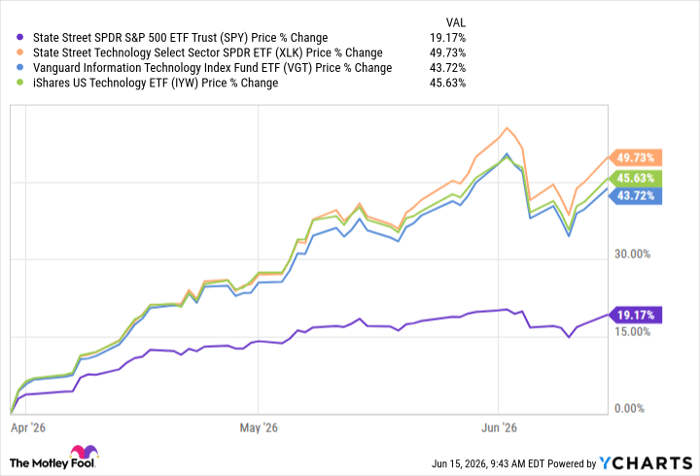
Most investors know the second quarter of this year has been a good one. Bouncing back from the pullback stemming from the beginning of the military conflict with Iran, since March 30, the SPDR S&P 500 ETF Trust (NYSEMKT: SPY), meant to mirror the S&P 500 (SNPINDEX: ^GSPC), has gained a little more than 17%.
That's only a pittance compared to the performance of one particular sector during this stretch, however. Fueled by the euphoria surrounding the artificial intelligence (AI) revolution and then bolstered by recent earnings reports, technology ETFs like the State Street Technology Select Sector SPDR ETF (NYSEMKT: XLK), Vanguard Information Technology ETF (NYSEMKT: VGT), and the iShares U.S. Technology ETF (NYSEMKT: IYW) have gained anywhere from 40% to 45% from their late-March low. That's the first time we've seen such outperformance in years, and really, ever.
Will AI create the world's first trillionaire? Our team just released a report on the one little-known company, called an "Indispensable Monopoly" providing the critical technology Nvidia and Intel both need. Continue »
Data by YCharts.
And that's a problem for investors just now thinking about boarding this train.
These tech ETFs are unusually expensive right now
Don't misread the message. It's absolutely possible to miss out on a lot of upside while holding out for a better entry price.
On the other hand, true wisdom is knowing when to break the rules. This may well be one of those times.
The stumbling block, of course, is valuations. Vanguard's popular tech ETF is now priced at an average trailing price-to-earnings ratio of 38.4, versus FactSet's figure of 27.4 for the S&P 500. The iShares technology fund's trailing P/E ratio is frothy at 44.0, while State Street says XLK's trailing-12-month earnings multiple is 38.8, and its forward-looking price-to-earnings ratio is a lofty 28.6. Although FactSet's forward-looking earnings multiple for the tech sector is measurably lower at 23.2, both are still well above the overall S&P 500's forward-looking price-to-earnings ratio of 20.1 and its 10-year average forward-looking price/earnings ratio of 19.0.
Sure, tech stocks have always been more expensive than most other tickers. They've often been worth their premium, too.
Even by historical standards, though, this sector's bullishness since the end of March has become a conundrum, adding to already steep valuations that were in place then. For perspective, World PE Ratio reports the 10-year average price/earnings ratio for the S&P 500's technology stocks is a much more palatable 25.7, versus its calculated current figure of just over 34.0.
No matter how you slice it, just within the past few weeks, technology stocks have become uncomfortably expensive.
Managing risk is as important as achieving growth
That doesn't necessarily mean these tickers can't defy the statistical odds by continuing to log gains that simply make them even more expensive from here. The artificial intelligence revolution is a truly promising growth engine and obviously inspiring unquestioning bullishness.

Image source: Getty Images.
As veteran investors can attest, however, if and when the market comes to its senses about valuations, it corrects the problem in a hurry.
It would also be naïve to ignore the reality that confident hope regarding AI's future is the core driver of the tech sector's recent and not-so-recent gains. Anything less than complete satisfaction of these lofty expectations could unravel this underlying confidence in a hurry.
So, no, now's not the time to be diving into these names.
Should you buy stock in Vanguard Information Technology ETF right now?
Before you buy stock in Vanguard Information Technology ETF, consider this:
The Motley Fool Stock Advisor analyst team just identified what they believe are the 10 best stocks for investors to buy now… and Vanguard Information Technology ETF wasn’t one of them. The 10 stocks that made the cut could produce monster returns in the coming years.
Consider when Netflix made this list on December 17, 2004... if you invested $1,000 at the time of our recommendation, you’d have $440,440!* Or when Nvidia made this list on April 15, 2005... if you invested $1,000 at the time of our recommendation, you’d have $1,303,950!*
Now, it’s worth noting Stock Advisor’s total average return is 959% — a market-crushing outperformance compared to 211% for the S&P 500. Don't miss the latest top 10 list, available with Stock Advisor, and join an investing community built by individual investors for individual investors.
See the 10 stocks »
*Stock Advisor returns as of June 17, 2026.
James Brumley has no position in any of the stocks mentioned. The Motley Fool has positions in and recommends FactSet Research Systems. The Motley Fool has a disclosure policy.
Recommended Articles


