




Market Correction Ahead: Warren Buffett's Historical Warning for Investors
Key Points
The Buffett indicator is the ratio of U.S. market capitalization to gross domestic product.
Buffett has said that investors are likely to do well if the ratio is 70% to 80%.
However, they are "playing with fire" when it exceeds 200%. It's about 230% today.
- 10 stocks we like better than S&P 500 Index ›
In a 2001 Fortune magazine interview, former Berkshire Hathaway (NYSE: BRKA)(NYSE: BRKB) CEO Warren Buffett talked about the Buffett indicator. This is the ratio he created years ago that measures total U.S. market capitalization to gross domestic product (GDP).
He noted in that interview that "it is probably the best single measure of where valuations stand at any given moment." Like any market signal, it's not foolproof, but it does give us a glimpse into the Buffett investing style and what he looks for in stocks.
Will AI create the world's first trillionaire? Our team just released a report on the one little-known company, called an "Indispensable Monopoly" providing the critical technology Nvidia and Intel both need. Continue »
In this interview, Buffett explained how to interpret this ratio: "For me, the message of that chart is this: If the percentage relationship falls to the 70% or 80% area, buying stocks is likely to work very well for you. If the ratio approaches 200% -- as it did in 1999 and a part of 2000 -- you are playing with fire."
That last part is important, because the Buffett indicator has been doing more than just approaching the 200% area. It's been above that level for the majority of the 2020s. As of May 2026, this ratio sits at 229.7%.
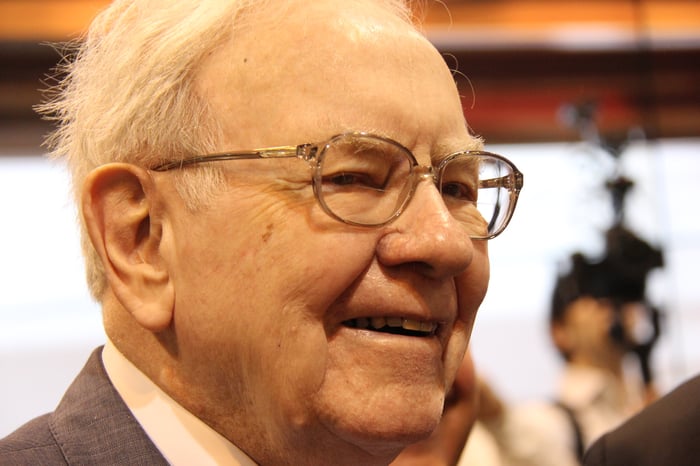
Image source: The Motley Fool.
What the Buffett indicator means
The one advantage of the Buffett indicator is that Warren Buffett himself essentially tells us his definition of value. If it's at 70% to 80%, it's probably a good buying opportunity. Around 100%, it's probably fine, but not an especially attractive entry point.
It's at the 200% level where the danger lies. Based on this, it's not surprising that Berkshire Hathaway was sitting on such a large cash pile toward the end of Buffett's tenure. He famously said that the recent 9% pullback in the S&P 500 (SNPINDEX: ^GSPC) was "nothing." Looking at where the Buffett indicator sits right now, it seems safe to say that he wasn't even close to considering buying.
The history of extreme Buffett indicator levels
The ratio hit an all-time high, not surprisingly, during the tech bubble, when it reached 162.6%. The subsequent bear market drew down the S&P 500 by 50%, and a new high in the Buffett indicator wasn't hit again until 2020. It's been above 150% ever since.
| Buffett Indicator Peak | Approximate Level | S&P 500 Drawdown |
|---|---|---|
| Tech bubble | 162.6% | 49% |
| Post-COVID peak | 218.7% | 34% |
| All-time high (2026) | 232.7% | ? |
| Current | 229.7% | ? |
Data sources: Advisor Perspectives, YCharts.
At roughly 230% today, this ratio is a full 30 points above the level Buffett said was "playing with fire." Obviously, stocks can still push to new highs despite record valuations. But investors should clearly be cautious here. The artificial intelligence (AI) trade is fueling a lot of optimism, but there comes a point where the value just isn't there anymore.
A correction may not be imminent, but the risk is very high -- and the Buffett indicator is saying we're there now.
Should you buy stock in S&P 500 Index right now?
Before you buy stock in S&P 500 Index, consider this:
The Motley Fool Stock Advisor analyst team just identified what they believe are the 10 best stocks for investors to buy now… and S&P 500 Index wasn’t one of them. The 10 stocks that made the cut could produce monster returns in the coming years.
Consider when Netflix made this list on December 17, 2004... if you invested $1,000 at the time of our recommendation, you’d have $433,268!* Or when Nvidia made this list on April 15, 2005... if you invested $1,000 at the time of our recommendation, you’d have $1,259,391!*
Now, it’s worth noting Stock Advisor’s total average return is 935% — a market-crushing outperformance compared to 207% for the S&P 500. Don't miss the latest top 10 list, available with Stock Advisor, and join an investing community built by individual investors for individual investors.
See the 10 stocks »
*Stock Advisor returns as of June 15, 2026.
David Dierking has no position in any of the stocks mentioned. The Motley Fool has positions in and recommends Berkshire Hathaway. The Motley Fool has a disclosure policy.
Recommended Articles


