




SpaceX Is Set to Start Trading Friday in What Could Be the Biggest IPO in History. Here's What Market History Says About Buying Day 1.
Key Points
SpaceX is expected to begin trading on the Nasdaq on Friday at an initial market value of about $1.77 trillion.
The market's biggest IPOs have usually popped on day one, but most later traded below their offer prices.
Lockup expirations have been a recurring source of pressure on newly public stocks.
- 10 stocks we like better than Space Exploration Technologies ›
SpaceX is set to make stock market history. The rocket maker turned satellite internet and artificial intelligence (AI) conglomerate is expected to begin trading on the Nasdaq on Friday, June 12, after selling about 555.6 million shares at a fixed price of $135 apiece. It will trade under the ticker SPCX. The $75 billion raise would be the largest from any initial public offering (IPO) ever -- more than double the $29.4 billion record set by Saudi Aramco in 2019. And it gives the company an initial market value of about $1.77 trillion, instantly one of the most valuable companies in the world.
Anticipation among everyday investors seems just as outsized. SpaceX's prospectus names several retail brokerage platforms that will make shares available at the offer price, an unusual arrangement at this scale. Everyone else who wants in on Friday will pay whatever price the market sets at the open.
Will AI create the world's first trillionaire? Our team just released a report on the one little-known company, called an "Indispensable Monopoly" providing the critical technology Nvidia and Intel both need. Continue »
So, what does history say about buying a debut of this magnitude on day one? Here are three lessons from the market's biggest IPOs.
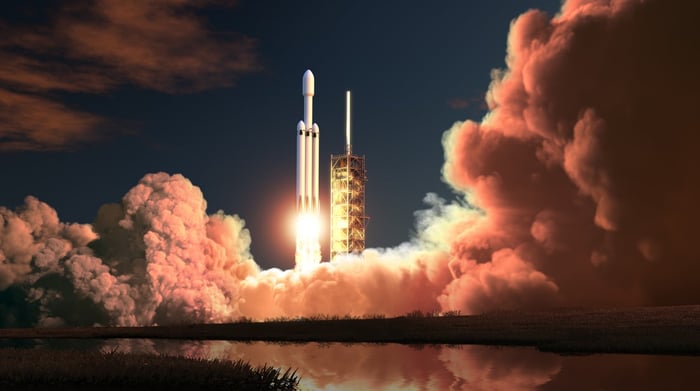
Image source: Getty Images.
1. The first-day pop mostly rewards offer-price buyers
Big IPOs usually rise on their first day. But the headline gain is measured from the offer price, not from the price most investors can actually get. When Chinese e-commerce giant Alibaba went public in 2014, its shares were priced at $68 and opened at $92.70 before closing at $93.89 -- a 38% first-day gain. That pop, however, went almost entirely to investors who received shares in the offering. Anyone who bought at the opening trade earned barely more than 1% by the close.
It can be worse. Visa priced its 2008 IPO at $44 and closed its first session 28% higher at $56.50. But the stock opened at $59.50, meaning investors who bought at the opening trade finished their first day down about 5%.
2. Patient buyers have usually been offered a better price
Here's the part of IPO history that gets less attention: each of the market's most celebrated debuts eventually traded below not just its first-day close but its offer price.
Meta Platforms, then known as Facebook, closed its first day in 2012 at $38.23, nearly flat against a $38 offer price. The stock then needed more than a year to climb back above that level. Alibaba slid below $68 less than a year after its debut. Even Visa, one of the market's great long-term winners, dipped below $44 by January 2009.
Chip designer Arm Holdings offers the most recent example. After pricing its 2023 IPO at $51 and closing its first day about 25% higher at $63.59, the stock was back at $51 within a week. Notably, that didn't make Arm a poor investment. Shares more than doubled from the offer price within their first year on the market. The lesson isn't that the biggest IPOs are doomed -- it's that investors who waited have usually been able to buy at or below the first day's price.
3. Lockup expirations are a known pressure point
Only about 4% of SpaceX's shares are being sold in the offering. The rest are largely held by insiders and early investors who are restricted from selling for now. And history shows what can happen when those restrictions lapse.
Meta's first lockup expiration in August 2012 freed about 271 million shares for sale, and the stock fell to about half its offer price around the event. SpaceX's prospectus lays out a staggered schedule of its own, with insider shares becoming eligible for sale in tranches tied to its first quarterly reports as a public company -- and CEO Elon Musk can't sell for a full year. As that new supply reaches the market, trading could remain volatile well beyond Friday.
What the playbook means for SpaceX (and interested investors)
None of this answers whether SpaceX deserves its price tag. That's maybe even a tougher debate than the one around which direction the stock will trade after the IPO. The company's revenue grew 33% year over year in 2025 to $18.7 billion, led by its Starlink-driven connectivity business, which generated $11.4 billion of that total and counted 10.3 million subscribers at the end of March. But the company also posted a $4.9 billion net loss last year, driven largely by its AI segment following the February acquisition of xAI. And at $135 per share, the stock is valued at about 95 times its 2025 revenue.
In my opinion, SpaceX looks overvalued.
Ultimately, Friday's headline numbers may say more about who got shares at $135 than about where the stock is headed. And investors who like the business may get chances to buy at better prices as lockups expire and early volatility plays out. So, for investors drawn to SpaceX, that may be the most useful takeaway of all: the decision doesn't have to be made in full at Friday's opening bell.
Should you buy stock in Space Exploration Technologies right now?
Before you buy stock in Space Exploration Technologies, consider this:
The Motley Fool Stock Advisor analyst team just identified what they believe are the 10 best stocks for investors to buy now… and Space Exploration Technologies wasn’t one of them. The 10 stocks that made the cut could produce monster returns in the coming years.
Consider when Netflix made this list on December 17, 2004... if you invested $1,000 at the time of our recommendation, you’d have $442,220!* Or when Nvidia made this list on April 15, 2005... if you invested $1,000 at the time of our recommendation, you’d have $1,230,114!*
Now, it’s worth noting Stock Advisor’s total average return is 926% — a market-crushing outperformance compared to 203% for the S&P 500. Don't miss the latest top 10 list, available with Stock Advisor, and join an investing community built by individual investors for individual investors.
See the 10 stocks »
*Stock Advisor returns as of June 11, 2026.
Daniel Sparks and his clients have no position in any of the stocks mentioned. The Motley Fool has positions in and recommends Meta Platforms and Visa. The Motley Fool recommends Alibaba Group and Arm Holdings. The Motley Fool has a disclosure policy.
Recommended Articles


