




The Stock Market May Have a Federal Reserve Problem with Kevin Warsh Replacing Jerome Powell
Key Points
Kevin Warsh (President Trump's nominee) is on track to replace current Federal Reserve Chair Jerome Powell in May.
Warsh wants to shrink the Fed's balance sheet, but doing so could put upward pressure on interest rates.
Higher interest rates could drag the stock market lower, especially with the S&P 500 trading at a rich valuation.
- 10 stocks we like better than S&P 500 Index ›
The S&P 500 (SNPINDEX: ^GSPC) has more than doubled since the current bull market began in October 2022, and the index currently trades near its record high. But the stock market may run into trouble when Kevin Warsh potentially replaces Federal Reserve Chair Jerome Powell in May.
Last week, the Senate Banking Committee voted to advance Warsh's nomination to the full Senate, but the vote fell entirely along party lines for the first time in history. Democrats are concerned Warsh will push for unnecessary rate cuts to appease President Trump, who has repeatedly attacked Powell for keeping interest rates "too high."
Will AI create the world's first trillionaire? Our team just released a report on the one little-known company, called an "Indispensable Monopoly" providing the critical technology Nvidia and Intel both need. Continue »
However, investors should be more concerned about Warsh's ambition to shrink the Fed's balance sheet, which could actually put upward pressure on interest rates. That could be bad news for the stock market, particularly because the S&P 500 already trades at a rich valuation.
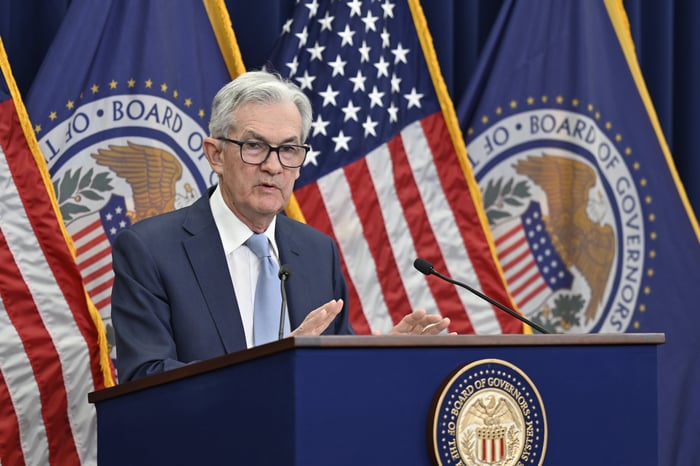
Fed Chair Jerome Powell addresses reporters at a press conference. Image source: Official Federal Reserve Photo.
Kevin Warsh wants to shrink the Federal Reserve's balance sheet
In April, Kevin Warsh critiqued the Federal Reserve during his confirmation hearing, telling senators the central bank had lost its way. He called for a "regime change" in the conduct of monetary policy, emphasizing his belief that the Fed needs to shrink its balance sheet.
"The Fed has an interest rate tool and a balance sheet tool. My view is the interest rate tool gets in the cracks. It's fairer," said Warsh last month. "The balance sheet tool disproportionately helps those with financial assets. The interest rate tool hits the entire economy."
Warsh is referring to the Federal Reserve purchasing Treasury bonds and mortgage-backed securities (MBS), an unconventional monetary policy tool known as quantitative easing. It was first used during the financial crisis; the economy was on shaky ground even after interest rates had been cut to zero, so the Fed started buying bonds to stabilize the financial system.
Warsh argues quantitative easing was used as a measure of last resort and never should have become a lasting policy. The Fed currently has about $6.7 trillion in assets on its balance sheet. That is down from $9 trillion in 2022, but still far higher than $800 million before the financial crisis.
Shrinking the Federal Reserve's balance sheet could hurt the stock market in several ways
Warsh wants the Federal Reserve's balance sheet to be much smaller. But bond prices and yields move in opposite directions. A reduction in the Fed's balance sheet could push bond prices lower (via diminished demand from the central bank) and drive yields higher. That could hurt the stock market in several ways:
- Companies would have to pay more to borrow money, which would diminish their ability to invest in their businesses, leading to slower earnings growth.
- Higher yields would make bonds look more attractive on a relative basis, which would give investors a reason to move money out of the stock market.
- A reduction in the Fed's balance sheet would remove liquidity from the financial system, which could reduce institutional demand for stocks.
Also, analysts often value stocks by discounting future cash flows, but the discount rate in the equation usually depends on the 10-year Treasury yield. Higher yields require a higher discount rate to compensate investors for the additional risk that comes with holding other assets.
So what? A higher discount rate would reduce the present value of future cash flows, which would compress price-to-earnings multiples because investors would pay less for future earnings. That could drag the S&P 500 down because it already trades at an expensive 20.9 times forward earnings, a premium to the 10-year average of 18.9 times forward earnings.
Here's the bottom line: The stock market is expensive by historical standards. The current premium could be justified if interest rates continue to trend lower, as the market currently expects. But the Fed shrinking its balance sheet would put upward pressure on interest rates. That would make the premium harder to justify and could lead the stock market lower.
Should you buy stock in S&P 500 Index right now?
Before you buy stock in S&P 500 Index, consider this:
The Motley Fool Stock Advisor analyst team just identified what they believe are the 10 best stocks for investors to buy now… and S&P 500 Index wasn’t one of them. The 10 stocks that made the cut could produce monster returns in the coming years.
Consider when Netflix made this list on December 17, 2004... if you invested $1,000 at the time of our recommendation, you’d have $490,864!* Or when Nvidia made this list on April 15, 2005... if you invested $1,000 at the time of our recommendation, you’d have $1,216,789!*
Now, it’s worth noting Stock Advisor’s total average return is 963% — a market-crushing outperformance compared to 201% for the S&P 500. Don't miss the latest top 10 list, available with Stock Advisor, and join an investing community built by individual investors for individual investors.
See the 10 stocks »
*Stock Advisor returns as of May 6, 2026.
Trevor Jennewine has no position in any of the stocks mentioned. The Motley Fool has no position in any of the stocks mentioned. The Motley Fool has a disclosure policy.
Recommended Articles


