




Want to Build Real Wealth in Healthcare? These Stocks Are Worth Considering
Key Points
Investors can count on steady growth over time from quality healthcare companies.
Certain healthcare giants also offer significant dividend payments.
- 10 stocks we like better than Johnson & Johnson ›
When you think of the path to wealth, you might immediately think of supercharged technology stocks -- players that may have delivered double or even triple-digit gains in a short period of time. And these sorts of stocks could make excellent additions to your portfolio.
But it's important to remember that high-growth companies aren't the only ticket to building wealth. Another very reliable way to reach such a goal is through investing in solid healthcare companies, those you can count on for earnings growth over time, and in some cases, extras such as dividends. They shouldn't replace the higher-growth names in your portfolio, but instead, play a complementary role. And together, this mix should drive impressive returns over time.
Will AI create the world's first trillionaire? Our team just released a report on the one little-known company, called an "Indispensable Monopoly" providing the critical technology Nvidia and Intel both need. Continue »
So, if you want to build real wealth in healthcare, the following stocks are worth considering.

Image source: Getty Images.
1. Johnson & Johnson
Johnson & Johnson (NYSE: JNJ) made a key decision a few years ago. The company spun off its consumer health business to focus on two units with stronger growth potential: pharmaceuticals, known as innovative medicine, and medtech. Today, J&J is winning this bet.
In the most recent quarter, the pharma giant reported an 11% increase in innovative medicine sales and a more than 7% gain in medtech sales. Overall, the company delivered a nearly 10% sales increase to about $24 billion. All of this is driven by 28 products or platforms that generate at least $1 billion in annual revenue, meaning blockbuster levels. This, along with a sharp focus on innovation, may help J&J reach its goal of double-digit growth by the end of the decade.
On top of this, investors benefit from a dividend of $5.36, representing a yield of 2.3%. And the company's free cash flow levels, as well as its long commitment to dividend increases -- 64 years -- suggest it has what it takes to keep this growth going.
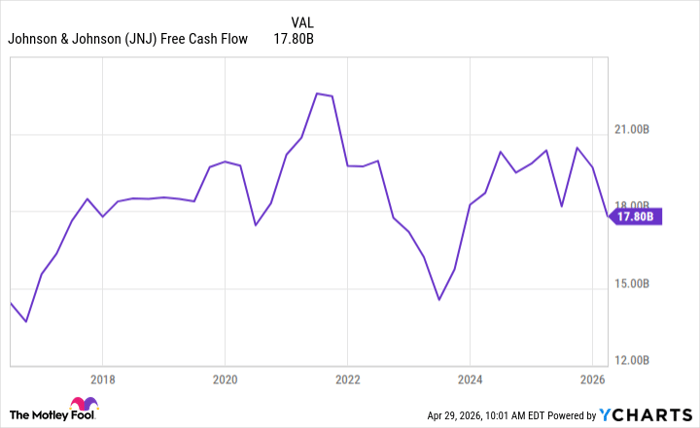
JNJ Free Cash Flow data by YCharts
2. Vertex Pharmaceuticals
Vertex Pharmaceuticals (NASDAQ: VRTX) is the world's leading provider of treatments for cystic fibrosis (CF), and this has resulted in a long track record of earnings growth. The company last year reported a 9% increase in revenue to $12 billion, and much of this is thanks to the CF portfolio. Vertex's latest drug in this portfolio, Alyftrek, and longtime blockbuster, Trikafta, due to recent label expansions, now treat about 95% of the CF population in the U.S. And the company continues to work on the development of a candidate to treat patients who can't be helped by these current products.
This is already a bright picture. But to make it even better, Vertex has successfully expanded into other treatment areas, winning approval with partner CRISPR Therapeutics of Casgevy for blood disorders a couple of years ago. And last year, Vertex gained approval for Journavx, a drug for pain management. These approvals show the company has the ability to successfully expand beyond one treatment area -- and they offer the potential for additional growth down the road. All of this makes Vertex a fantastic biotech to buy and hold for the long term.
3. UnitedHealth Group
UnitedHealth Group (NYSE: UNH) stumbled last year as the health insurer faced several headwinds. This in particular weighed on earnings: It underestimated the cost of healthcare and the use of services. But the company recognized the problems immediately and made a major effort to turn things around.
Today, these moves are delivering results. The company recently reported quarterly results and raised its outlook for full-year earnings to greater than $17.35 per share. That's up from a forecast for about $17.10. UnitedHealth's revenue rose 2% in the quarter to more than $111 billion -- this may not be tremendous growth, but the key point is it's moving in the right direction. And, importantly, the company noted improvement across all of its business segments.
UnitedHealth says this performance is due to better pricing, operational improvements, and the use of artificial intelligence (AI) to gain efficiency.
I like UnitedHealth's solid moat: As the biggest U.S. health insurer, with this insurance business and a services business, it would be difficult to unseat. And as UnitedHealth takes big steps along the path to recovery, it could build real wealth for investors over time.
Should you buy stock in Johnson & Johnson right now?
Before you buy stock in Johnson & Johnson, consider this:
The Motley Fool Stock Advisor analyst team just identified what they believe are the 10 best stocks for investors to buy now… and Johnson & Johnson wasn’t one of them. The 10 stocks that made the cut could produce monster returns in the coming years.
Consider when Netflix made this list on December 17, 2004... if you invested $1,000 at the time of our recommendation, you’d have $497,606!* Or when Nvidia made this list on April 15, 2005... if you invested $1,000 at the time of our recommendation, you’d have $1,306,846!*
Now, it’s worth noting Stock Advisor’s total average return is 985% — a market-crushing outperformance compared to 200% for the S&P 500. Don't miss the latest top 10 list, available with Stock Advisor, and join an investing community built by individual investors for individual investors.
See the 10 stocks »
*Stock Advisor returns as of April 30, 2026.
Adria Cimino has positions in Vertex Pharmaceuticals. The Motley Fool has positions in and recommends CRISPR Therapeutics and Vertex Pharmaceuticals. The Motley Fool recommends Johnson & Johnson and UnitedHealth Group. The Motley Fool has a disclosure policy.
Recommended Articles


