




Why the Fed's Next Move Could Be the Most Important Catalyst for Stocks This Spring
Key Points
Oil prices have sharply increased, as the war in Iran continues.
While the Fed has held off on raising interest rates, that could spell trouble for inflation.
As the economy weakens, the Fed is in a tough place.
- These 10 stocks could mint the next wave of millionaires ›
Oil prices have surged over the past two months, as world leaders fail to resolve the war in Iran. The impasse has resulted in higher gas prices for consumers, with the national average at $4.02 per gallon, according to AAA.
It's also led to higher overall inflation. Plastic products, fertilizers, and other items that use oil in the manufacturing process are now more expensive to produce, and pricier fuel drives up shipping costs.
Will AI create the world's first trillionaire? Our team just released a report on the one little-known company, called an "Indispensable Monopoly" providing the critical technology Nvidia and Intel both need. Continue »
Earlier this month, the Bureau of Labor Statistics reported that inflation rose 3.3% over the past 12 months, the highest it's been in nearly two years. Surging inflation could put more pressure on the Federal Reserve to increase interest rates, which could spell trouble for Wall Street.
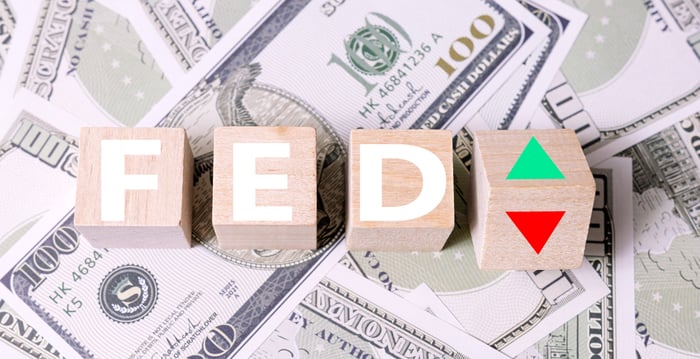
Image source: Getty Images.
How will the Fed manage inflation?
The Federal Reserve is in a tricky place right now. At a speaking event at Harvard University in late March, Fed Chair Jerome Powell explained that the central bank is not raising interest rates for now, instead taking a "wait and see" approach to the war in Iran.
It often takes months for interest rate adjustments to make a noticeable impact, and there's a chance the war could be resolved before that. However, Powell noted that the deflating economy could complicate the Fed's future decisions.
Raising interest rates can help calm inflation, but it can also slow economic growth and increase the already discouraging unemployment rate. The U.S. lost around 92,000 jobs in February, with the unemployment rate at 4.3% as of March 2026, up from 3.8% two years ago.
"You've got tension between the two objectives," Powell said, highlighting the Fed's tough choice between inflation and unemployment.
What does this mean for the stock market?
Typically, lower interest rates tend to be positive for the stock market. Lower borrowing costs can encourage company growth and improve profit margins, leading to higher stock prices.
Wall Street was optimistic after the Fed's decision not to raise rates at this time, with the S&P 500 surging by more than 12% since Powell's remarks in late March, as of this writing.
However, the longer the war in Iran continues, the higher inflation could surge, and the more pressure the central bank will be under to rein in rising costs. At some point, the Fed may have no choice but to raise rates, which could potentially lead to a drop in stock prices.
Now more than ever, it's important for investors to keep a long-term outlook. Nobody can say what the market will do in the coming months, especially with so much uncertainty surrounding the conflict in the Middle East. But if history shows us anything, it's that the market can survive even severe volatility if given enough time.
Where to invest $1,000 right now
When our analyst team has a stock tip, it can pay to listen. After all, Stock Advisor’s total average return is 972%* — a market-crushing outperformance compared to 198% for the S&P 500.
They just revealed what they believe are the 10 best stocks for investors to buy right now, available when you join Stock Advisor.
See the stocks »
*Stock Advisor returns as of April 23, 2026.
Katie Brockman has no position in any of the stocks mentioned. The Motley Fool has no position in any of the stocks mentioned. The Motley Fool has a disclosure policy.
Recommended Articles


