




The Federal Reserve's April Inflation Forecast Was Just Updated -- and the Outlook for the Stock Market Worsened, Yet Again
Key Points
Although the S&P 500 and Nasdaq Composite hit new highs last week, their recent bounces may prove fleeting because of one all-important economic data point.
The Iran war is causing consumers pain at the pump and threatens to increase transportation and production costs for businesses.
The Federal Reserve Bank of Cleveland's inflation-forecasting tool points to an even faster increase in prices in April, which may eventually force the Federal Open Market Committee to act.
- 10 stocks we like better than S&P 500 Index ›
Last week, investors witnessed the benchmark S&P 500 (SNPINDEX: ^GSPC) and technology-powered Nasdaq Composite (NASDAQINDEX: ^IXIC) catapult to fresh record highs. While the iconic Dow Jones Industrial Average (DJINDICES: ^DJI) failed to join its peers, it's not too far away from claiming an all-time high.
Speculation about a quick end to the Iran war and strong earnings growth stemming from the evolution of artificial intelligence clearly has investors excited. But this bounce-back in equities may prove fleeting because of one all-important economic data point: inflation.
Will AI create the world's first trillionaire? Our team just released a report on the one little-known company, called an "Indispensable Monopoly" providing the critical technology Nvidia and Intel both need. Continue »

Fed Chair Jerome Powell delivering remarks. Image source: Official Federal Reserve Photo.
Consumers are feeling the pinch of the Iran war
A little over seven weeks ago, at President Donald Trump's command, the U.S. military, along with Israel, commenced attacks against Iran. Shortly after this conflict began, Iran closed the Strait of Hormuz to virtually all oil shipping traffic. This has resulted in the largest energy supply disruption in modern history.
On a given day, approximately 20 million barrels of petroleum liquids pass through the Strait of Hormuz. With this movement at a virtual standstill, crude oil prices have skyrocketed.
The most immediate impact of rapidly rising energy prices has been felt at the pump by consumers. As of April 15, the national average price of a gallon of regular gas was $4.11, up from less than $3 prior to the Iran war, according to AAA. The increase in the per-gallon price of diesel has been even steeper.
While rising gas and diesel prices hurt consumers at the pump, there's a much bigger story at play. A sizable uptick in energy expenses translates into higher transportation and production costs for businesses, and a potential worst-case scenario for a pricey stock market.

Image source: Getty Images.
The Fed's updated inflation forecast for April continues to worsen
On April 10, the U.S. Bureau of Labor Statistics published the March inflation report, highlighting a trailing 12-month (TTM) inflation rate of 3.3% -- up 90 basis points from February. Although the stickiness of Trump's tariffs in the goods sector played a role, energy price shocks did most of the heavy lifting.
The million-dollar question for Wall Street is: Will U.S. inflation move even higher?
While recent trading activity suggests that Wall Street expects inflation to be transitory from the Iran war, one of the Fed's own forecasting tools disagrees.
Every weekday, the Federal Reserve Bank of Cleveland's Inflation Nowcasting tool takes recently reported economic data into account and adjusts the front-month inflation forecast. When this month began, the Cleveland Fed's Inflation Nowcasting tool projected a TTM rate of 3.28% for April. This has since risen to 3.38%, then 3.56% on April 8, and now stands at 3.58%, as of April 15.
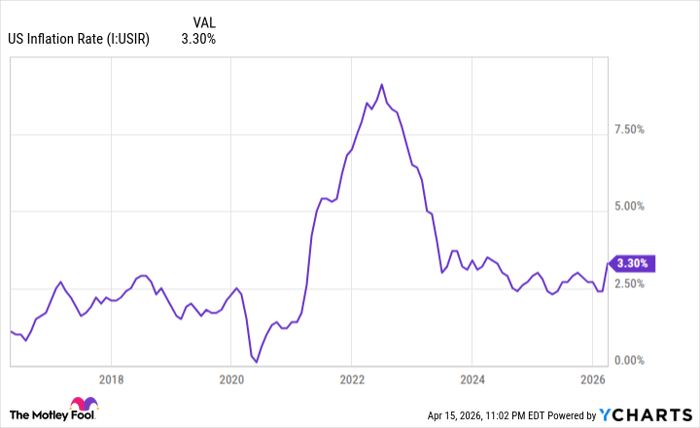
US Inflation Rate data by YCharts.
Though this might not sound like a worrisome increase in prices, it's a potentially devastating forecast for Wall Street.
The stock market began the year at its second-priciest valuation since January 1871, according to the S&P 500's Shiller Price-to-Earnings Ratio. While AI excitement helped support premium valuations, it was the belief that the Federal Open Market Committee (FOMC) -- the 12-person body, led by Fed Chair Jerome Powell, responsible for setting the nation's monetary policy -- would lower interest rates that kept stock valuations high.
A TTM inflation rate of 3.58% offers the FOMC no reason to lower interest rates, and might even provide enough of a spark to force the Fed's hand to raise rates. A monetary policy shift by the FOMC could halt Wall Street's bull market rally in its tracks.
Should you buy stock in S&P 500 Index right now?
Before you buy stock in S&P 500 Index, consider this:
The Motley Fool Stock Advisor analyst team just identified what they believe are the 10 best stocks for investors to buy now… and S&P 500 Index wasn’t one of them. The 10 stocks that made the cut could produce monster returns in the coming years.
Consider when Netflix made this list on December 17, 2004... if you invested $1,000 at the time of our recommendation, you’d have $524,786!* Or when Nvidia made this list on April 15, 2005... if you invested $1,000 at the time of our recommendation, you’d have $1,236,406!*
Now, it’s worth noting Stock Advisor’s total average return is 994% — a market-crushing outperformance compared to 199% for the S&P 500. Don't miss the latest top 10 list, available with Stock Advisor, and join an investing community built by individual investors for individual investors.
See the 10 stocks »
*Stock Advisor returns as of April 20, 2026.
Sean Williams has no position in any of the stocks mentioned. The Motley Fool has no position in any of the stocks mentioned. The Motley Fool has a disclosure policy.
Recommended Articles


