




Prediction: The AI Supply Chain Shortage Will Create 2 New Trillion-Dollar Companies by 2030
Key Points
AMD's recent AI deals are big enough to supercharge the company's growth, as it's set to benefit from the terrific demand for AI computing power.
Oracle is filling a key gap in the AI infrastructure market, and it shouldn't be long before the stock steps on the gas.
- 10 stocks we like better than Advanced Micro Devices ›
The demand for artificial intelligence (AI) applications is exceeding supply, which is not a big surprise, as enterprises adopting this technology are witnessing tangible improvements in productivity.
Research conducted by Morgan Stanley revealed that companies adopting AI saw an average increase of 11.5% in productivity. Market research firm IDC has a rosier forecast, estimating that a dollar spent on AI solutions could generate $4.90 in economic value. As a result, it's easy to see why AI adoption is increasing at a nice clip.
Will AI create the world's first trillionaire? Our team just released a report on the one little-known company, called an "Indispensable Monopoly" providing the critical technology Nvidia and Intel both need. Continue »
However, key AI software providers, such as Palantir Technologies, are witnessing significant growth in their revenue backlogs as they're unable to meet all the demand that's coming their way. This explains why hyperscalers have been spending aggressively to build more data centers. But the capacity expansion is being held back by a shortage of semiconductors and memory chips.
The good news for investors, however, is that this shortage is creating solid investment opportunities. Memory companies, for instance, are benefiting from massive price increases that are fueling outstanding revenue and earnings growth. In fact, it won't be surprising to see the AI supply chain shortage helping Advanced Micro Devices (NASDAQ: AMD) and Oracle (NYSE: ORCL) become trillion-dollar companies by the end of the decade.
Let's see why that may be the case.
Image source: The Motley Fool
AMD: The insatiable thirst for AI computing power makes the stock a no-brainer buy
Nvidia and Broadcom have been the leading names in the AI chip market in recent years, but AMD has been slowly carving a niche for itself in this space. It struck big deals last year with OpenAI and Meta Platforms to provide a combined 12 gigawatts of graphics processing units (GPUs) for their AI data centers.
These deals have opened a tremendous long-term growth opportunity for AMD in the data center GPU space. At the same time, the company has been gaining share in the client and server central processing unit (CPU) markets from Intel. Specifically, AMD's unit share of server CPUs increased by 3.1 percentage points year over year in the fourth quarter of 2025 to 28.8%, according to Mercury Research.
Its revenue share was much stronger at 41.3%, suggesting that it is commanding premium pricing for its server CPUs. AMD is likely to enjoy stronger pricing in the server CPU market due to chip shortages. The demand for server CPUs exceeds supply, which explains why market research firm Omdia anticipates a 11% to 15% price increase.
So AMD's pricing power could continue to improve as its share of the server CPU market grows, and the lucrative deals with hyperscalers in the data center GPU market should be another tailwind. Not surprisingly, analysts are forecasting healthy earnings growth for AMD over the next three years.
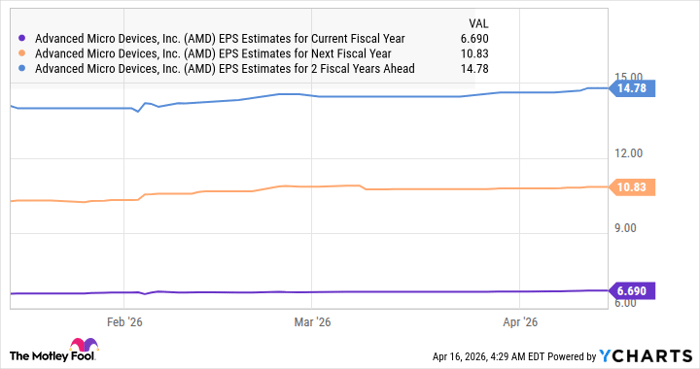
AMD EPS Estimates for Current Fiscal Year data by YCharts
AMD estimates that its annual data center revenue could hit $100 billion within the next five years, which would be a huge improvement over its 2025 data center revenue of $16.6 billion. So this semiconductor company can sustain healthy growth levels until the end of the decade. Assuming AMD's earnings grow at even 15% a year in 2029 and 2030, its bottom line could jump to $19.55 per share after five years.
If the stock trades at 31 times earnings at that time (in line with the Nasdaq-100 index's earnings multiple), its price could jump to $667. That's a potential jump of 2.4 times from current levels, which should be enough to send AMD's market cap to $1 trillion, up from its current level of about $450 billion.
Oracle: Aggressive data center buildout should be rewarded with handsome stock upside
Oracle stock may have lost 40% of its value in the past six months, but investors are overlooking the key role the company plays in the AI infrastructure ecosystem. There's a shortage of AI data center computing capacity, and Oracle is helping fill the gap in this market by aggressively adding new capacity.
Goldman Sachs estimates that data center power demand in the U.S. alone will exceed supply by an average of 10 gigawatts a year through 2028. Oracle added 400 megawatts of new data center capacity in the third quarter of fiscal 2026 (which ended on Feb. 28). What's more, the company added on the earnings call that it has "secured more than 10 gigawatts of power and data capacity coming online over the next three years."
Importantly, Oracle points out that more than 90% of the capacity that's coming online in the next three years will be fully funded by its partners. Investors have been wary of Oracle's ballooning debt, and this partner-funding model could help alleviate their concerns. This smart funding model probably explains why analysts are forecasting an acceleration in Oracle's earnings growth.
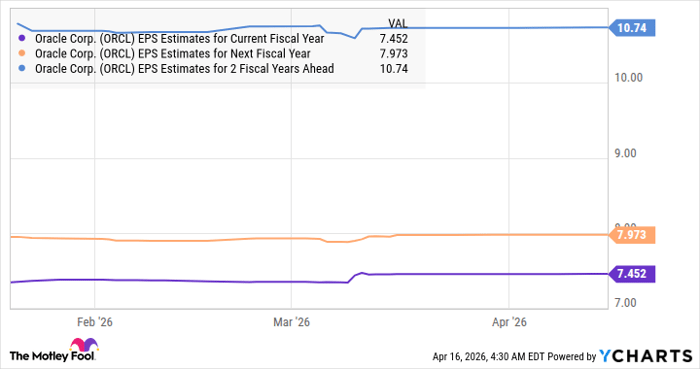
ORCL EPS Estimates for Current Fiscal Year data by YCharts
Oracle estimates that its adjusted earnings could go on to hit $21 per share in fiscal 2030. That seems achievable considering that it was sitting on a whopping $553 billion in remaining performance obligations at the end of the previous quarter, with the metric jumping by 325% year over year.
If the company indeed achieves its earnings guidance after five years and trades at 31 times earnings (the tech-laden Nasdaq-100 index's average earnings multiple), its stock price could rise to $665. That's around 3.8 times Oracle's current stock price. The company has a market cap of $500 billion as of this writing, so it can easily enter the trillion-dollar club by the end of the decade.
As such, opportunistic investors should consider using the slide in this AI stock to buy it as it has multibagger potential.
Should you buy stock in Advanced Micro Devices right now?
Before you buy stock in Advanced Micro Devices, consider this:
The Motley Fool Stock Advisor analyst team just identified what they believe are the 10 best stocks for investors to buy now… and Advanced Micro Devices wasn’t one of them. The 10 stocks that made the cut could produce monster returns in the coming years.
Consider when Netflix made this list on December 17, 2004... if you invested $1,000 at the time of our recommendation, you’d have $524,786!* Or when Nvidia made this list on April 15, 2005... if you invested $1,000 at the time of our recommendation, you’d have $1,236,406!*
Now, it’s worth noting Stock Advisor’s total average return is 994% — a market-crushing outperformance compared to 199% for the S&P 500. Don't miss the latest top 10 list, available with Stock Advisor, and join an investing community built by individual investors for individual investors.
See the 10 stocks »
*Stock Advisor returns as of April 19, 2026.
Harsh Chauhan has no position in any of the stocks mentioned. The Motley Fool has positions in and recommends Advanced Micro Devices, Broadcom, Goldman Sachs Group, Intel, Meta Platforms, Nvidia, Oracle, and Palantir Technologies. The Motley Fool has a disclosure policy.
Recommended Articles


