




Is Amazon Actually a Once-in-a-Decade Bargain Right Now? Here's What the Numbers Say.
Key Points
Amazon is trading at historically low valuation levels.
Meanwhile, its cloud computing revenue is accelerating, and it's seeing great operating leverage in its e-commerce business.
- These 10 stocks could mint the next wave of millionaires ›
Up less than 50% over the past five years, Amazon (NASDAQ: AMZN) stock has been a laggard compared to its tech giant brethren over the past few years. While the stock has gained some momentum this month, its overall performance over the past few years has been largely disappointing. However, its relatively stagnant stock price could mean that this is a once-in-a-decade bargain.
Let's look at four valuation numbers and see what they say about the stock's potential.
Will AI create the world's first trillionaire? Our team just released a report on the one little-known company, called an "Indispensable Monopoly" providing the critical technology Nvidia and Intel both need. Continue »
Image source: The Motley Fool.
No. 1: 32x
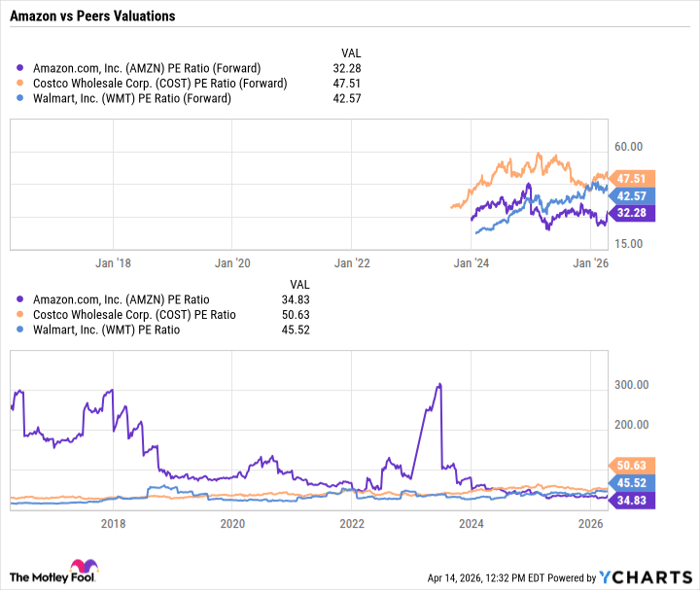
Amazon's current forward price-to-earnings (P/E) ratio is 32. That's well above the 24 forward P/E that it dropped to at one point last year, but it is still at a historically low level. The company's trailing P/E has also been trending lower much of the past decade and is at one of its lowest levels.
Data by YCharts.
Even more striking, though, is the valuation gap between Amazon and its brick-and-mortar peers Walmart and Costco Wholesale. Amazon had long traded at a premium in the retail space, but now it finds itself trading at a big discount, despite its retail operations still growing revenue and profits more quickly.
No. 2: 24%
Amazon Web Services (AWS) grew its revenue 24% year over year last quarter. It was the fastest pace of growth for its cloud computing segment in more than three years.
However, this is likely just the start of revenue growth acceleration for the segment. Amazon built a huge facility for artificial intelligence (AI) partner Anthropic that went online in Q4, while the company is pouring money into AI infrastructure to try to keep up with demand for its cloud services.
No. 3: $20 billion
Amazon's chip business has a current revenue run rate of $ 20 billion, and it's growing at triple-digit rates. Meanwhile, the company said that when including internal use, it's closer to a $50 billion business. Amazon's use for internal operations helps both save on capital expenditure (capex) costs as well as inference expenses, which help improve its operating margins.
This is an underappreciated part of Amazon's business that is growing quickly. Also, not to be overlooked, in addition to its popular Trainium AI chips, the company also has its own central processing units (CPUs), which appear to be the next AI bottleneck, given the rise of agentic AI.
No. 4: 9%
Amazon's North American operating margin was 9% in Q4, which was up from 8% a year ago. E-commerce is a high-sales, low-operating-margin business, so when you see a nice improvement in operating margins, it translates into big profit gains. That's why in Q4, Amazon saw a 24% jump in North American operating income on a 10% increase in sales.
This operating leverage is being led by advancements in robotics and AI, which are just making the business more efficient. It is also benefiting from strong growth in its high-gross-margin sponsor ad business.
Amazon is a great buy
The once-in-a-decade time to buy Amazon was likely during last year's dip, but now is still a great time to buy the stock, and the numbers back it up. Amazon stock is still historically and relatively cheap, while its cloud revenue growth is accelerating and it's seeing strong operating leverage in its e-commerce operations.
Don’t miss this second chance at a potentially lucrative opportunity
Ever feel like you missed the boat in buying the most successful stocks? Then you’ll want to hear this.
On rare occasions, our expert team of analysts issues a “Double Down” stock recommendation for companies that they think are about to pop. If you’re worried you’ve already missed your chance to invest, now is the best time to buy before it’s too late. And the numbers speak for themselves:
- Nvidia: if you invested $1,000 when we doubled down in 2009, you’d have $515,842!*
- Apple: if you invested $1,000 when we doubled down in 2008, you’d have $50,733!*
- Netflix: if you invested $1,000 when we doubled down in 2004, you’d have $580,872!*
Right now, we’re issuing “Double Down” alerts for three incredible companies, available when you join Stock Advisor, and there may not be another chance like this anytime soon.
See the 3 stocks »
*Stock Advisor returns as of April 17, 2026.
Geoffrey Seiler has positions in Amazon. The Motley Fool has positions in and recommends Amazon, Costco Wholesale, and Walmart. The Motley Fool has a disclosure policy.
Recommended Articles


