




We're Precisely 1 Month Away From a Historic Shake-Up at the Federal Reserve -- and Wall Street Isn't Ready for It
Key Points
Although the Dow Jones Industrial Average, S&P 500, and Nasdaq Composite have thrived throughout most of the decade, the winds of change may be blowing on Wall Street.
Jerome Powell's final day as Fed chair is one month from today (May 15).
President Donald Trump's Fed Chair nominee, Kevin Warsh, may create more problems than solutions for Wall Street.
- 10 stocks we like better than S&P 500 Index ›
For most of the decade, optimists have been running the show on Wall Street. Recently, the iconic S&P 500 (SNPINDEX: ^GSPC), growth-propelled Nasdaq Composite (NASDAQINDEX: ^IXIC), and ageless Dow Jones Industrial Average (DJINDICES: ^DJI) all hit psychologically important levels of 7,000, 24,000, and 50,000, respectively.
However, headwinds have been mounting for the stock market. Uncertainties stemming from the Iran war, the historical priciness of equities, and upcoming midterm elections have all threatened to drag down stocks.
Will AI create the world's first trillionaire? Our team just released a report on the one little-known company, called an "Indispensable Monopoly" providing the critical technology Nvidia and Intel both need. Continue »
But the biggest risk of all for Wall Street may be forthcoming, courtesy of an impending shake-up at America's foremost financial institution, the Federal Reserve.
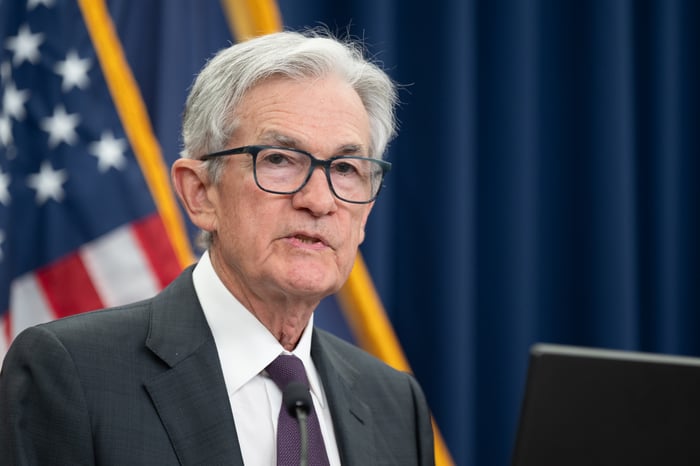
Jerome Powell's final day as Fed chair is May 15. Image source: Official Federal Reserve Photo.
Jerome Powell's term as Fed chair is in its twilight
Precisely one month from today, on May 15, Jerome Powell's second term as Fed chair will conclude.
Powell, whom President Donald Trump initially nominated during his first term to succeed former Fed Chair Janet Yellen, has been feuding with the president since Trump's second, non-consecutive term began in January 2025.
Trump has been vocal in his opinion that the Federal Open Market Committee (FOMC) should lower the federal funds target rate (the overnight lending rate between financial institutions) to 1% or below. The FOMC is a 12-person body, including Fed Chair Powell, responsible for setting the nation's monetary policy.
Donald Trump likely has several reasons for desiring lower interest rates. For starters, it would be considerably less costly for America to service its $39 trillion (and growing) national debt. Additionally, lower interest rates would almost certainly encourage businesses to borrow, thereby increasing hiring, acquisitions, and innovation.
But Fed Chair Powell has been steadfast in upholding the Fed's dual mandate of maximizing employment and stabilizing prices. Put simply, voting members of the FOMC will only allow economic data, not political opinion, to guide their monetary policy decisions.
Powell has also repeatedly pointed to the stickiness of price inflation in the goods sector, caused by President Trump's tariffs, as a reason interest rates aren't moving lower at a faster pace.
With the tension between Trump and Powell thick enough to cut with a knife, the writing has been on the wall for more than a year that a third term as Fed chair wasn't happening.

Fed Chair Jerome Powell speaking with President Donald Trump. Image source: Official White House Photo by Daniel Torok.
Trump's Fed chair nominee, Kevin Warsh, may create more problems than solutions for Wall Street
On Jan. 30, Donald Trump officially nominated Kevin Warsh to succeed Powell.
On the surface, this nomination makes sense, given that Warsh was previously on the Board of Governors of the Federal Reserve from Feb. 24, 2006, to March 31, 2011. He'd presumably bring experience to the position as a former voting member of the FOMC.
But if investors dig into Warsh's voting record and monetary policy ideology, they're likely to discover that he won't mesh well with President Trump or a historically expensive stock market.
For example, Warsh was a voting member of the FOMC before, during, and after the financial crisis. On the one hand, you could argue that he played a key role in guiding the U.S. economy through its toughest challenge since the Great Depression.
"If Trump wants someone easy on inflation, he got the wrong guy in Kevin Warsh."@AnnaEconomist pic.twitter.com/FGMfeSqHpU
-- Daily Chartbook (@dailychartbook) January 31, 2026
However, Warsh's voting record shows that he paid far more attention to stabilizing prices than to rising unemployment during the financial crisis. Even as the unemployment rate soared, Warsh preferred keeping interest rates elevated to avoid unwanted price increases. This track record implies that Warsh is highly unlikely to advocate for aggressive interest rate cuts and will undoubtedly draw the ire of President Trump.
More importantly, Wall Street has been counting on additional interest rate cuts to support a historically expensive stock market that's been powered by the artificial intelligence revolution. Between Trump's tariffs and the Iran war lifting the overall inflation rate, there's not going to be much (or any) incentive for Warsh and other members of the FOMC to lower the federal funds target rate.
Kevin Warsh's vocal criticism of the central bank's balance sheet may also lead to more problems for Wall Street.
Kevin Warsh Nomination: one reason why market players are interpreting it as a hawkish pick- I agree-is because of his views on the need for a radical balance sheet reduction.
-- Joseph Brusuelas (@joebrusuelas) January 30, 2026
The $31 trillion-dollar American economy demands liquidity & financing needs that are larger than what... pic.twitter.com/zYunGAItV8
From August 2008 to April 2022, the Federal Reserve's balance sheet ballooned from less than $900 billion to nearly $9 trillion. Though the central bank's total assets have been reduced to approximately $6.66 trillion, as of April 8, 2026, Trump's Fed chair nominee has intimated that he'd like to see the central bank sell off a good chunk of these long-term Treasury bonds and mortgage-backed securities. In other words, he prefers the Fed as a passive market participant.
The concern for Wall Street is that bond prices and bond yields are inversely related. If Warsh is successful in significantly paring down the Fed's balance sheet, it would likely reduce Treasury bond prices and boost yields, thereby increasing borrowing costs.
Based on Warsh's voting record and his desire to pare down the central bank's balance sheet, the trajectory of interest rates under his leadership points higher, not lower -- and that's terrible news for a pricey stock market.
Should you buy stock in S&P 500 Index right now?
Before you buy stock in S&P 500 Index, consider this:
The Motley Fool Stock Advisor analyst team just identified what they believe are the 10 best stocks for investors to buy now… and S&P 500 Index wasn’t one of them. The 10 stocks that made the cut could produce monster returns in the coming years.
Consider when Netflix made this list on December 17, 2004... if you invested $1,000 at the time of our recommendation, you’d have $556,335!* Or when Nvidia made this list on April 15, 2005... if you invested $1,000 at the time of our recommendation, you’d have $1,160,572!*
Now, it’s worth noting Stock Advisor’s total average return is 975% — a market-crushing outperformance compared to 193% for the S&P 500. Don't miss the latest top 10 list, available with Stock Advisor, and join an investing community built by individual investors for individual investors.
See the 10 stocks »
*Stock Advisor returns as of April 15, 2026.
Sean Williams has no position in any of the stocks mentioned. The Motley Fool has no position in any of the stocks mentioned. The Motley Fool has a disclosure policy.
Recommended Articles


