




Musk Announces: Tesla AI5 Chip Tape-Out Successful, AI6 and Dojo3 Progression to Follow
TradingKey - Elon Musk announced on social media platform X that Tesla ( TSLA )'s AI chip design team has successfully completed the tape-out of the AI5 chip. Simultaneously, several R&D projects, including Tesla's next-generation AI6 chip and the Dojo 3 supercomputer chip, are progressing as planned.
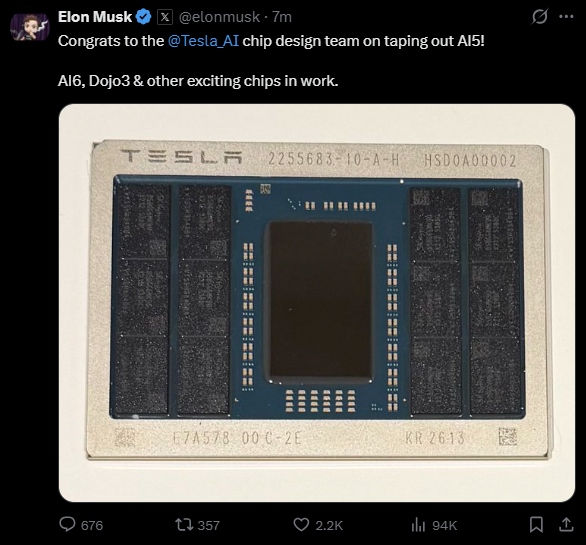
As the successor to the AI4 chip, AI5 will serve as the core computing power support for Tesla's autonomous driving and humanoid robot businesses.
According to disclosures, the performance of a single AI5 chip is comparable to Nvidia's Hopper architecture products, while a dual-chip configuration is closer to its Blackwell level, but with significantly lower costs and power consumption. The chip features substantial improvements in energy efficiency ratio, neural network processing capabilities, and data throughput speeds, which will effectively reduce the computing latency of autonomous driving models and enable faster decision-making reactions for vehicles in complex road conditions.
The completion of the tape-out signifies that the AI5 chip has transitioned from the design phase to actual production verification. Tesla's FSD team will soon be able to conduct model training and algorithm optimization based on the new computing platform, providing a technical foundation for higher-precision road recognition and smoother driving decisions.
Musk previously stated that certain metrics of the AI5 chip will improve by 40 times compared to the previous generation AI4, featuring 9 times the memory and 8 times the computing capacity. It is expected to become the optimal inference chip for models with parameters under 250 billion.
While AI5 is moving forward, the development of Tesla's more advanced AI6 chip has also been initiated. Last July, Tesla signed a long-term agreement worth $16.5 billion with Samsung Electronics, with Samsung responsible for the contract manufacturing of the AI6 chip.
The chip will further enhance performance, with the computing power of a single unit expected to double that of the AI5. It is primarily optimized for the edge computing needs of the Optimus humanoid robot and the Robotaxi autonomous taxi. According to plans, the AI6 chip is expected to complete its tape-out in December 2026 and achieve mass production in 2027.
In addition to AI5 and AI6, Tesla is also developing products such as the Dojo 3 supercomputer chip. Musk previously stated that Tesla's chip R&D cycle has been shortened to nine months.
Chip development is seen by Musk as a key to Tesla's future development. He has repeatedly emphasized that Tesla's core capabilities will rely entirely on self-developed chips. These technologies will not only improve autonomous driving safety but also create new value in fields such as healthcare through the Optimus robot.
Over the past year, Tesla's chip progress has repeatedly driven up the company's stock price, with the market pinning high hopes on the commercial value of its self-developed chip strategy.
Recommended Articles


