




US Dollar Index Price Forecast: Posts fresh three-week low near 101.45
- The US Dollar Index hits fresh three-week low near 101.45 amid weakness in US bond yields.
- US Treasury Yields are under pressure due to softening housing market conditions.
- Meta posts upbeat Q3 results, slightly raises guidance on AI spending.
The US Dollar (USD) underperforms its major peers due to easing United States (US) bond yields amid softening housing market conditions.
In the European trade on Thursday, the US Dollar Index (DXY), which gauges the Greenback’s value against six major currencies, posts a fresh three-week low near 101.45. 10-year US Treasury Yields are down 0.7% near 5.07%.
Soft US housing data underpins bid for duration
Analysts at Deutsche Bank highlight that the earlier decline in yields was "supported by soft housing data for September," pointing to a drop in housing starts of "‑5.2% vs +1.9% exp." alongside "a sharp slowing in pending home sales," where "their annual growth" has fallen "to its lowest since 2023 at ‑12.6% yoy." They note that this weaker housing backdrop has helped reinforce the modest bid for duration at the long end of the US curve.
Meanwhile, the narrative of concerns over Artificial Intelligence (AI)-growth concerns appears to be eroding as Meta has reiterated significant spending plans for AI infrastructure.
According to Deutsche Bank, analysts highlight that Meta shares rose by more than “+2% in after-hours trading,” after the company beat on Q3 revenue with “$64.6bn vs $63.3bn est.” and issued Q4 guidance “towards the upper end of expectations” at “$73-76bn vs $73.6bn est.” Deutsche Bank also notes that Meta “slightly boosted its 2026 capex plan from a $130bn-145bn range to $135bn-145bn,” underscoring its continued commitment to AI-related investment.
US Dollar Index Technical Analysis
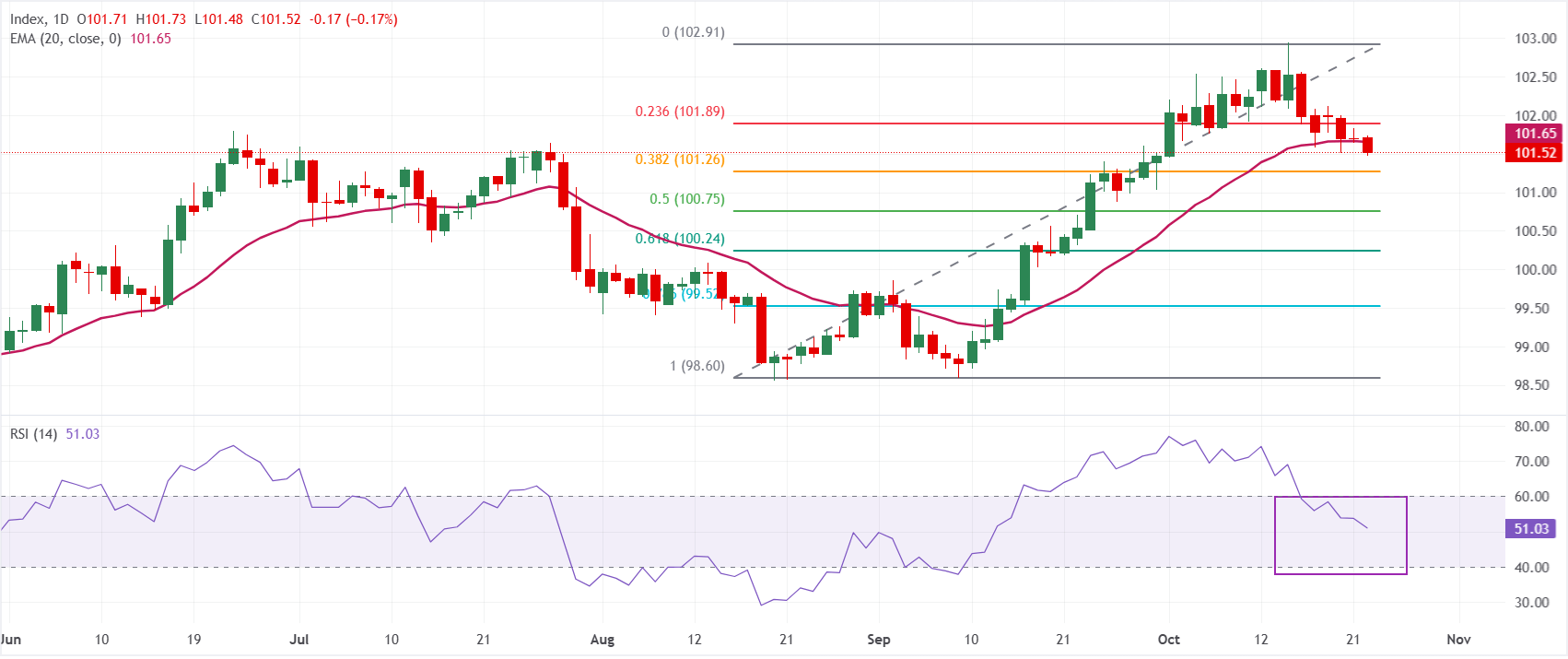
In the daily chart, Dollar Index Spot trades at 101.52. The near-term tone is neutral as price hovers just under the 20-day Exponential Moving Average (EMA) at 101.65 while holding above the 38.2% Fibonacci retracement at 101.26, suggesting consolidation after the recent advance. The Relative Strength Index (14) around 51 hints at a loss of directional conviction, with neither bulls nor bears currently in clear control.
On the topside, immediate resistance is seen at the 20-day EMA at 101.65, followed by the 23.6% Fibonacci retracement at 101.89; a sustained break above these barriers would open the way toward the recent swing high near the 0.0% retracement at 102.91. On the downside, initial support emerges at the 38.2% retracement at 101.26, with further floors at 100.75 and 100.24 (the 50.0% and 61.8% retracements), while deeper pullbacks would expose the 78.6% level at 99.52 and the base of the current Fibonacci span near 98.60.
(The technical analysis of this story was written with the help of an AI tool. Know more.)
US Dollar FAQs
The US Dollar (USD) is the official currency of the United States of America, and the ‘de facto’ currency of a significant number of other countries where it is found in circulation alongside local notes. It is the most heavily traded currency in the world, accounting for over 88% of all global foreign exchange turnover, or an average of $6.6 trillion in transactions per day, according to data from 2022. Following the second world war, the USD took over from the British Pound as the world’s reserve currency. For most of its history, the US Dollar was backed by Gold, until the Bretton Woods Agreement in 1971 when the Gold Standard went away.
The most important single factor impacting on the value of the US Dollar is monetary policy, which is shaped by the Federal Reserve (Fed). The Fed has two mandates: to achieve price stability (control inflation) and foster full employment. Its primary tool to achieve these two goals is by adjusting interest rates. When prices are rising too quickly and inflation is above the Fed’s 2% target, the Fed will raise rates, which helps the USD value. When inflation falls below 2% or the Unemployment Rate is too high, the Fed may lower interest rates, which weighs on the Greenback.
In extreme situations, the Federal Reserve can also print more Dollars and enact quantitative easing (QE). QE is the process by which the Fed substantially increases the flow of credit in a stuck financial system. It is a non-standard policy measure used when credit has dried up because banks will not lend to each other (out of the fear of counterparty default). It is a last resort when simply lowering interest rates is unlikely to achieve the necessary result. It was the Fed’s weapon of choice to combat the credit crunch that occurred during the Great Financial Crisis in 2008. It involves the Fed printing more Dollars and using them to buy US government bonds predominantly from financial institutions. QE usually leads to a weaker US Dollar.
Quantitative tightening (QT) is the reverse process whereby the Federal Reserve stops buying bonds from financial institutions and does not reinvest the principal from the bonds it holds maturing in new purchases. It is usually positive for the US Dollar.
Recommended Articles


