




Best AI Voice Agent Platforms in 2026: 8 Options for Builders and Businesses
Voice AI services have accelerated since 2022, drawing in a new wave of VC money. AI spending on voice agents rose from $315M in 2022 to $2.1B in 2024, a 7X increase. Amazon Ring has already hand-picked one of the voice-agent startups to expand its product.
AI voice services also turn into an arena for technological challenges, such as implementing languages and achieving viable response times for smooth conversations. A Wired investigation also looked into agentic behaviors and the problem of bots claiming to be human.
This feature, or rather flaw, could create problems with disclosure regulations and communication laws. Our guide will build an honest comparison of platforms for the creation of AI voice agents and their potential use cases.
Quick Comparison
| Platform | Type | Real price per minute, all expenses | Model flexibility | Latency (self-reported) | HIPAA path | Entry point |
| Retell AI | Dev platform | ~$0.13 – $0.31/min
(0.07 base + STT/TTS + LLM + telephony) |
BYO everything | ~600 ms | Free BAA | Free credits ($10 trial) |
| Vapi | Dev platform | ~$0.15 – $0.33/min
(0.05 platform fee + STT + LLM + TTS + telephony) |
BYO everything | ~450 – 800 ms | Enterprise only (or ~$1k/mo tier) | Free credits ($10 trial) |
| ElevenLabs Agents | Dev platform | ~$0.08 – $0.20+/min
(0.08/min agent engine + LLM/telephony usage) |
Partial | ~300 – 500 ms | Enterprise only | Free credits / $6/mo |
| Bland | Dev platform | ~$0.11 – $0.15+/min
(0.11-0.14 connected rate + call attempt fees + telephony) |
Bundled stack | ~400 ms | Free BAA | Free credits |
| Synthflow | No-code | ~$0.13 – $0.23/min
(0.09 voice engine + LLM + telephony + routing add-ons) |
Partial | ~500 – 600 ms | Enterprise only | Free credits (Trial minutes) |
| Pipecat | Open source | ~$0.04 – $0.10/min
(Raw component costs only; zero platform markup) |
BYO everything | ~300 – 500 ms | Free BAA (Self-hosted/Infra) | Free credits (Open source) |
| PolyAI | Enterprise service | ~$0.50 – $1.50+/min equivalent
(~$150k+/yr custom contracts) |
Bundled stack | ~500 – 1000 ms | Enterprise only | Sales call |
| Sierra | Enterprise service | ~$0.50 – $1.50+/min equivalent
(Outcome-based pricing; ~$150k+/yr contract) |
Partial | ~500 – 800 ms | Enterprise only | Sales call |
How to Choose a Voice Agent Platform
When looking for a voice agent platform, transparency and clear comparison are the best tools. Approaches to voice agents differ, as the field is still in its rapid growth stage. As a result, not all platforms offer the same mix of workflows and have differing pricing structures.
We also broke down the pricing structure of each AI voice agent platform, including the real final price with both AI and telephony expenses included. We will break down our methodology in assessing each AI voice platform.
The real cost per minute
The total cost of building a voice agent may include multiple components. The first one is the platform fee, differing for each AI voice agent environment.
The additional usage of a specific LLM will add to the final cost. Text-to-speech technology itself may add to the total bundle.
Finally, telephony services make up the final price of running an AI voice agent.
Model flexibility
Before choosing an AI voice agent, the question to ask is how flexible the model is. Some platforms use a buy-your-own (BYO) approach to onboarding the preferred LLM. Other platforms offer a bundle subscription, limiting the end user to a pre-selected LLM. A low-cost platform may end up costing more if there are additional requirements to supply an LLM subscription.
Latency and interruption handling
Latency numbers are usually self-reported by platforms. However, the number presented is often the product of perfect or unrealistic conditions.
Each AI voice agent runs on a multi-layered system, operating under variable real-world conditions. Internet connection, telephony lag, and the workflow of conversations may end up with a result that is nowhere near the claims of minimal latency.
As a result, the latency claims of platforms are not neatly comparable. A workflow handles incoming audio, speech-to-text, LLM reasoning, text-to-speech, and the agent’s audio output. Platforms often take one step of the pathway and assign a latency score, while disregarding the rest of the pipeline.
Compliance
The number one goal of AI voice agents is to integrate into seamless conversational workflows. Country-specific or regional privacy laws may not be compatible with every AI voice agent workflow.
In the most general case, the handling of conversations may fall under the SOC 2 (System and Organization Controls 2) standard. This is a voluntary framework created by the American Institute of CPAs. The criteria for a Trust Service include five points on data: security, availability, processing integrity, Confidentiality, and privacy.
A stricter requirement is linked to HIPAA (Health Insurance Portability and Accountability Act), which ensures technology does not lead to the loss of privacy. HIPAA is a mandatory federal law in the USA, meaning any AI voice agent will have to work compliance into its stack. The difference may be in the thousands of dollars, mostly for the cost of add-ons. In this case, the basic price of an AI voice agent platform may be misleading.
Build vs. buy vs. open source
The end goal of using an AI voice agent may be linked to business processes or to experimentation and optimization. One of the decisions on picking the best AI voice agent platform is to go with a building process, buying a ready-made stack, or an open-source, non-commercial solution. Below, we will discuss the details of each platform’s approach.
Building the AI voice agent from scratch may take months, the biggest setback for a team. The advantages are full control of the data and the opportunity for built-in compliance. Teams may meet unexpected challenges with telephony or optimize some of the elements in the response stack.
Buying a solution saves time, as an AI voice agent may be ready within days. The biggest advantage is the lower engineering effort and the potential for turnkey solutions. The setback of those solutions would be the costs, which are sold to the AI agent deployer at a markup. A ready-made solution will require less fine-tuning, but the deployer will be constrained by the platform’s decisions.
The choice between a self-built and a ready-made platform may be reflected in the final per-minute price of using the AI voice agent. The team must estimate which elements of the response stack are the most difficult to engineer from scratch, and if any platform offers a turnkey solution that is also economically viable.
The third option is an open-source platform, which takes a different approach to managing the entire stack of voice AI connection. Open-source projects customize real-time audio streams and solve the hard problem of turn-taking and latency.
Platforms like Pipecat manage media in real time, cutting the time of moving between speech, text, LLM, and synthesized speech. Those platforms also offer instant audio interruption when the user starts speaking. Open-source platforms require expertise and engineering effort, but propose a more streamlined approach to AI voice agents.
The 8 Best AI Voice Agent Platforms in 2026
We selected the eight best AI voice agent platforms as of 2026, spanning multiple launch models and pricing packages. Below, we will analyze each platform based on its strengths and weaknesses.
1. Retell AI – transparent pricing, compliance without the enterprise gate
Retell AI is one of the startups boosted by Y Combinator in 2024, raising $5.1M in seed capital. The platform reports $40M in monthly calls and a return of $40M annually.
Retell AI offers a drag-and-drop builder, with enough advanced tools for hands-on developers. Based on its response stack, Retell AI self-reports 600 ms latency.
Retell AI offers teams to go live with as low as $10 in setup fees, and a pay-as-you-go model. The platform offers $0.07 to $0.031 for voice chats, and $0.002 per message for chat AI agents. The total stack includes $0.055 per minute for infrastructure fees, text-to-speech at $0.015 to $0.04 per minute, and LLM usage at $0.001 to $0.14. Telephony is another $0.015 per minute.
Teams can select their own LLM, including GPT-4.1, Claude, and Gemini, each listed at a per-minute rate.
Retell AI is notable for being able to handle privacy regulations like SOC 2 and HIPAA on a pay-as-you-go model, with no contract needed. This makes Retell AI one of the cheapest regulated options, as privacy tools can run up a significant monthly bill.
The pros of Retell AI include flexibility to pick an AI LLM, as well as shift between hands-on and turnkey solutions. The building of a conversation workflow is visualized, removing the confusion and chaos of handling the shift between all the steps in the response process.
Retell AI is limited to 20 concurrent calls, and any subsequent calls will be queued with a waiting period of 40 seconds. This makes Retell AI more unpredictable at scale, as waiting times or clients abandoning the call may not be viable for businesses.
2. Vapi — the developer ecosystem leader
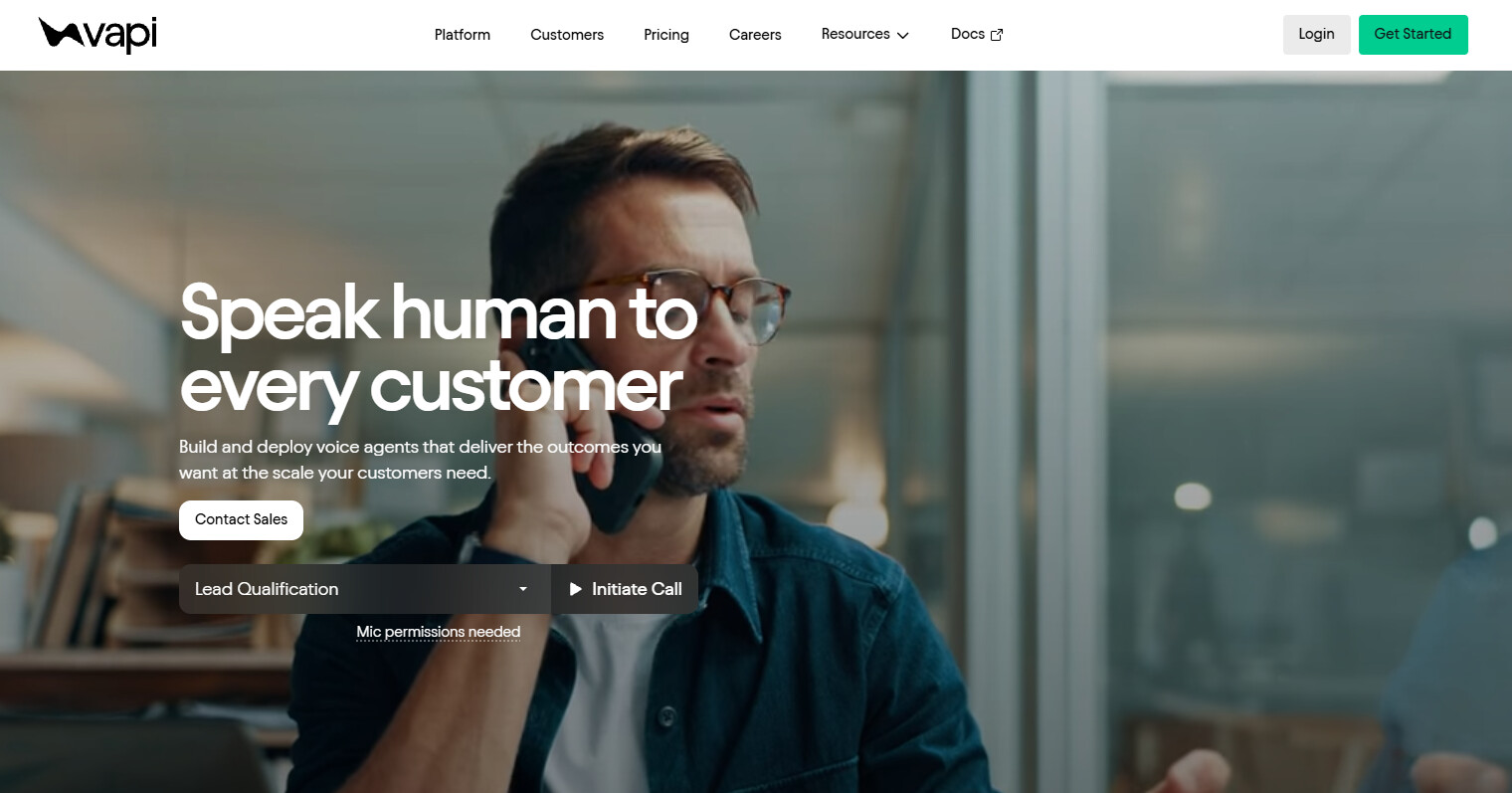
Vapi promises the creation of advanced voice agents, advertising its tools to customize and improve AI voice agents. Vapi is supported by a $50M Series B raise, led by Peak XV, reaching a $500M valuation.
The Vapi platform stands out as the winner of the Amazon Ring competition, getting ahead of 40 rivals. The company already claims over 1B handled calls and a user base of 750K developers.
For developer teams, Vapi offers a fully modular service, where each element of the response workflow is optional. Vapi supports dozens of providers for STT, LLM, and TTS. API keys are on a buy-your-own basis with no markup.
On Vapi, teams can control multiple agents through the ‘Squads’ technology. The platform self-reports under 600 ms in latency.
The platform offers stacked pricing, with a $0.05 per minute fee to consolidate all selected tools. Builders could also choose to buy their own keys, in which case the $0.05 per minute fee applies. Teams could also choose to pay Vapi for a package of STT, LLM, and TTS, which will include a platform fee.
Telephony through Twilio, Telnyx or other services is between $0.005 and $0.02 per minute. STT ranges between $0.005 and $0.02 per minute, while TTS is $0.02 to $0.15 per minute. LLM reasoning with OpenAI, Claude, Gemini or Llama is at $0.01 to $0.06 per minute. This pricing is for 10 concurrent calls.
To remain compliant, Vapi requires an additional HIPAA tool for $2,000 per month and an additional $1,000 per month for zero-data-retention. For healthcare and wellness businesses, this cliff could inflate the bottom line.
The pros of Vapi include the ability to customize every step. The platform is prominent and has proven its influence as the tool selected by Amazon Ring.
Cons include high technical requirements for building an AI voice agent. The platform does not offer visualization tools, and may not be suitable for beginners looking for turnkey solutions.
3. ElevenLabs Agents – best voices, most languages, cheapest entry
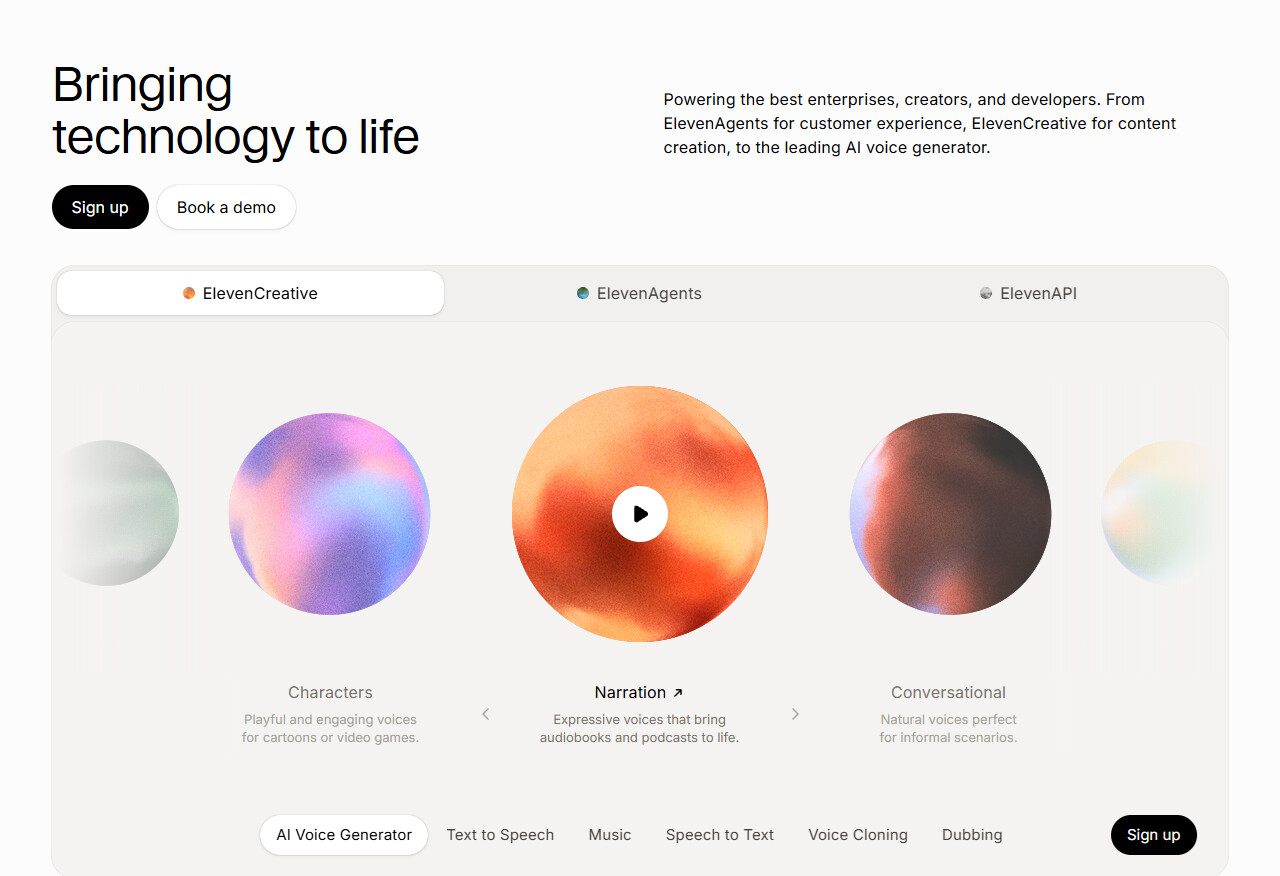
ElevenLabs aims to build a platform for ultra-realistic speech and sound effects. This AI voice agent generator is reportedly the source of the best simulated voices, with a vaster array of languages. ElevenLabs also targets creators and enterprises with the cheapest entry in the industry.
ElevenLabs closed a $180M Series C financing, with a total valuation of $3.3B as of January 2025. The funding round was led by a16z and ICONIQ. The platform reports over 250K agents created in the first months after its launch. Eleven Labs clients include Twilio, Cisco, Revolut, and Klarna.
The edge of ElevenLabs is its best-in-class native TTS solution, with over 70 languages. The platform works with any LLM, and multiple communication channels beyond telephony – web, WhatsApp, SMS.
ElevenLabs offers a minimal-tier free access with three projects and 10,000 AI credits. Low-cost packages include a starter subscription at $6 and a creator subscription for $22 per month, with a $99 per month for pro tier. The platform is one of the most accessible for creating low-cost agents. Scale tier is at $299 per month, business level at $990 per month, and enterprise-tier subscription with custom pricing.
Per-minute pricing is more complicated, with $0.08 per minute for LLM and telephony. While fixed costs are relatively low, paid plans have a limited bundle of agent minutes. After that, the standard usage rate turns on, with $0.16 per minute for periods of peak usage.
The platform allows for SOC 2 II compliance, ISO 27001, HIPAA, and PCI L1, but only for the Enterprise package.
The pros of ElevenLabs include the low entry point for creating functional AI agents. ElevenLabs also targets multiple user profiles, from beginner creators to business and scaling clients.
The cons include the rapidly rising expenses for additional per-minute costs. ElevenLabs can carry enterprise applications, game development, or high-capacity real-time AI agents, but with quickly rising API character charges and per-minute costs.
4. Bland – bundled flat pricing on owned infrastructure
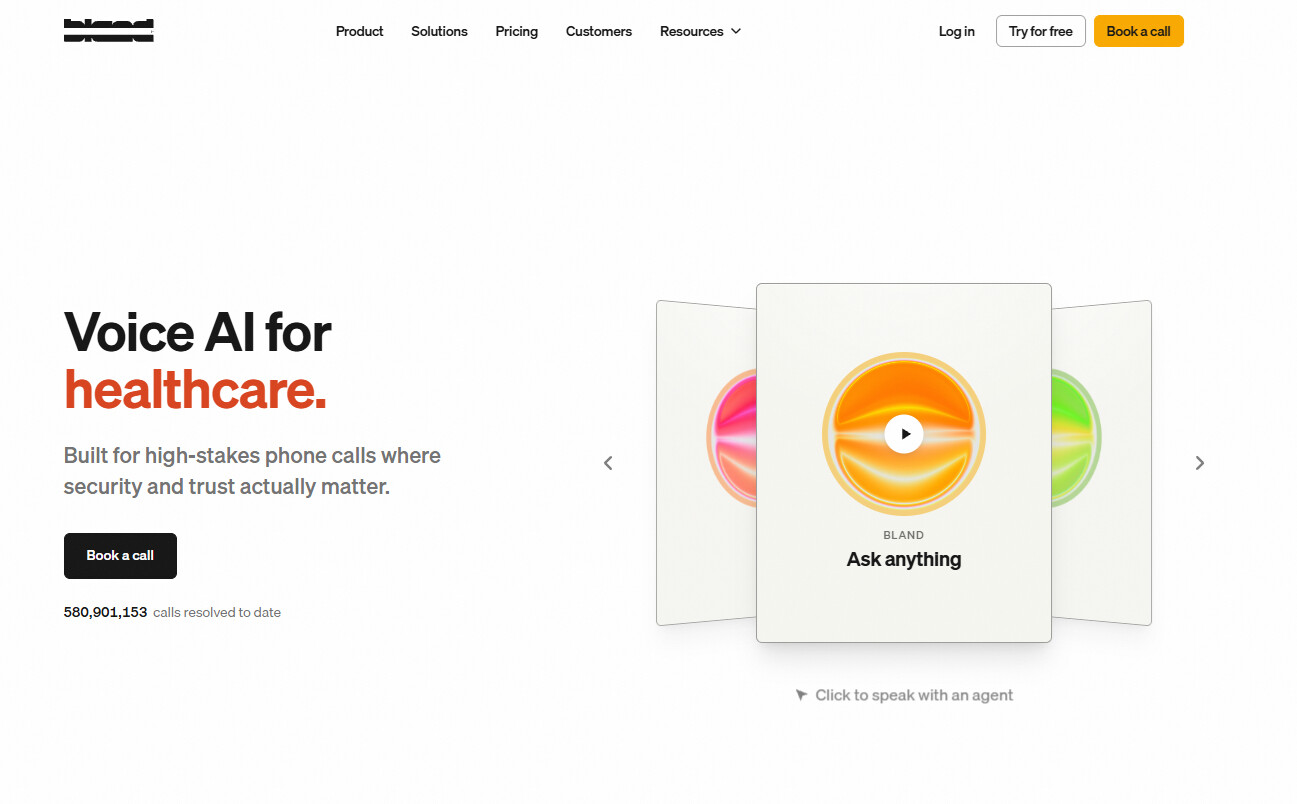
Bland advertises its platform as a tool for high-stakes conversation, where confidentiality and data safety are key. The platform offers enterprise-grade phone-call infrastructure, with a proprietary self-hosted stack. This also means Bland does not work with third-party models.
Bland has surpassed $100M in funding, after closing a Series C round for another $50M. The platform claims over 558M calls resolved. The platform claims below 400ms latency for its calls, mostly attributed to its proprietary system.
What differentiates Bland from other AI voice agent platforms is the bundled all-inclusive pricing per minute. Clients receive one number, with no additional token usage charges. Plans start on a per-minute basis, with $0.14 for the base free plan. Build subscription costs $299 per month, with a bundled price of $0.12 per minute. Scale tier is $499 per month and $0.11 per minute. Enterprise tier can achieve prices as low as $0.09 per minute.
The Bland solution includes eligibility for SOC 2 and HIPAA regulations, as well as the cardholder and transaction handler standard PCI DSS v4.0.
Despite the regulation claims, Bland’s AI agent lied that it was human, reported Wired in June 2024. The AI agent could be programmed to lie and deny being a bot, and in one case the agent posed as a pediatric dermatology office, asking a hypothetical 14-year-old patient to upload photos. Bland stated it would build its platform so nothing unethical happened through the usage of AI agents.
The pros of Bland include pricing predictability, strong compliance potential, and good voice realism with reported low latency.
Bland has some setbacks, as it targets highly technical teams. Smaller teams and lower tiers may have inconsistent support. Bland is also heavily leaning into telephony, neglecting other AI agent communication channels.
5. Synthflow – the no-code and agency pick
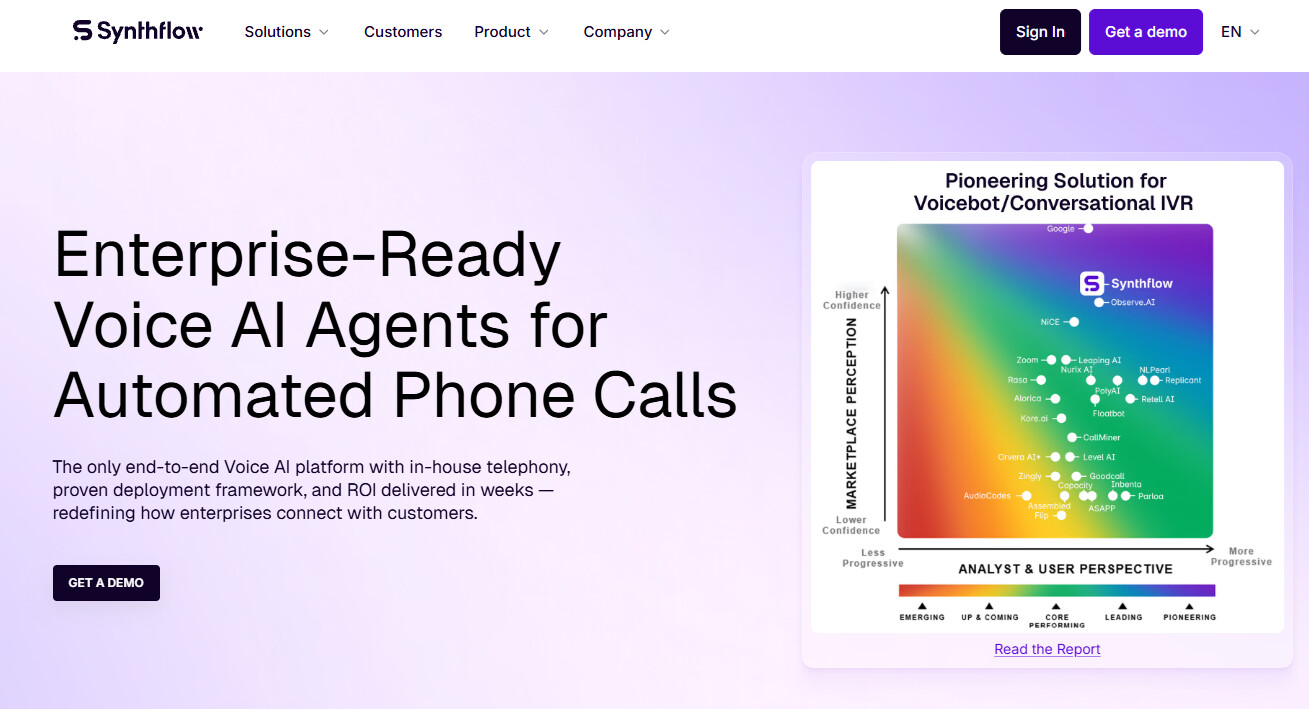
Synthflow is a no-code platform that places agencies and small businesses as its priority. Synthflow claims 65M calls per month.
In 2025, Synthflow raised $20M in Series A funding, led by Accel. In terms of funding and activity, Synthflow is a smaller-scale platform, but has the advantage of targeting the needs of agencies.
Synthflow offers one of the few true no-code paths in the AI voice agent industry. The packages are also offered as white-label services. Synthflow is tailored to EU-based hosting and is compliant with ISO 27001, giving it an edge for European buyers.
Synthflow offers a variable usage-based payment model, including call minutes and AI components. The platform retired its legacy plans and switched to a pay-as-you-go plan for new accounts. The platform has retired the previous Starter, Pro, Growth, and Agency plans.
In 2026, Synthflow has $0 per month platform fees, while per-minute costs range between $0.09 and $0.11. For smaller customers, pricing adds $0.09 per minute for the voice agent and adds LLM and telephony fees. A five-minute call can be around $0.65, and the price per minute with added features runs between $0.13 and $0.24, based on third-party reviews. Enterprise contracts are priced at around $30,000 per year.
The main advantage of Synthflow is a fully visual building process, with a drag-and-drop builder. This allows agencies to deploy AI agents quickly. The platform also offers native integrations with other platforms like Make.com, Zapier, HubSpot, Stripe, and Google Calendar. Synthflow has built-in tools for webhooks, FTP, and SMTP with no additional setup.
Cons include reports of latency spikes and talk-over failures. According to G2 reviews, users report spiking expenses, a learning curve before deploying an agent, and missing advanced features.
6. Pipecat (Daily) – the open-source route
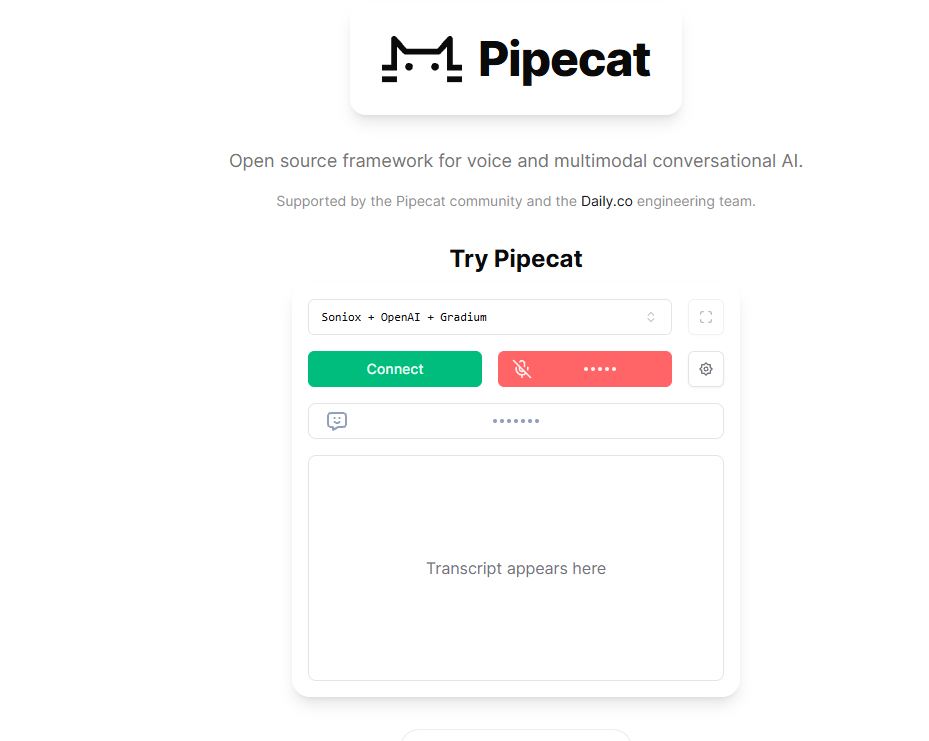
Pipecat, launched and supported by the Daily co., brings AI agent tools as an open-source platform. Pipecat’s product is distributed under a BSD license, offering an open Python framework.
Pipecat earned 13.6K GitHub stars, recently launching v1.5.0, as of July 2026. The platform allows the selection and onboarding of 20 STT services, more than 25 LLMs, and more than 30 TTS providers. Telephony is available through Twilio, Vonage, Telnyx, and more. Pipecat offers integration with both PSTN and SIP telephony.
This allows for thousands of user-selected combinations, all with a zero platform fee and no lock-in payment.
By using Pipecat, teams only pay the providers directly and can use any LLM, including local models. This approach requires strong technical teams, but is open to experiments and exploration for early AI agent builders.
For enterprises, Pipecat Cloud offers a managed option. In case of communication requirements, the managed option offers access to HIPAA and GDPR tools. The enterprise package has varying costs, including per-minute charges, but Pipecat offers a transparent breakdown of all included services.
The pros of Pipecat are low costs and direct access to building the right combination of tools for each team’s goals. Pipecat offers a curated option through the paid Pipecat Cloud.
The main cons include the need to test latency for each new project. This may increase complexity and worsen problems with interruption and talking over. Python engineering is required for all launch levels, both free and paid.
7. PolyAI – enterprise contact centers
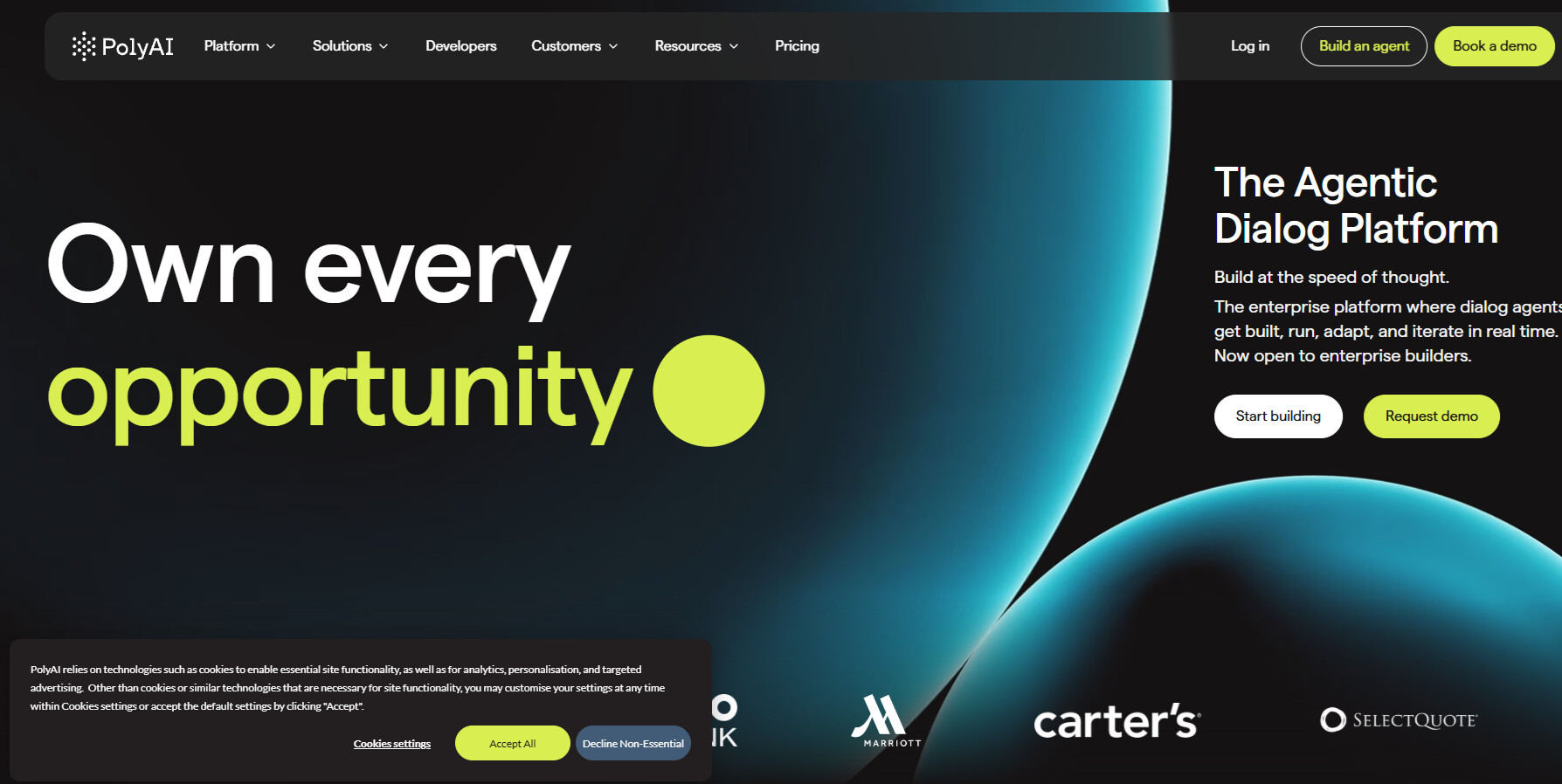
PolyAI focuses on building dialog agents for multiple platforms, recently opening up to enterprise clients. The platform built an enterprise center in London, focusing on voice AI. PolyAI was launched back in 2017, as a spin-off from the Dialogue Systems Group, founded at the University of Cambridge. The platform’s main goal is to achieve seamless conversational voice communication, as well as high-quality understanding and AI reasoning.
At the end of 2025, PolyAI raised $86M in a Series D round, led by Georgian, Hedosophia, Khosla, as well as Nvidia’s NVVentures, Citi, and Zendesk Ventures. The funding will be used to boost research and increase the AI voice quality.
PolyAI claims to serve more than 100 enterprises, with over 2,000 live deployments in 45 languages, covering 25 national markets. PolyAI claims PG&E, Golden Nugget, Simplyhealth, and Unicredit among its customers.
Among the advantages of PolyAI is the proprietary Raven model, trained on over 1B enterprise conversations. This makes up the biggest advantage for PolyAI. Its conversational realism and readiness to serve in a contemporary business environment.
The services operate on a custom, contract-based pricing mechanism. There is no self-serve or free option, and the platform mostly serves enterprise-level clients. The platform is not for builders or content creators, but rather tailored to serve contact centers. Some of the contracts run up to $150K per year.
The pros of PolyAI include a high level of curation and quality fit for big clients. The main cons are the need for a custom contract and few testing opportunities.
8. Sierra – outcome-priced agents at the high end

Sierra AI specializes in customer-facing AI voice agents, with a view of serving enterprise clients. The company was launched in 2023, co-founded by Bret Taylor, board chairman at OpenAI and former co-CEO of Salesforce and CTO of Meta. Clay Bavor came in from Google, bringing Sierra up as one of the most prominent players in the market for AI agents.
Sierra does not aim for the creation of experimental or generic AI bots. Instead, the platform focuses on branded, high-quality voice services, as well as enterprise-grade email agents. Some of the agents can also execute trusted, complex backend tasks, such as processing refunds, reservations, or even handling user account details.
Sierra offers outcome-based pricing, based on resolved conversations. To achieve this detailed pricing model, Sierra offers custom contracts with negotiated pricing. Sierra is transparent about its pricing structure, but has not shared its contract ranges. Estimates vary between $150,000 and $750,000. At this price range, agents execute real actions, including PCI-compliant payments.
Sierra offers services at the highest price range of AI agent platforms. Tailor has spoken of outcome-based pricing as the future of AI agent workflows, focusing on the much lower price compared to human responses and resolutions.
The pros of Sierra AI include agents with multiple roles within an organization. The cons include the need for an enterprise contract and the lack of more generic agent options.
The Rules: Do AI Voice Agents Have to Disclose They’re AI?
Rulings on robocalls and automation vary based on jurisdictions. For the US market, the FCC ruling from February 2024 restricts robocalls and robotexts without the prior express consent of the called party. The case of Bland reveals that breakouts are possible, as Wired investigated the case of an AI agent impersonating a human without revealing its AI identity.
As a result, selecting a voice AI agent may require the option to offer workflows that explicitly point out the caller is an AI. Those services may burden the bottom line for teams, as compliance add-ons may run to thousands of dollars per month. Higher-tier contracts or subscriptions usually have built-in privacy tools.
What Still Breaks
AI voice agents on the current market are still building up their quality. The main problems include latency spikes, talk-overs, and failures in LLM reasoning or hallucination. Clearing out those flaws may lead to an even bigger cost burden for AI agent deployers.
Final Verdict: Match the Platform to Your Team, Not the Demo
Almost all AI agent platforms offer a hypothetical case or a demo for their products. In this guide, we presented a set of objective metrics to estimate which platform is the best for a team’s purposes.
The best approach is to match the platform to the team’s strengths. A highly technical team may be able to handle open-source solutions or be able to set up the code for custom agents.
Costs are another big issue, so we tried our best to offer the latest pricing information. The prices proposed do not always reflect all costs related to launching an AI agent. With per-minute pricing, some workflows can end up racking a higher-than-expected monthly bill. Some agents offer low entry points, but with no ceiling on spending for all the elements of a conversation workflow.
Platforms also focus on different needs, ranging from creators to medium or large enterprises. Each platform’s profile will help select the best AI agent platform for the team’s needs.
Recommended Articles


