




EUR/USD Price Forecast: Sideways likely till it holds key support level of 1.0880
- EUR/USD consolidates near 1.0980 while entering into the weekend.
- Both the Fed and the ECB are expected to hike interest rates in December.
- Next week, key triggers would be the Eurozone flash HICP and the US NFP data for November.
The Euro (EUR) turns sideways against the US Dollar (USD) after recovering from the key support level of 1.0881. In the early European trade on Friday, the EUR/USD pair is almost flat at around 1.0980.
The major currency pair will likely remain in a tight range amid a light United States (US)/Eurozone economic calendar during the day.
Next week, key triggers for the major currency pair would be a string of US data, notably Nonfarm Payrolls (NFP) report for November, and the Eurozone preliminary Harmonized Index of Consumer Prices (HICP) data.
Meanwhile, both the Federal Reserve (Fed) and the European Central Bank (ECB) are expected to raise interest rates in their December policy meeting.
The CME FedWatch tool also shows a 68% chance that the Fed will hike interest rates in the January policy meeting.
EUR/USD Technical Analysis
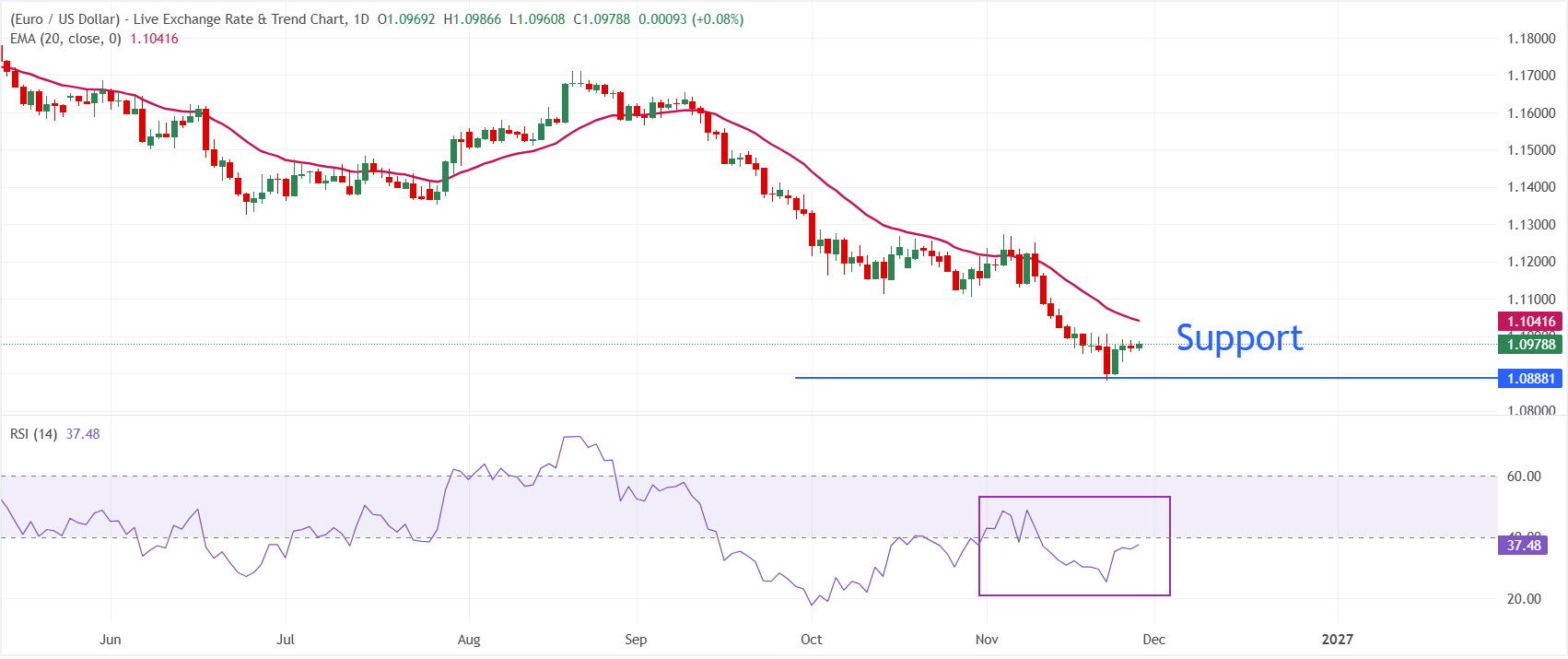
In the daily chart, EUR/USD trades at 1.0979. The pair maintains a bearish near-term bias as it holds beneath the 20-day exponential moving average (EMA), which comes in at 1.1042 and acts as immediate overhead resistance, reinforcing the notion of a capped recovery. The Relative Strength Index (RSI) at 37 stays below the neutral 50 line, hinting at lingering downside pressure even as oversold conditions are not yet extreme.
On the topside, initial resistance is defined by the 20-day EMA at 1.1042, and a daily close above this barrier would be needed to ease the bearish tone and allow for a more sustained corrective bounce. Looking down, the November 23 low at 1.0881 is the key support level.
Strategists at UOB Group note that, after holding a negative view on the Euro for around two weeks, they “revised our view to neutral yesterday (26 Nov, spot at 1.0975).” They explain that “the decline in EUR has stabilised” and that the currency “has likely entered a range-trading phase between 1.0920 and 1.1040.” UOB adds that “there is no change in our view,” reinforcing the expectation that EUR/USD will remain confined to this consolidation band over the coming 1–3 weeks.
(The technical analysis of this story was written with the help of an AI tool. Know more.)
Central banks FAQs
Central Banks have a key mandate which is making sure that there is price stability in a country or region. Economies are constantly facing inflation or deflation when prices for certain goods and services are fluctuating. Constant rising prices for the same goods means inflation, constant lowered prices for the same goods means deflation. It is the task of the central bank to keep the demand in line by tweaking its policy rate. For the biggest central banks like the US Federal Reserve (Fed), the European Central Bank (ECB) or the Bank of England (BoE), the mandate is to keep inflation close to 2%.
A central bank has one important tool at its disposal to get inflation higher or lower, and that is by tweaking its benchmark policy rate, commonly known as interest rate. On pre-communicated moments, the central bank will issue a statement with its policy rate and provide additional reasoning on why it is either remaining or changing (cutting or hiking) it. Local banks will adjust their savings and lending rates accordingly, which in turn will make it either harder or easier for people to earn on their savings or for companies to take out loans and make investments in their businesses. When the central bank hikes interest rates substantially, this is called monetary tightening. When it is cutting its benchmark rate, it is called monetary easing.
A central bank is often politically independent. Members of the central bank policy board are passing through a series of panels and hearings before being appointed to a policy board seat. Each member in that board often has a certain conviction on how the central bank should control inflation and the subsequent monetary policy. Members that want a very loose monetary policy, with low rates and cheap lending, to boost the economy substantially while being content to see inflation slightly above 2%, are called ‘doves’. Members that rather want to see higher rates to reward savings and want to keep a lit on inflation at all time are called ‘hawks’ and will not rest until inflation is at or just below 2%.
Normally, there is a chairman or president who leads each meeting, needs to create a consensus between the hawks or doves and has his or her final say when it would come down to a vote split to avoid a 50-50 tie on whether the current policy should be adjusted. The chairman will deliver speeches which often can be followed live, where the current monetary stance and outlook is being communicated. A central bank will try to push forward its monetary policy without triggering violent swings in rates, equities, or its currency. All members of the central bank will channel their stance toward the markets in advance of a policy meeting event. A few days before a policy meeting takes place until the new policy has been communicated, members are forbidden to talk publicly. This is called the blackout period.
Recommended Articles


