




Euro rebounds from a 19-month low before ECB minutes and US inflation
- EUR/USD rebounds from just under 1.0900, its lowest since April 2025.
- Dollar Index gives back its Monday gain as doubts about AI stocks return.
- ECB's October meeting account is due Thursday, after US PCE on Wednesday.
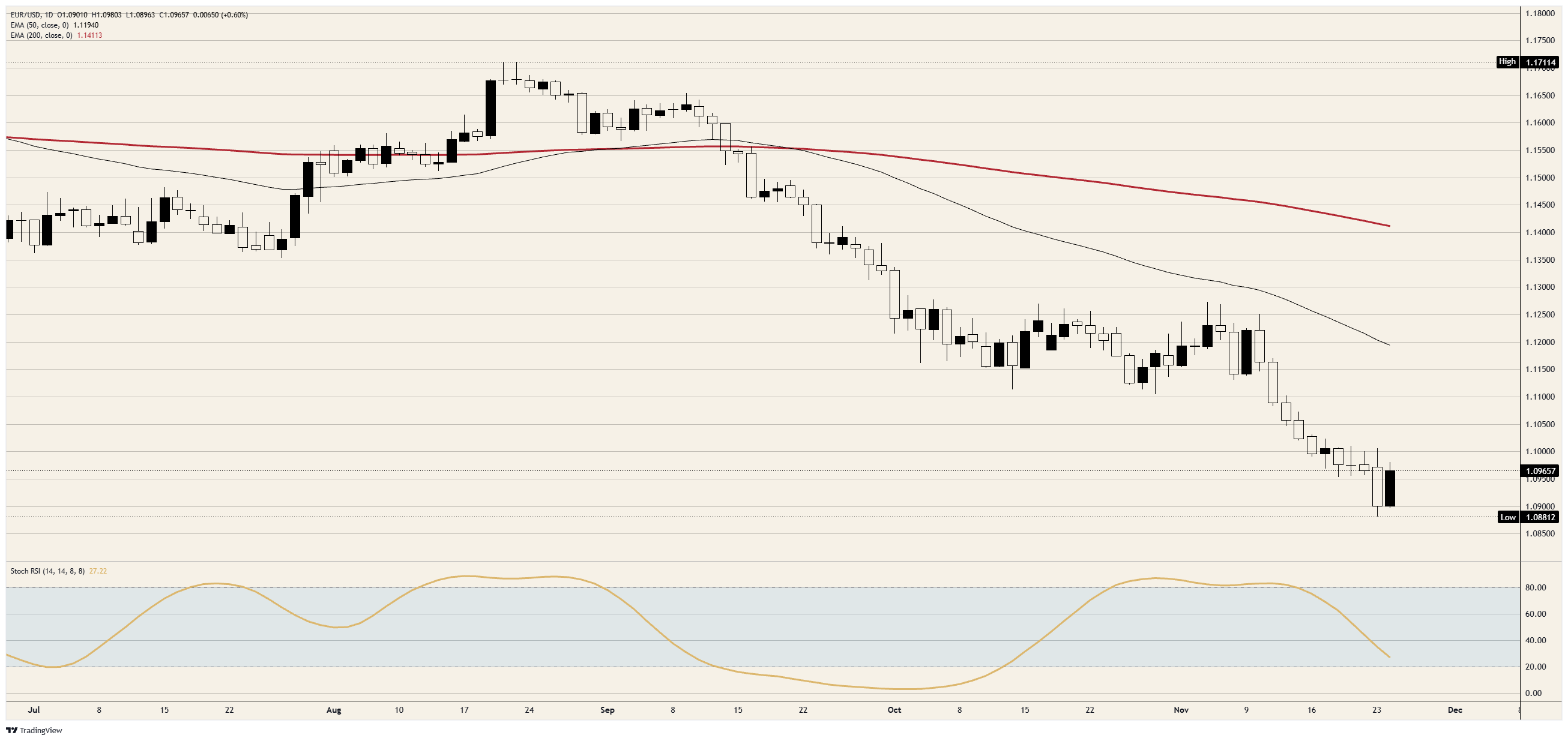
The Dollar Index has given back nearly all of Monday's rise to its highest since April 2025, and the Euro has come off a 19-month low with it. EUR/USD fell to just under 1.0900 before turning higher. It's now trading just above 1.0950 after stalling short of 1.1000.
Nvidia (NVDA) brought back Chief Executive Huang, which lifted US stocks and the Dollar on Monday. That faded as Nvidia and other artificial intelligence (AI) shares fell again, which took the Dollar down and the Euro up. The Fed's December 9 hike is still more than 95% priced, so the rate gap that pushed the Euro to its low hasn't narrowed.
Euro-area business activity was broadly unchanged in November, and France's contraction deepened as its political and budget disputes continued. Markets are pricing in two more quarter-point European Central Bank (ECB) hikes by March 2027 after two this year, which hasn't lifted the Euro while US rates are higher and the Fed is priced to move first. German private-sector activity grew at its fastest pace since 2022 in November, the month the Euro fell to its lowest in 19 months.
On the calendar
The US figures come first: the October Personal Consumption Expenditures Price Index (PCE) and a revised third-quarter Gross Domestic Product (GDP) reading are out at 13:30 GMT on Wednesday, a day before Thanksgiving shuts US markets. Both feed pricing for the Fed's meetings in December and January.
The ECB's account of its October 29 meeting is due at 12:30 GMT on Thursday, and flash November inflation figures for France and Spain follow on Friday. ECB President Lagarde said on November 7 that she couldn't promise a hike on December 17, and both releases feed pricing for that decision.
On the charts
The Euro is about 9% below its January high, just under 1.2100, and about 200 pips below the 1.1100 level that held as a floor for six weeks through November 11. The 50-day Exponential Moving Average (EMA) is just under 1.1200 and the 200-day is just above 1.1400. The shorter average has been below the longer one since mid-September.
EUR/USD daily chart
Euro FAQs
The Euro is the currency for the 20 European Union countries that belong to the Eurozone. It is the second most heavily traded currency in the world behind the US Dollar. In 2022, it accounted for 31% of all foreign exchange transactions, with an average daily turnover of over $2.2 trillion a day. EUR/USD is the most heavily traded currency pair in the world, accounting for an estimated 30% off all transactions, followed by EUR/JPY (4%), EUR/GBP (3%) and EUR/AUD (2%).
The European Central Bank (ECB) in Frankfurt, Germany, is the reserve bank for the Eurozone. The ECB sets interest rates and manages monetary policy. The ECB’s primary mandate is to maintain price stability, which means either controlling inflation or stimulating growth. Its primary tool is the raising or lowering of interest rates. Relatively high interest rates – or the expectation of higher rates – will usually benefit the Euro and vice versa. The ECB Governing Council makes monetary policy decisions at meetings held eight times a year. Decisions are made by heads of the Eurozone national banks and six permanent members, including the President of the ECB, Christine Lagarde.
Eurozone inflation data, measured by the Harmonized Index of Consumer Prices (HICP), is an important econometric for the Euro. If inflation rises more than expected, especially if above the ECB’s 2% target, it obliges the ECB to raise interest rates to bring it back under control. Relatively high interest rates compared to its counterparts will usually benefit the Euro, as it makes the region more attractive as a place for global investors to park their money.
Data releases gauge the health of the economy and can impact on the Euro. Indicators such as GDP, Manufacturing and Services PMIs, employment, and consumer sentiment surveys can all influence the direction of the single currency. A strong economy is good for the Euro. Not only does it attract more foreign investment but it may encourage the ECB to put up interest rates, which will directly strengthen the Euro. Otherwise, if economic data is weak, the Euro is likely to fall. Economic data for the four largest economies in the euro area (Germany, France, Italy and Spain) are especially significant, as they account for 75% of the Eurozone’s economy.
Another significant data release for the Euro is the Trade Balance. This indicator measures the difference between what a country earns from its exports and what it spends on imports over a given period. If a country produces highly sought after exports then its currency will gain in value purely from the extra demand created from foreign buyers seeking to purchase these goods. Therefore, a positive net Trade Balance strengthens a currency and vice versa for a negative balance.
Recommended Articles


