




USD/JPY Price Forecast: Strives to return above 20-day EMA
- USD/JPY extends upside to near 157.80 as the Japanese Yen underperforms.
- Both the Fed and the BoJ are expected to hold interest rates steady this week.
- The BoJ is expected to hike interest rates in the December policy meeting.
The Japanese Yen (JPY) continues to underperforms its peers amid caution ahead of the Bank of Japan’s (BoJ) monetary policy announcement on Friday. In the European trade on Tuesday, the US Dollar (USD) is up 0.22% at around 157.80 against the Japanese currency.
Japanese Yen Price Today
The table below shows the percentage change of Japanese Yen (JPY) against listed major currencies today. Japanese Yen was the weakest against the New Zealand Dollar.
| USD | EUR | GBP | JPY | CAD | AUD | NZD | CHF | |
|---|---|---|---|---|---|---|---|---|
| USD | 0.13% | 0.14% | 0.19% | 0.07% | 0.01% | -0.17% | 0.06% | |
| EUR | -0.13% | 0.00% | 0.07% | -0.04% | -0.12% | -0.31% | -0.07% | |
| GBP | -0.14% | -0.01% | 0.06% | -0.07% | -0.12% | -0.31% | -0.07% | |
| JPY | -0.19% | -0.07% | -0.06% | -0.13% | -0.19% | -0.37% | -0.15% | |
| CAD | -0.07% | 0.04% | 0.07% | 0.13% | -0.05% | -0.24% | -0.01% | |
| AUD | -0.01% | 0.12% | 0.12% | 0.19% | 0.05% | -0.18% | 0.05% | |
| NZD | 0.17% | 0.31% | 0.31% | 0.37% | 0.24% | 0.18% | 0.24% | |
| CHF | -0.06% | 0.07% | 0.07% | 0.15% | 0.00% | -0.05% | -0.24% |
The heat map shows percentage changes of major currencies against each other. The base currency is picked from the left column, while the quote currency is picked from the top row. For example, if you pick the Japanese Yen from the left column and move along the horizontal line to the US Dollar, the percentage change displayed in the box will represent JPY (base)/USD (quote).
BoJ seen on hold on Friday as market prices in December hike and firmer Yen support
Analysts at Brown Brothers Harriman (BBH) note that the Bank of Japan is "widely expected to keep rates on hold at 1.25% and assess September’s 25bps hike before tightening again." They highlight Governor Kazuo Ueda’s cautious tone, recalling that "in September, BoJ Governor Kazuo Ueda warned that rapid rate hikes could unsettle asset prices, adding that it could take some time to confirm that 2% inflation is entrenched."
On the monetary policy outlook, BBH points out that market pricing has turned more hawkish, with "the swaps curve price in 75% odds of a 25bps BoJ rate hike to 1.50% at the December 18 meeting and nearly 75bps of tightening in the next twelve months.”
Before the BoJ’s monetary policy decision, the major trigger for the USD/JPY pair will be Federal Reserve’s (Fed) monetary policy announcement on Wednesday. According to the CME FedWatch tool, the Fed is almost certain to leave interest rates unchanged in the 3.75%-4.00% range. Investors will pay close attention to commentary regarding the inflation and the economic outlook.
As of writing, the US Dollar Index (DXY), which gauges the Greenback’s value against six major currencies, trades 0.16% higher to near 102.20.
USD/JPY Technical Analysis
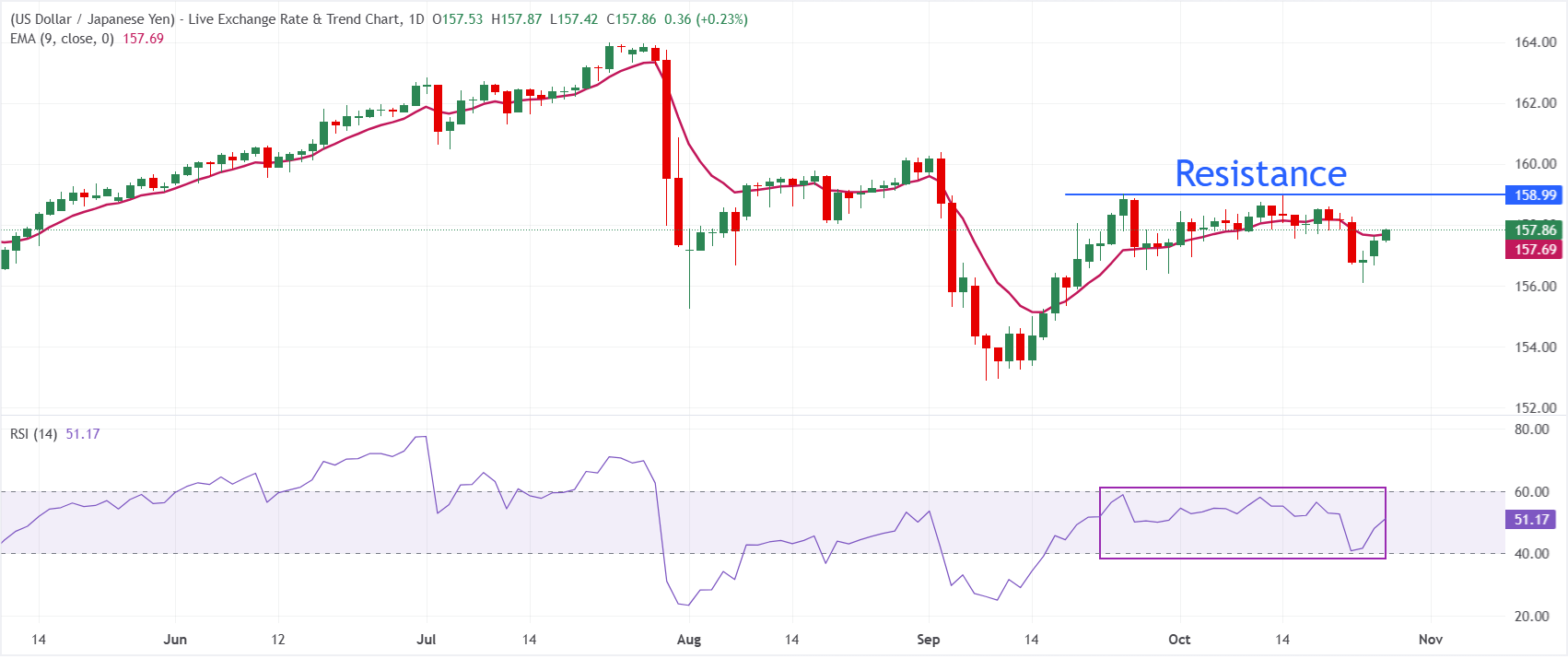
In the daily chart, USD/JPY trades at 157.86. The pair holds above the 9-period exponential moving average (EMA) at 157.69, keeping a mildly bullish near-term bias as price is supported by this short-term trend indicator. The Relative Strength Index (14) around 51 suggests neutral-to-positive momentum, hinting that buyers retain a modest advantage while avoiding overbought conditions.
On the downside, immediate support is seen at the 9-period EMA at 157.69, which guards the current advance and would need to give way to signal a deeper corrective move. With no nearby technical resistance levels identified in the latest dataset, the pair appears biased to extend gains as long as it holds above this moving average, though fresh highs would likely attract closer scrutiny of momentum for signs of fatigue.
(The technical analysis of this story was written with the help of an AI tool. Know more.)
Economic Indicator
Fed Interest Rate Decision
The Federal Reserve (Fed) deliberates on monetary policy and makes a decision on interest rates at eight pre-scheduled meetings per year. It has two mandates: to keep inflation at 2%, and to maintain full employment. Its main tool for achieving this is by setting interest rates – both at which it lends to banks and banks lend to each other. If it decides to hike rates, the US Dollar (USD) tends to strengthen as it attracts more foreign capital inflows. If it cuts rates, it tends to weaken the USD as capital drains out to countries offering higher returns. If rates are left unchanged, attention turns to the tone of the Federal Open Market Committee (FOMC) statement, and whether it is hawkish (expectant of higher future interest rates), or dovish (expectant of lower future rates).
Read more.Next release: Wed Oct 28, 2026 18:00
Frequency: Irregular
Consensus: 4%
Previous: 4%
Source: Federal Reserve
Recommended Articles


