




Euro surges as traders ignore Fed’s hawkish minutes
- EUR/USD jumps as Treasury buyback drags US yields lower.
- Fed minutes show policymakers ready to tighten if inflation stalls.
- ECB hike bets firm as Eurozone inflation edges higher.
The shared currency gained over 0.85% during the North American session on Wednesday, even though the latest Federal Reserve minutes had a “hawkish” tone, with some participants, along with the three dissenters, suggesting that raising rates could be necessary if the disinflation process stalls. The EUR/USD trades at 1.1673.
EUR/USD climbs as lower US yields offset hawkish Fed minutes
The Federal Reserve unveiled its July meeting minutes, in which the dissenters acknowledged that inflation appears broad-based and supported a more “restrictive policy.” The minutes revealed that policymakers are worried about inflation, with many participants assessing “that policy tightening would likely be necessary if inflation did not decline.”
The FOMC minutes revealed that there was no discussion of easing policy. The new Fed Chair, Kevin Warsh, asked the Committee whether it would be better for the US central bank to host only six monetary policy meetings, which would allow two months of full data. Meanwhile, the schedule for 2026 will remain unchanged.
The US Treasury buyback of long-end bonds revealed that the Treasury is worried about elevated yields. Sources cited by Bloomberg said, “The measures are essentially a method of yield curve control designed to suppress long-term rates that are deemed too elevated and at risk of derailing the economic expansion.”
The Eurozone Harmonized Index of Consumer Prices (HICP) in July rose to 2.9% from 2.8% in June, matching preliminary forecasts. Underlying inflation expanded at a 2.5% pace, up from 2.4% in June.
The data further cement the case for higher interest rates in Europe. The European Central Bank (ECB) led by Christine Lagarde, is expected to increase rates by 25 basis points at the September 10 meeting. The money market had priced in an 88% chance of a rate hike, according to Prime Terminal data.
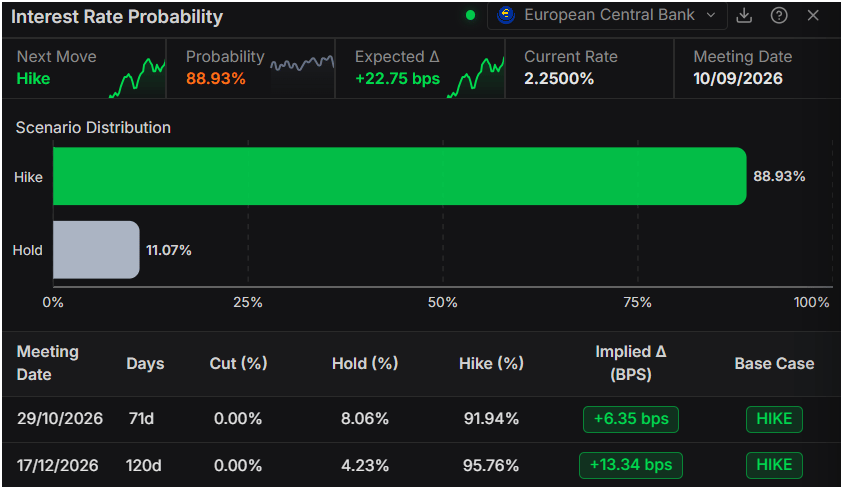
Ahead, the US economic docket will feature Initial Jobless Claims, a speech by St. Louis Fed President Alberto Musalem and S&P Global Flash PMIs. In Europe, traders will eye Germany’s Producer Price Index (PPI), the Trade Balance and speeches by ECB members,
EUR/USD Price Forecast: Technical outlook
In the daily chart, EUR/USD trades at 1.1678. The pair holds a bullish near-term bias as price advances above the cluster of longer-term support defined by the triple simple moving average set around 1.1470 and the reclaimed trend-line break near 1.1459, suggesting underlying demand on dips. Momentum is stretched, with the 14-period Relative Strength Index at 72.8, placing the market in overbought territory and hinting that upside progress could slow despite the constructive trend backdrop.
On the topside, the next significant hurdle is the horizontal resistance line at 1.1849, which caps the immediate upside and would need to give way to extend the current rally. On the downside, initial support is seen at the 1.1678 area, followed by the former trend-line barrier at 1.1459 and the triple simple moving average cluster around 1.1470, where buyers are likely to re-emerge on a deeper corrective pullback.
(The technical analysis of this story was written with the help of an AI tool. Know more.)
Euro FAQs
The Euro is the currency for the 20 European Union countries that belong to the Eurozone. It is the second most heavily traded currency in the world behind the US Dollar. In 2022, it accounted for 31% of all foreign exchange transactions, with an average daily turnover of over $2.2 trillion a day. EUR/USD is the most heavily traded currency pair in the world, accounting for an estimated 30% off all transactions, followed by EUR/JPY (4%), EUR/GBP (3%) and EUR/AUD (2%).
The European Central Bank (ECB) in Frankfurt, Germany, is the reserve bank for the Eurozone. The ECB sets interest rates and manages monetary policy. The ECB’s primary mandate is to maintain price stability, which means either controlling inflation or stimulating growth. Its primary tool is the raising or lowering of interest rates. Relatively high interest rates – or the expectation of higher rates – will usually benefit the Euro and vice versa. The ECB Governing Council makes monetary policy decisions at meetings held eight times a year. Decisions are made by heads of the Eurozone national banks and six permanent members, including the President of the ECB, Christine Lagarde.
Eurozone inflation data, measured by the Harmonized Index of Consumer Prices (HICP), is an important econometric for the Euro. If inflation rises more than expected, especially if above the ECB’s 2% target, it obliges the ECB to raise interest rates to bring it back under control. Relatively high interest rates compared to its counterparts will usually benefit the Euro, as it makes the region more attractive as a place for global investors to park their money.
Data releases gauge the health of the economy and can impact on the Euro. Indicators such as GDP, Manufacturing and Services PMIs, employment, and consumer sentiment surveys can all influence the direction of the single currency. A strong economy is good for the Euro. Not only does it attract more foreign investment but it may encourage the ECB to put up interest rates, which will directly strengthen the Euro. Otherwise, if economic data is weak, the Euro is likely to fall. Economic data for the four largest economies in the euro area (Germany, France, Italy and Spain) are especially significant, as they account for 75% of the Eurozone’s economy.
Another significant data release for the Euro is the Trade Balance. This indicator measures the difference between what a country earns from its exports and what it spends on imports over a given period. If a country produces highly sought after exports then its currency will gain in value purely from the extra demand created from foreign buyers seeking to purchase these goods. Therefore, a positive net Trade Balance strengthens a currency and vice versa for a negative balance.
Recommended Articles


