




The Japanese Yen gets its ambush, and the Bank of Japan gets overnight to justify it
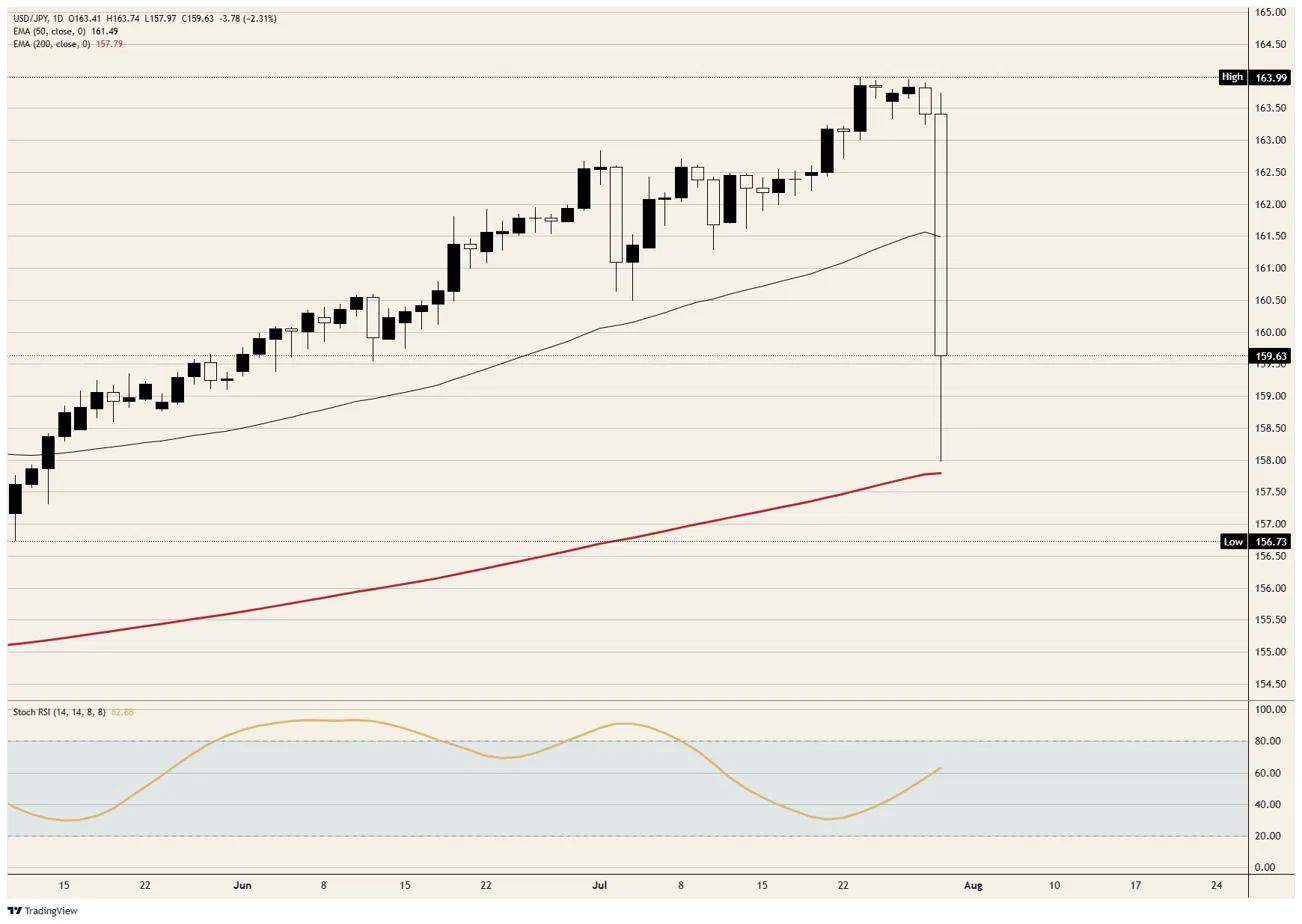
- USD/JPY trades just above 159.50 after a 2.31% collapse, the sharpest single-session Dollar decline against the Yen since 2022.
- Tokyo has confirmed nothing, which is the design: no jawboning, no rate checks, just size arriving without warning at 13:30 GMT.
- The decision and quarterly Outlook Report land Friday, and whether any of this holds depends on what the Governor is willing to say.
USD/JPY trades just above 159.50, down 2.31% and more than five Yen below a high set just short of 164.00. The move arrived in minutes rather than hours, went through the 50-day Exponential Moving Average (EMA) near 161.50 without pausing, and stopped within 20 pips of the 200-day EMA just below 158.00. Nothing on the calendar accounts for a move of that size.
Ten minutes, five Yen
The collapse began at 13:30 GMT and was substantially over before most desks had read the tape. One trading desk recorded roughly 8.1 billion Dollars of selling in the pair across core venues in the ten minutes that followed, with volumes across the complex running far above normal. The Ministry of Finance division that directs intervention was unreachable for comment, and the government has said nothing since.
American data at 12:30 GMT had already softened the Dollar, with advance second-quarter Gross Domestic Product (GDP) growth of 1.5% against a 2.1% consensus and core Personal Consumption Expenditures (PCE) inflation at 0.1% MoM. Soft data moves this pair in tens of pips, not hundreds. The Yen took more than 2% out of the Euro and the Pound and close to 2% out of the Australian Dollar in the same window, which is the signature of one buyer rather than a repricing.
The playbook changed before the operation did
Earlier Japanese operations were preceded by weeks of escalating verbal warnings, rate checks and calibrated hints, all of which gave speculative positions time to trim. This one carried none of that. The approach now is to say nothing and then arrive at size, with the stated aim of wiping out speculative Yen shorts rather than politely discouraging them, and Thursday is the first full demonstration of what that looks like.
The timing was not accidental either. The operation landed the day after a divided Federal Reserve, into a weak American growth print, with month-end flows already running and the Yen at four-decade lows. Tokyo bought the cheapest Dollars it was going to get, at the moment the largest number of leveraged positions sat on the wrong side of the trade.
Now the central bank has to agree
The Bank of Japan announces Friday and is expected to hold at 1.00% after June's increase. The Outlook Report is the substance, with the fiscal 2026 growth forecast expected to be revised up toward 0.8% from 0.5%, and a large majority of surveyed economists still looking for 1.25% by year end, with October the favoured timing for it.
Tokyo committed roughly 70 billion Dollars to supporting the currency across April and May, and the Yen still reached four-decade lows two months later, which is a fair measure of what an operation buys without a rate move behind it. Intervention without a policy follow-through gets absorbed, and the arithmetic explains why. The gap between the American target range and the Japanese policy rate is roughly 260 basis points, which is the yield the carry trade rebuilds on within days of any operation. A press conference that treats the currency as central to the inflation outlook keeps Thursday's work intact. One that frames the energy shock as temporary and declines to bring the next increase forward hands the positions Tokyo just liquidated back at better levels.
What lands next
Tokyo inflation figures are imminent, with the core measure at a 1.7% consensus against 1.6% previously, alongside the June unemployment rate at 2.5% and retail trade expected to slow to 3.1% YoY from 5.3%. The decision follows overnight and the press conference is at 06:30 GMT. Chinese official surveys at 01:30 GMT carry a consensus of exactly 50.0 on both measures and will set the risk tone Asia trades into.
Next week brings labour cash earnings on Tuesday against a 3.2% previous, the wage measure policymakers have repeatedly named as their test, and the June meeting minutes the same day. The American calendar delivers its manufacturing survey Monday, private payrolls Wednesday, and Nonfarm Payrolls Friday against a 57K previous, with a September Federal Reserve hike priced at 63%. Every one of those is an opportunity to widen the gap Tokyo has just spent reserves narrowing.
Levels and bias
Resistance: First at 160.00, the handle the operation was defending. Above it, the 50-day EMA near 161.50 decides whether Thursday was a correction or a turn, with 163.50 the reference beyond that.
Support: 158.00 covers both the session low and the 200-day EMA, which halted the first wave almost exactly. A daily close below there opens 156.50 and puts the operation firmly in profit.
Bias: Bearish while 161.50 caps. Fading an active operation into a central bank meeting is a poor trade whatever the carry arithmetic says, and Tokyo has historically worked in multi-day bursts rather than single strikes. A Friday that declines to validate the currency is the trigger that hands the pair back to the funding trade.
USD/JPY daily chart
Japanese Yen FAQs
The Japanese Yen (JPY) is one of the world’s most traded currencies. Its value is broadly determined by the performance of the Japanese economy, but more specifically by the Bank of Japan’s policy, the differential between Japanese and US bond yields, or risk sentiment among traders, among other factors.
One of the Bank of Japan’s mandates is currency control, so its moves are key for the Yen. The BoJ has directly intervened in currency markets sometimes, generally to lower the value of the Yen, although it refrains from doing it often due to political concerns of its main trading partners. The BoJ ultra-loose monetary policy between 2013 and 2024 caused the Yen to depreciate against its main currency peers due to an increasing policy divergence between the Bank of Japan and other main central banks. More recently, the gradually unwinding of this ultra-loose policy has given some support to the Yen.
Over the last decade, the BoJ’s stance of sticking to ultra-loose monetary policy has led to a widening policy divergence with other central banks, particularly with the US Federal Reserve. This supported a widening of the differential between the 10-year US and Japanese bonds, which favored the US Dollar against the Japanese Yen. The BoJ decision in 2024 to gradually abandon the ultra-loose policy, coupled with interest-rate cuts in other major central banks, is narrowing this differential.
The Japanese Yen is often seen as a safe-haven investment. This means that in times of market stress, investors are more likely to put their money in the Japanese currency due to its supposed reliability and stability. Turbulent times are likely to strengthen the Yen’s value against other currencies seen as more risky to invest in.
Recommended Articles


