




Peace breaks out and the New Zealand Dollar pays for it
- NZD/USD closed Monday near its session low even as a powerful risk-on rally lifted global markets.
- A US-Iran framework deal to end the war and reopen the Strait of Hormuz drove that rally.
- Falling Crude Oil prices now threaten the rate-hike story that has been the Kiwi's main pillar of support.
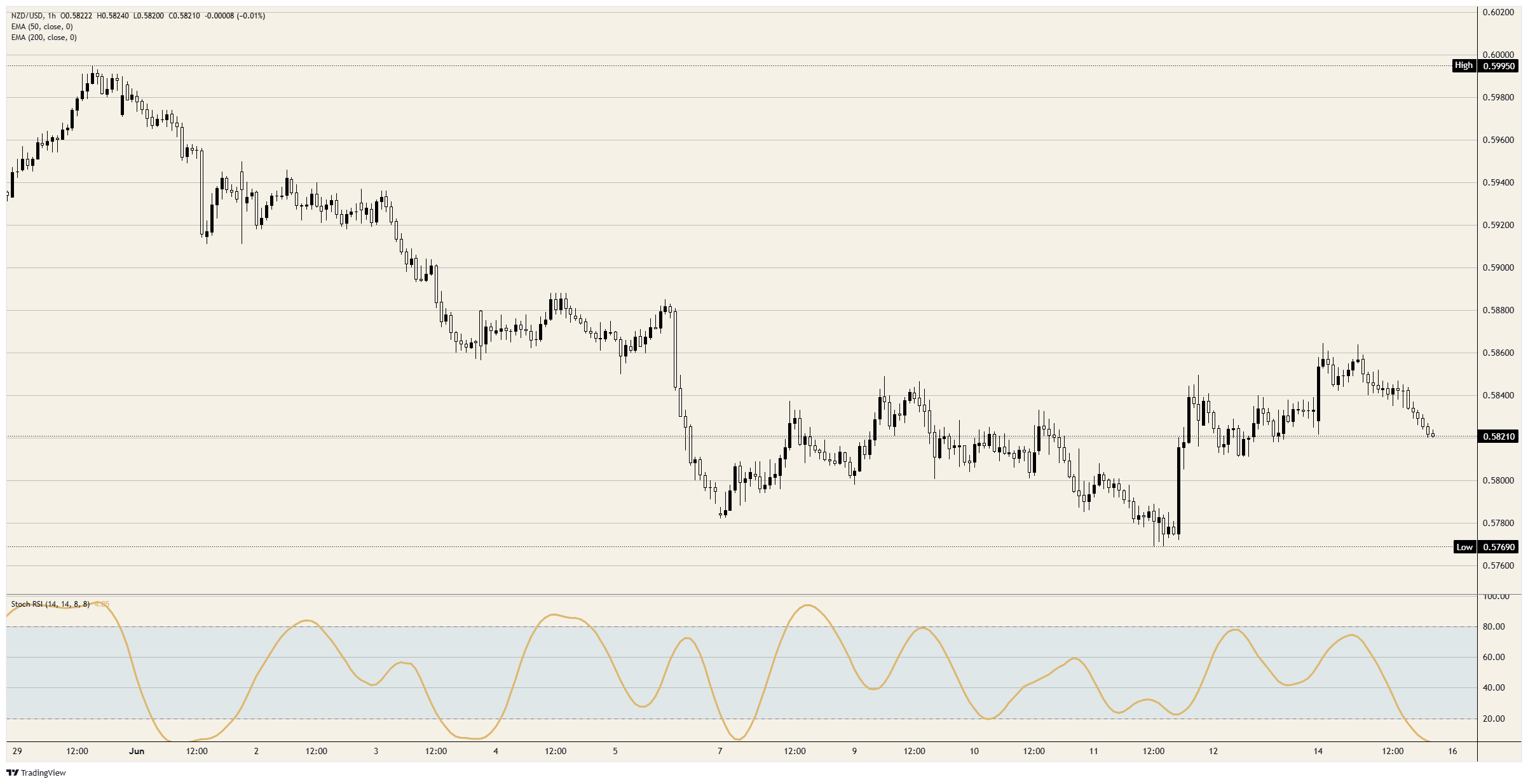
Monday played out as a textbook risk-on session, with global equities ripping higher and Crude Oil tumbling after Washington and Tehran unveiled a framework deal to end the war and reopen the Strait of Hormuz. Commodity currencies are built to thrive in exactly this kind of tape, so the New Zealand Dollar finishing as one of the weakest majors on the board is the day's real puzzle. NZD/USD spiked to its session high just above 0.5850 in early European hours, then leaked steadily lower to close near 0.5800.
The data gave it an excuse it ignored
The awkward detail is that the US numbers handed the Kiwi a second reason to climb. The New York Federal Reserve's Empire State manufacturing survey for June collapsed to 5.7, far below the 14 expected and down from 19.6, while Industrial Production rose a limp 0.1% MoM against a 0.3% consensus. A soft US print like that normally pressures the Dollar and lifts NZD/USD.
That the Kiwi sold off into both a softer Dollar and a roaring risk rally is the whole point. The weakness was not imported from a strong Greenback; it was home-grown, and the domestic backdrop did nothing to help, with the Business NZ Performance of Services Index (PSI) slipping to 47.5 over the weekend to mark a deeper services contraction.
Peace is the enemy of the rate trade
For weeks the Kiwi's resilience has rested on an unlikely benefactor, the Iran war itself. The Reserve Bank of New Zealand (RBNZ) has held its Official Cash Rate (OCR) at 2.25% while warning it will need to raise rates to counter the inflation surge driven by higher Crude Oil, and markets now price a first hike as soon as July, with further increases pencilled in toward a peak near 4.0% in 2027. That hawkish repricing, rather than growth or risk appetite, is what has kept the Kiwi off its lows.
Strip the war premium out of Crude Oil and that logic begins to unravel. Brent slumped toward $83 and WTI toward $80 on Monday, a long way from the $126 conflict peak and already beneath the sub-$100 path the RBNZ had assumed for Crude Oil by the end of June. Cheaper fuel softens the inflation impulse, which weakens the case for higher rates and, with it, the Kiwi's strongest argument. What counts as good news for the world reads as bad news for the rate trade.
The week is built to punish conviction
The calendar offered a second reason to sell first and ask questions later, on top of a framework deal that still has to be signed before the week is out. Tuesday brings Chinese Industrial Production and Retail Sales for May, and as New Zealand's largest export market, China weighs on the Kiwi as heavily as anything domestic. The Reserve Bank of Australia (RBA) also decides on Tuesday, with a hold at 4.35% expected, a trans-Tasman signal the Kiwi cannot brush off.
The genuine event risk is concentrated on Wednesday, and there is plenty of it. The Federal Reserve (Fed) is expected to leave rates near 3.75% when it reports at 18:00 GMT, so the Federal Open Market Committee (FOMC) statement and a fresh dot plot will carry the message, and this is Kevin Warsh's first meeting as Chair, adding its own uncertainty. Hours later, New Zealand's first-quarter Gross Domestic Product (GDP) lands, with growth pencilled near 0.9% QoQ. With that much binary risk stacked into 48 hours, trimming a crowded long looks less like panic and more like prudence.
Where the line gets drawn
Resistance: The session high just above 0.5850 is the first hurdle, reinforced by the cluster of daily 50- and 200-period Exponential Moving Averages (EMAs) bunched directly above it; a daily close back through that band reopens the 0.5900 handle.
Support: The 0.5800 handle, defended into Monday's close, is the immediate floor. A break there exposes the early-June low around 0.5750, and beneath that the April trough near 0.5700 returns to view.
Bias: Lower while NZD/USD trades under the 0.5850 moving-average cluster. The daily Stochastic Relative Strength Index (Stoch RSI) near 31 and a close on the session lows argue for continuation, and with the war premium draining out of the rate story, rallies into resistance look like fades rather than reversals. The Fed and GDP double-header on Wednesday is the swing factor that can override the technical read in either direction.
NZD/USD 1-hour chart
New Zealand Dollar FAQs
The New Zealand Dollar (NZD), also known as the Kiwi, is a well-known traded currency among investors. Its value is broadly determined by the health of the New Zealand economy and the country’s central bank policy. Still, there are some unique particularities that also can make NZD move. The performance of the Chinese economy tends to move the Kiwi because China is New Zealand’s biggest trading partner. Bad news for the Chinese economy likely means less New Zealand exports to the country, hitting the economy and thus its currency. Another factor moving NZD is dairy prices as the dairy industry is New Zealand’s main export. High dairy prices boost export income, contributing positively to the economy and thus to the NZD.
The Reserve Bank of New Zealand (RBNZ) aims to achieve and maintain an inflation rate between 1% and 3% over the medium term, with a focus to keep it near the 2% mid-point. To this end, the bank sets an appropriate level of interest rates. When inflation is too high, the RBNZ will increase interest rates to cool the economy, but the move will also make bond yields higher, increasing investors’ appeal to invest in the country and thus boosting NZD. On the contrary, lower interest rates tend to weaken NZD. The so-called rate differential, or how rates in New Zealand are or are expected to be compared to the ones set by the US Federal Reserve, can also play a key role in moving the NZD/USD pair.
Macroeconomic data releases in New Zealand are key to assess the state of the economy and can impact the New Zealand Dollar’s (NZD) valuation. A strong economy, based on high economic growth, low unemployment and high confidence is good for NZD. High economic growth attracts foreign investment and may encourage the Reserve Bank of New Zealand to increase interest rates, if this economic strength comes together with elevated inflation. Conversely, if economic data is weak, NZD is likely to depreciate.
The New Zealand Dollar (NZD) tends to strengthen during risk-on periods, or when investors perceive that broader market risks are low and are optimistic about growth. This tends to lead to a more favorable outlook for commodities and so-called ‘commodity currencies’ such as the Kiwi. Conversely, NZD tends to weaken at times of market turbulence or economic uncertainty as investors tend to sell higher-risk assets and flee to the more-stable safe havens.
Recommended Articles


