




Japanese Yen gets a rescue Tokyo did not pay for
- USD/JPY dropped hard after Trump canceled a third night of strikes on Iran and claimed a deal is close.
- Collapsing Crude Oil and falling US yields drove the move; hot PPI data could not compete.
- The slide does Tokyo's intervention work for free, for as long as the deal talk survives.
USD/JPY spent the entire session glued to the area around 160.50, and it took the cancellation of a war, rather than anything out of Tokyo, to finally knock it lower. Just after 17:30 GMT, President Trump called off the evening's planned strikes on Iran and declared a deal to end the conflict all but agreed.
The pair dropped a full big figure to lows just above 159.50 within two hours, even though US inflation data earlier in the day argued for the opposite trade. That tension between hot numbers and a falling Dollar is the real story of the session.
Two days of strikes, then a handshake claim
The reversal capped a brutal 48 hours. US forces struck Iran on Tuesday and Wednesday after negotiations stalled, and Tehran answered with ballistic missiles aimed at American bases in Bahrain, Kuwait and Jordan. Trump opened Thursday by threatening to seize Kharg Island and the rest of Iran's energy export infrastructure.
By late afternoon the strikes were canceled, with the final points of a deal supposedly approved at the highest level of Iranian leadership. Tehran has confirmed none of it; Iranian semiofficial media advised weighing the claim against his earlier ones; and the naval blockade of Iranian ports remains in place.
Hot inflation, falling yields, no contradiction
The awkward detail is that Thursday's US data argued for a stronger Dollar. The May Producer Price Index (PPI) printed at 1.1% MoM against forecasts near 0.7%, landing a day after a hot Consumer Price Index (CPI) report, and rate futures leaned a little further toward a Federal Reserve (Fed) hike rather than a cut. USD/JPY barely blinked.
The bond market has simply decided this inflation is a war surcharge, not a domestic problem. Brent collapsed more than 3% to its weakest level since April, near $90 a barrel, and the two-year Treasury yield shed roughly 7 basis points once the strikes were called off. Even the White House is marketing inflation as something that drops away the moment the war ends, which tells you where the pressure on yields, and on the pair, is coming from.
Tokyo's intervention, outsourced to Washington
For Japan, the canceled escalation is a double windfall. The country imports nearly all of its energy, so every Dollar that comes off the Crude Oil price trims both the import bill and the imported-inflation squeeze the economy has worn since February.
There is also the intervention math. With USD/JPY camped above 160.00, Japan's Ministry of Finance was back in the zone where it has previously spent heavily defending the currency, and the peace headline just delivered roughly a hundred pips of relief without a single Dollar sold. The catch is that the favor only lasts as long as the deal talk does.
The bounce is not impressing anyone
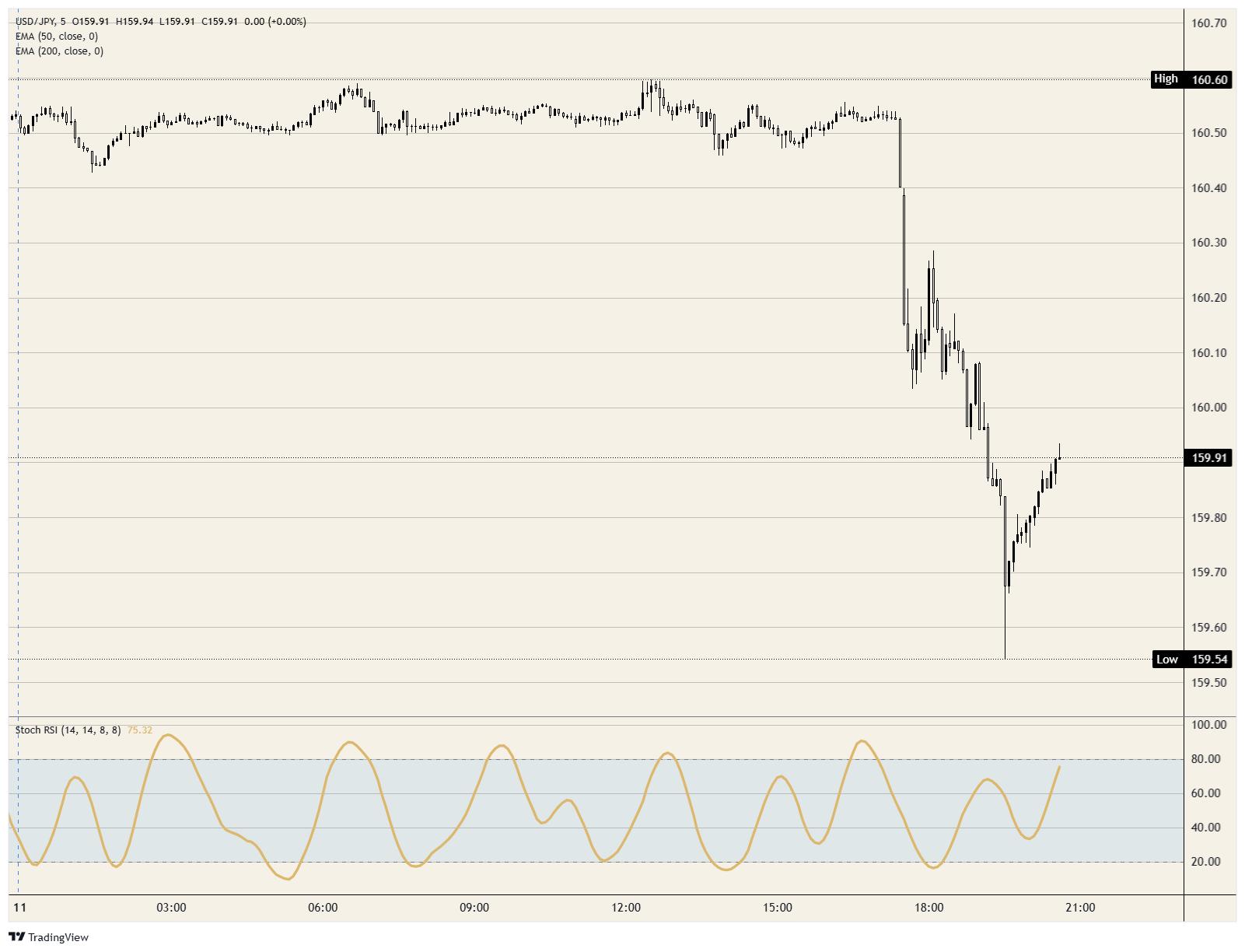
The chart shows a session-long coil around 160.50, then a waterfall that cut through 160.00 without a fight, stopping only just above 159.50. The recovery since has stalled below 160.00, a level that now flips from floor to ceiling.
Momentum is not helping dip buyers either. The Stochastic Relative Strength Index (Stoch RSI) has already reset to the middle of its range while price has clawed back only a fraction of the drop, a lopsided ratio that tilts the consolidation bearish rather than corrective.
Trading the headline regime
Upside: A reclaim of 160.00 followed by a push back toward 160.50 would say the market is fading the deal talk, and an Iranian denial is the obvious trigger for that round trip.
Downside: A break below 159.50 extends the unwind toward 159.00, with a confirmed signing date out of Tehran the catalyst that keeps the war premium draining.
Bias: Lower while de-escalation holds, and rallies into 160.00 are the preferred entry; this tape is repricing a war one social media post at a time, so size accordingly.
USD/JPY 5-minute chart
Japanese Yen FAQs
The Japanese Yen (JPY) is one of the world’s most traded currencies. Its value is broadly determined by the performance of the Japanese economy, but more specifically by the Bank of Japan’s policy, the differential between Japanese and US bond yields, or risk sentiment among traders, among other factors.
One of the Bank of Japan’s mandates is currency control, so its moves are key for the Yen. The BoJ has directly intervened in currency markets sometimes, generally to lower the value of the Yen, although it refrains from doing it often due to political concerns of its main trading partners. The BoJ ultra-loose monetary policy between 2013 and 2024 caused the Yen to depreciate against its main currency peers due to an increasing policy divergence between the Bank of Japan and other main central banks. More recently, the gradually unwinding of this ultra-loose policy has given some support to the Yen.
Over the last decade, the BoJ’s stance of sticking to ultra-loose monetary policy has led to a widening policy divergence with other central banks, particularly with the US Federal Reserve. This supported a widening of the differential between the 10-year US and Japanese bonds, which favored the US Dollar against the Japanese Yen. The BoJ decision in 2024 to gradually abandon the ultra-loose policy, coupled with interest-rate cuts in other major central banks, is narrowing this differential.
The Japanese Yen is often seen as a safe-haven investment. This means that in times of market stress, investors are more likely to put their money in the Japanese currency due to its supposed reliability and stability. Turbulent times are likely to strengthen the Yen’s value against other currencies seen as more risky to invest in.
Recommended Articles


