




Indian Rupee hits record low as USD/INR surges on Oil, risk aversion
- The USD/INR pair reached a fresh record high of 92.58 on Wednesday.
- Indian Rupee remains under pressure amid higher Oil prices driven by the ongoing war in the Middle East.
- The INR weakens as investors withdraw over $350 million from equities amid rising risk aversion.
The Indian Rupee (INR) declines against the US Dollar (USD), extending its losing streak for the fifth successive session. The USD/INR pair reached a fresh record high of 92.58 during the Asian hours on Wednesday. Traders expect the Reserve Bank of India (RBI) to sell dollars to avert steeper rupee losses.
The INR faces challenges due to higher Oil prices, which could be attributed to the ongoing war in the Middle East. India imports over 80% of its crude Oil needs. When Oil prices rise, India must pay more in dollars to buy the same quantity of crude.
The USD/INR pair could further appreciate as the Indian Rupee struggles with increased risk aversion amid geopolitical conflict in the Middle East. Foreign fund outflows from the Indian stock market weighed on the Indian Rupee. Rising risk aversion led investors to pull over $350 million from Indian equities on Monday.
The US Dollar Index (DXY), which measures the value of the US Dollar (USD) against six major currencies, extends gains for the third consecutive day, trading around 99.10 at the time of writing. Traders will likely observe the US ISM Services Purchasing Managers’ Index (PMI), due later in the North American session.
The Greenback advances on fading expectations of imminent rate cuts from the Federal Reserve (Fed). The yield on the US 10-year Treasury note holds around 4.06% at the time of writing after rising for two consecutive sessions amid elevated inflation fears.
Higher energy prices have added to inflation concerns, prompting markets to scale back bets on near-term policy easing. Investors largely expect the US central bank to keep interest rates unchanged until summer, despite calls from US President Donald Trump for lower borrowing costs.
US President Donald Trump noted the US Navy would provide insurance support to commercial vessels in the Gulf after Iran effectively disrupted traffic through the Strait of Hormuz. He added that US forces would escort ships if necessary, following reports that Iranian forces had fired on several vessels, per BBC.
Israel reportedly hit a building where Iranian clerics were meeting to choose a new Supreme Leader. US President Donald Trump warned that the escalation could pave the way for an equally hardline leadership in Iran, underscoring uncertainty surrounding the conflict’s outcome.
Technical Analysis: USD/INR reaches fresh record high above 92.50
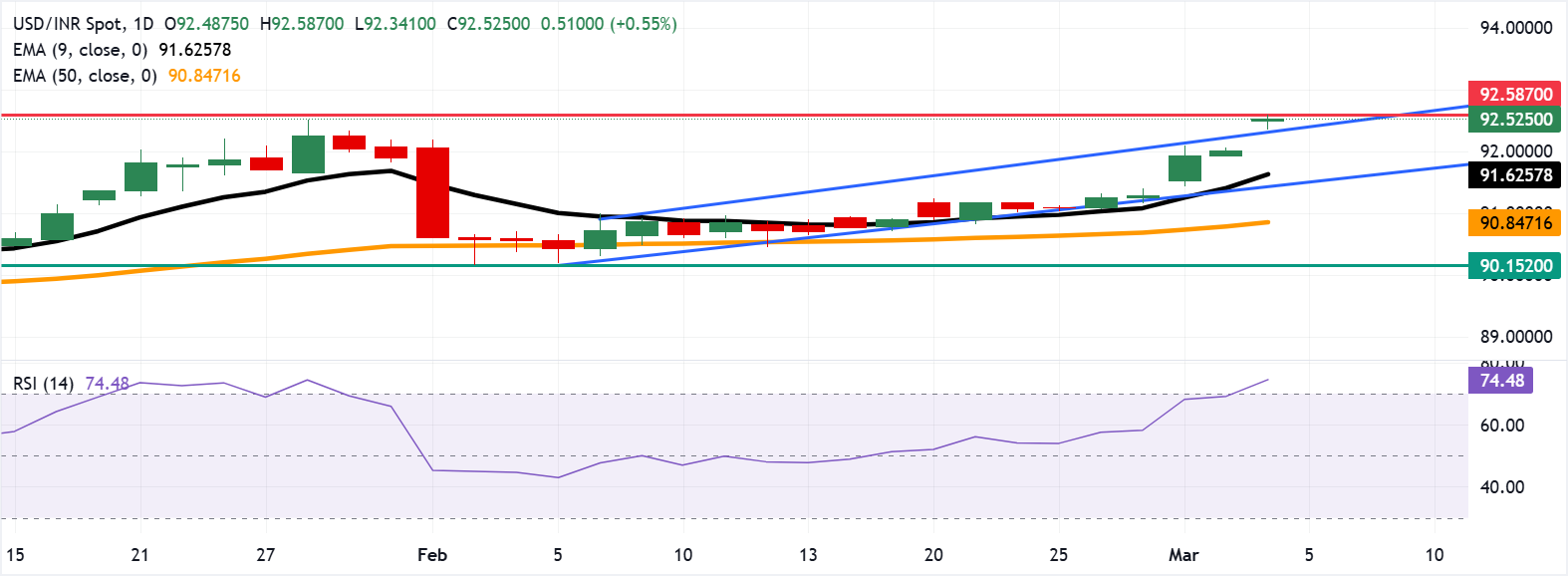
USD/INR stays at a fresh record high of 92.58 at the time of writing. The technical analysis of the daily chart indicates a persistent bullish bias as the pair is positioned above the upper boundary of the ascending channel pattern.
The near-term bias is bullish as the USD/INR pair holds well above the rising 50-day Exponential Moving Average (EMA) near 90.84, while the nine-day average accelerates higher and stays above the medium-term gauge, confirming strengthening upside momentum.
The Relative Strength Index (RSI) stands in overbought territory around 74, indicating firm buying pressure, though stretched conditions could cap the pace of further gains rather than reverse the trend immediately.
A break above the record high at 92.58 would lead the USD/INR pair to approach the psychological level of93.00. On the downside, a pullback to the ascending channel would expose the initial support at the nine-day EMA at 91.62, followed by the lower channel boundary around 91.50.
(The technical analysis of this story was written with the help of an AI tool.)
Indian Rupee FAQs
The Indian Rupee (INR) is one of the most sensitive currencies to external factors. The price of Crude Oil (the country is highly dependent on imported Oil), the value of the US Dollar – most trade is conducted in USD – and the level of foreign investment, are all influential. Direct intervention by the Reserve Bank of India (RBI) in FX markets to keep the exchange rate stable, as well as the level of interest rates set by the RBI, are further major influencing factors on the Rupee.
The Reserve Bank of India (RBI) actively intervenes in forex markets to maintain a stable exchange rate, to help facilitate trade. In addition, the RBI tries to maintain the inflation rate at its 4% target by adjusting interest rates. Higher interest rates usually strengthen the Rupee. This is due to the role of the ‘carry trade’ in which investors borrow in countries with lower interest rates so as to place their money in countries’ offering relatively higher interest rates and profit from the difference.
Macroeconomic factors that influence the value of the Rupee include inflation, interest rates, the economic growth rate (GDP), the balance of trade, and inflows from foreign investment. A higher growth rate can lead to more overseas investment, pushing up demand for the Rupee. A less negative balance of trade will eventually lead to a stronger Rupee. Higher interest rates, especially real rates (interest rates less inflation) are also positive for the Rupee. A risk-on environment can lead to greater inflows of Foreign Direct and Indirect Investment (FDI and FII), which also benefit the Rupee.
Higher inflation, particularly, if it is comparatively higher than India’s peers, is generally negative for the currency as it reflects devaluation through oversupply. Inflation also increases the cost of exports, leading to more Rupees being sold to purchase foreign imports, which is Rupee-negative. At the same time, higher inflation usually leads to the Reserve Bank of India (RBI) raising interest rates and this can be positive for the Rupee, due to increased demand from international investors. The opposite effect is true of lower inflation.
Recommended Articles


