




WTI Oil Price Forecast: Oil Stays Above US$100 as Middle East Supply Risks Escalate

How to Trade Oil CFDs in Australia
WTI crude oil has pushed back above US$100 a barrel, with Middle East supply disruptions continuing to raise concerns about how much crude can reach global markets.
On Monday, September 14, WTI futures climbed more than 3% at the market open before consolidating above the US$100 level. The latest move followed fresh Houthi attacks on Saudi Arabia, reports of a vessel being hit in the Strait of Hormuz and the temporary shutdown of Saudi Arabia's critical East-West oil pipeline.
The situation became even more uncertain after Oman announced that a planned meeting between Iran and Gulf states on the Strait of Hormuz had been postponed. The meeting was intended to discuss a possible framework for maritime security and shipping through the strategic waterway.
For Australian traders, the oil rally matters beyond the WTI chart. Higher crude prices can feed into petrol costs, inflation expectations, interest-rate expectations and risk sentiment across Australian financial markets.
So, how high could WTI go from here?
The key levels for traders are now US$100, US$110 and US$120, while a sustained break below US$90 would weaken the current bullish structure.
WTI Oil Price Today: Market Snapshot
WTI was trading around US$103 on September 14, while Brent was above US$107 after both benchmarks extended their gains following renewed attacks on Saudi infrastructure and shipping in the Gulf.
The latest move also means the US crude benchmark has recovered sharply from the levels seen earlier in September. WTI had settled around US$100.05 on September 11 after recording a weekly gain of more than 8%.
Why Is WTI Oil Rising Above US$100?
1. Saudi Arabia's East-West Pipeline Has Been Shut
One of the most important developments for the oil market is the temporary shutdown of Saudi Arabia's East-West Pipeline.
The pipeline normally provides Saudi Arabia with an alternative route to export crude through the Red Sea, reducing its dependence on the Strait of Hormuz.
Following attacks, Saudi Arabia temporarily shut the pipeline while emergency teams assessed the damage. Reuters reported that the outage could threaten as much as 4% of global oil supply if it persists.
The importance of the pipeline has increased because shipping through the Strait of Hormuz has already been severely disrupted.
According to Reuters, Saudi crude production had fallen to around 6.2 million barrels per day in August, compared with 10.9 million barrels per day in February.
That leaves the market with less room to absorb another supply shock.
2. Strait of Hormuz Risks Remain
The Strait of Hormuz remains one of the most important variables for the oil market.
Shipping activity through the strait has fallen significantly, while a vessel was reportedly hit by a projectile during the weekend. Reuters reported that only four outbound and 10 inbound vessels were recorded over the weekend, compared with a recent 10-day average of around 14 daily transits.
Any further reduction in tanker traffic could increase the geopolitical premium embedded in crude prices.
For WTI traders, this means that headlines surrounding the Gulf can produce significant intraday volatility.
3. Iran-Gulf Talks Have Been Postponed
The market had been hoping that diplomatic discussions could provide a path towards reopening safer shipping routes.
However, Oman's foreign minister confirmed that a planned meeting between Iran and Gulf countries had been postponed.
That reduces the probability of an immediate de-escalation and leaves the oil market focused on physical supply rather than diplomatic progress.
4. Houthi Activity Is Increasing Supply Risks
The risk is no longer limited to the Strait of Hormuz.
Houthi forces have intensified their activities around the Red Sea and Bab el-Mandeb, creating another obstacle for oil transportation.
Reuters reported that the Houthi advance along Yemen's Red Sea coastline is increasing pressure on Saudi oil exports and global shipping routes.
This creates a dangerous scenario for the oil market: multiple export routes are facing simultaneous geopolitical risks.
WTI Oil Price Forecast: Can WTI Reach US$110 or US$120?
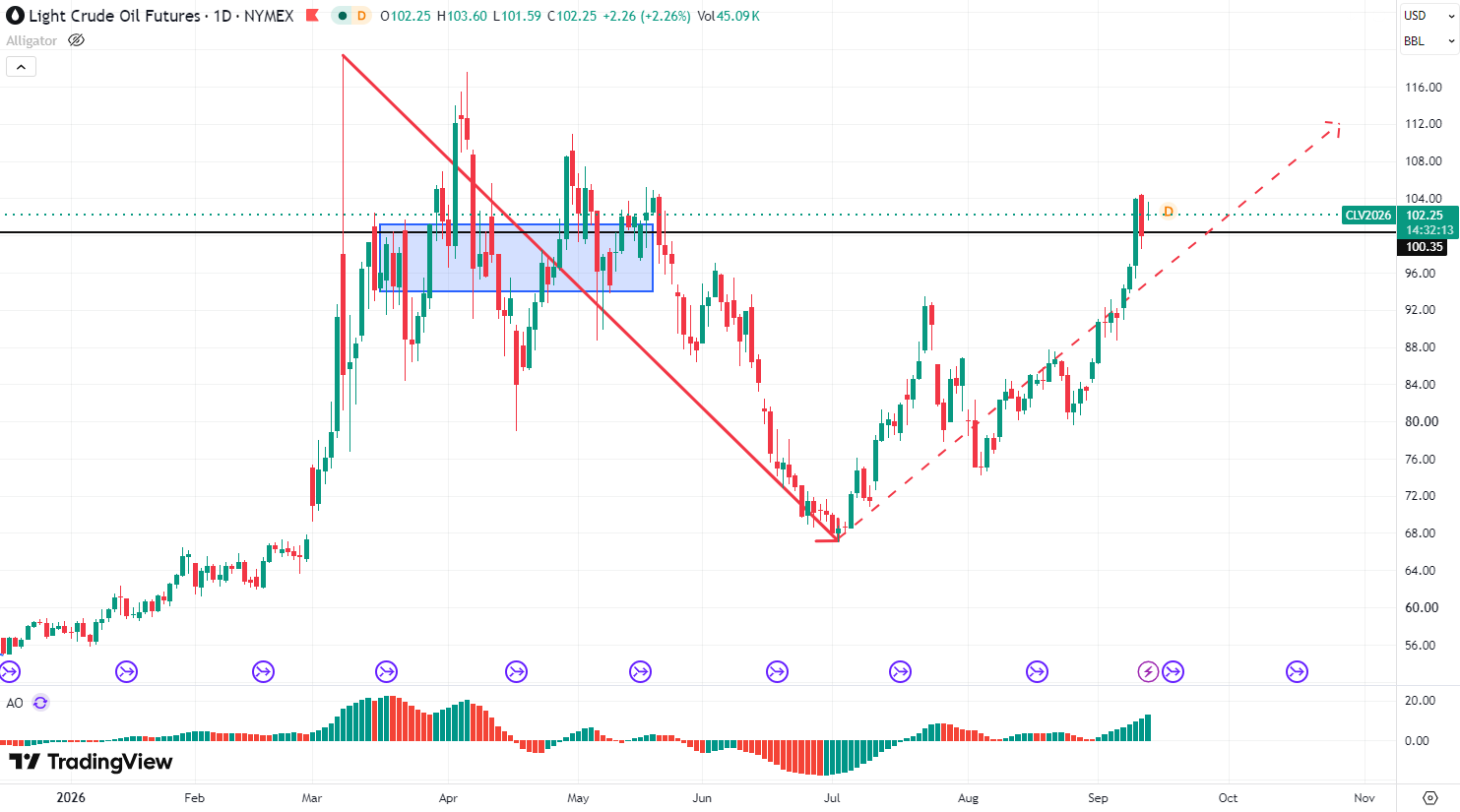
Source: Tradingview
The technical picture remains bullish as long as WTI holds above the psychologically important US$100 level.
The recent price structure shows a series of higher highs and higher lows, suggesting that buyers remain in control.
The key question is whether US$100 becomes a new support zone rather than simply a temporary psychological milestone.
Bullish Scenario: WTI Breaks Above US$110
If WTI remains above US$100 and breaks through US$110, the next major target could be the previous high around US$119–120.
This level is particularly important because IG market analyst Tony Sycamore has previously identified the March high around US$119.48 as a potential upside target if geopolitical risks continue to escalate.
A sustained break above US$110 would therefore open the door to a potential test of US$120.
Bernstein has gone even further, warning that Brent crude could potentially reach US$120–150 per barrel if Middle East supply disruptions persist. The bank said its previous US$90 2026 Brent forecast had already been overtaken by market conditions, with risks now skewed to the upside.
This does not mean WTI will necessarily reach those levels, but it highlights how dramatically the market's risk distribution has changed.
Bearish Scenario: WTI Falls Below US$100
The biggest short-term risk to the bullish trend would be a successful diplomatic breakthrough.
If Iran and Gulf states reach an operational agreement that significantly improves shipping through the Strait of Hormuz, or if Saudi Arabia quickly restores the East-West Pipeline, some of the geopolitical premium could disappear from crude prices.
In that scenario, WTI could fall back towards:
US$95 → US$90
A sustained break below US$90 would significantly weaken the current bullish structure and increase the probability of a deeper correction.
For traders, this means US$100 is more than a round number. It is becoming a key bullish/bearish decision zone.
What Could Trigger the Next Big WTI Move?
1. Strait of Hormuz Shipping
Any evidence of a sustained reopening could cause oil's geopolitical premium to fall.
Conversely, further attacks or a collapse in tanker traffic could accelerate the rally.
2. Saudi East-West Pipeline
The pipeline's restoration is arguably one of the most important near-term bearish catalysts for oil.
If the pipeline remains offline for an extended period, concerns about Saudi export capacity could intensify. Reuters reported that Saudi oil stocks at Yanbu could become increasingly constrained if the outage persists.
3. Iran-Gulf Diplomacy
The postponed Oman meeting is now a key event for oil traders.
A practical agreement could trigger a sharp correction, while continued diplomatic failure would keep the supply premium elevated.
4. US Monetary Policy
Oil above US$100 is also becoming an inflation problem.
Rising energy prices are already pushing global bond yields higher and increasing expectations for further central-bank tightening. In Australia, markets have been increasingly concerned about the possibility of additional RBA rate increases.
5. US Midterm Elections
The US political calendar could become increasingly important as the conflict continues.
President Trump has previously suggested that the Iran conflict could end after the US midterm elections. However, the timing and credibility of any diplomatic breakthrough remain highly uncertain.
For oil traders, the important point is that the November political window could become a major volatility event rather than a guaranteed turning point.
How to Trade WTI Oil CFDs in Australia
For Australian traders who want exposure to short-term oil price movements, WTI CFDs provide a way to speculate on both rising and falling crude prices without owning physical barrels of oil.
A CFD trader can potentially take a long position if they expect WTI to rise, or a short position if they expect prices to fall.
For example:
WTI breaks above US$105 → bullish traders may look for continuation towards US$110.
WTI holds US$100 → traders may monitor whether the breakout develops into a new uptrend.
WTI falls below US$95 → bearish traders may watch for a move towards US$90.
WTI breaks below US$90 → the medium-term bullish structure would become less convincing.
However, CFDs are leveraged products, meaning both gains and losses can be amplified. Traders should consider position size, stop-loss levels, overnight financing costs and overall risk before opening a position.
Trade WTI Crude Oil CFDs with Mitrade
Australian traders can use Mitrade to access WTI crude oil CFDs and respond to fast-moving oil markets.
With CFDs, you don't need to take physical delivery of crude oil. You can trade based on whether you expect the oil price to rise or fall, giving you flexibility during both bullish and bearish market conditions.

 Trade WTI and other major commodities Access leveraged CFD trading Trade rising and falling markets Monitor real-time price movements

What Does US$100 Oil Mean for Australian Traders?
The WTI move above US$100 is particularly important for Australian investors because oil prices can influence more than energy stocks.
Higher crude prices can affect:
Australian petrol prices
Inflation expectations
RBA interest-rate expectations
The Australian dollar
Airline and transport costs
Mining and energy stocks
Consumer spending
Australian bond yields
Australia is a major commodity exporter, so higher energy prices can support some resource-related companies. However, the inflationary impact can create a different problem for the broader economy.
Recent Australian market moves show that investors are already becoming increasingly concerned about the inflation consequences of higher oil prices.
On September 11, the ASX 200 fell 0.9%, while Australian government bond yields moved above 5% amid concerns that higher energy prices could keep inflation elevated and encourage further RBA tightening.
The RBA's next monetary-policy meeting is scheduled for September 28–29, making oil prices an important variable for Australian traders to monitor over the coming weeks.
You might be interested in…
Disclaimer: The content presented above, whether from a third party or not, is considered as general advice only. CFD trading involves significant risk of loss. Past performance does not guarantee future results. This article serves informational purposes only and does not constitute financial advice. Consider your risk tolerance before trading.


