




Gold Price Forecast: Can XAU/USD Reach US$4,500 After Weak US Jobs Data?

Why Trade Gold CFDs with Mitrade?
Gold Price Today: XAU/USD Remains Above US$4,300
Gold has entered a new bullish phase after a surprisingly weak US jobs report triggered a sharp repricing of Federal Reserve rate expectations.
US nonfarm payroll employment fell by 23,000 in July, compared with market expectations for an increase of around 80,000. The result represented a substantial downside surprise and reinforced concerns that the US labour market may be losing momentum.
After breaking decisively above US$4,300, spot gold surged above US$4,400 at one point before easing back towards the US$4,340 area on Monday, August 10. Gold remains close to its recent highs, with traders now turning their attention to the next major catalyst: the US July CPI inflation report due on Wednesday, August 12.
The latest rally has been driven by more than just safe-haven demand.
The US labour market delivered a major downside surprise, while expectations for Federal Reserve policy are being reassessed. At the same time, easing concerns around energy supply and the Strait of Hormuz could reduce some inflation pressure, potentially giving the Fed more room to adjust monetary policy.
For Australian gold traders, the key question has now shifted:
Can XAU/USD hold above US$4,300 and break towards US$4,500?
US CPI Is the Next Major Catalyst for Gold
The US July CPI report is scheduled for Wednesday, August 12, making it one of the most important events for gold traders this week.
The market will be watching not only the headline CPI figure but also core inflation.
What Could CPI Mean for Gold?
A softer CPI reading could reinforce the message from the weak labour-market report.
If inflation continues to moderate while employment deteriorates, markets could become more confident that the Federal Reserve has room to ease monetary policy.
That would potentially put downward pressure on real yields and the US dollar — both potentially supportive factors for gold.
However, a hotter-than-expected CPI reading could create a very different reaction.
If inflation proves sticky, traders could scale back expectations for rate cuts. Treasury yields could rise and gold could face profit-taking after its rapid rally.
For this reason, US$4,300 could become the key line between a bullish continuation and a deeper correction.
Gold and US Real Yields: The Next Test for the Rally
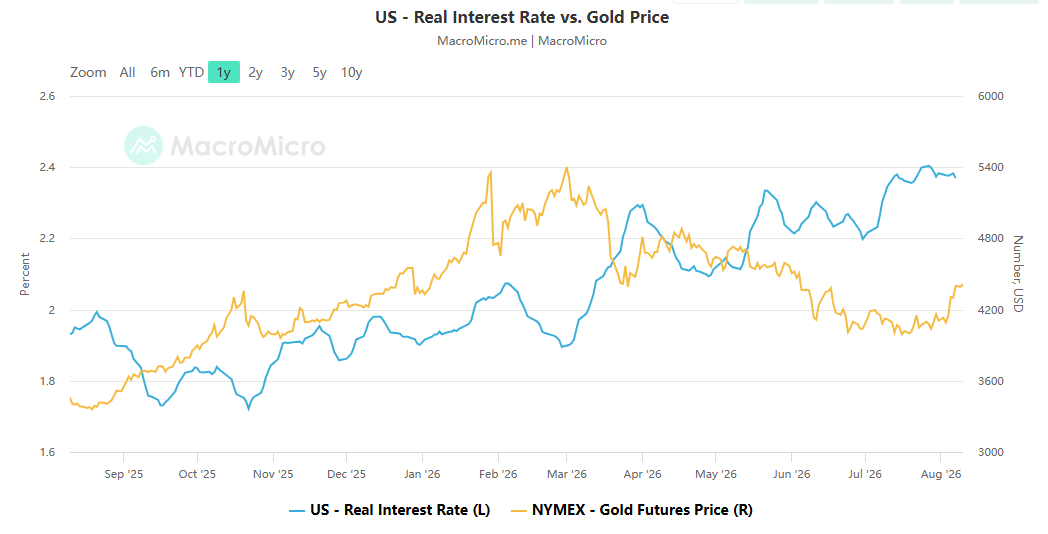
The latest gold rally highlights an important relationship between bullion and US real interest rates.
Gold's direction does not depend simply on whether nominal interest rates are high or low. What matters is also the direction and momentum of real yields.
If real yields continue moving higher, gold can come under pressure even when inflation is elevated.
But if the upward momentum in real yields begins to fade, gold may be able to absorb higher nominal rates more easily.
Fonte: sc.macromicro.me
This is particularly relevant after the latest US employment report.
The weaker labour-market data has given markets a reason to reassess the trajectory of US monetary policy. If the upcoming CPI report confirms that inflation is also cooling, the pressure from real yields could ease further.
That would strengthen the bullish case for XAU/USD.
Is the Middle East Becoming Less Important for Gold?
Geopolitical risk remains a major variable, but its influence on gold may be changing.
Recent developments surrounding the Strait of Hormuz have raised hopes that the disruption to global energy transportation could eventually ease.
For gold, the implications are more complicated than simply “geopolitical tensions are bullish”.
If a reopening of the Strait of Hormuz reduces oil prices and energy-related inflation pressure, it could actually make it easier for the Federal Reserve to adopt a less restrictive policy stance.
Lower energy prices could therefore indirectly support gold through the interest-rate channel.
This creates an unusual market dynamic:
Lower geopolitical risk → lower oil prices → lower inflation pressure → potentially lower rate expectations → potentially lower real yields → potentially supportive for gold.
The relationship is not automatic, but it is becoming increasingly important as traders shift their attention from geopolitical headlines to monetary policy.
UBS Sees Gold at US$5,200 by June 2027
The long-term bullish case for gold extends beyond the next US CPI report.
UBS recently raised its gold outlook, forecasting that gold could reach US$5,000 in the first half of 2027, with a target of US$5,200 by June 2027.
The bank highlighted several structural drivers behind the longer-term outlook, including investment demand, central-bank buying, portfolio diversification and expectations for a more supportive interest-rate environment.
This does not mean gold will move in a straight line towards US$5,200.
In fact, UBS also warned that gold could experience significant volatility and corrections along the way.
For traders, the important distinction is between a long-term bullish thesis and a short-term trading setup.
A market can remain structurally bullish while experiencing sharp corrections of several hundred dollars.
Gold Price Forecast: Can XAU/USD Reach US$4,500?
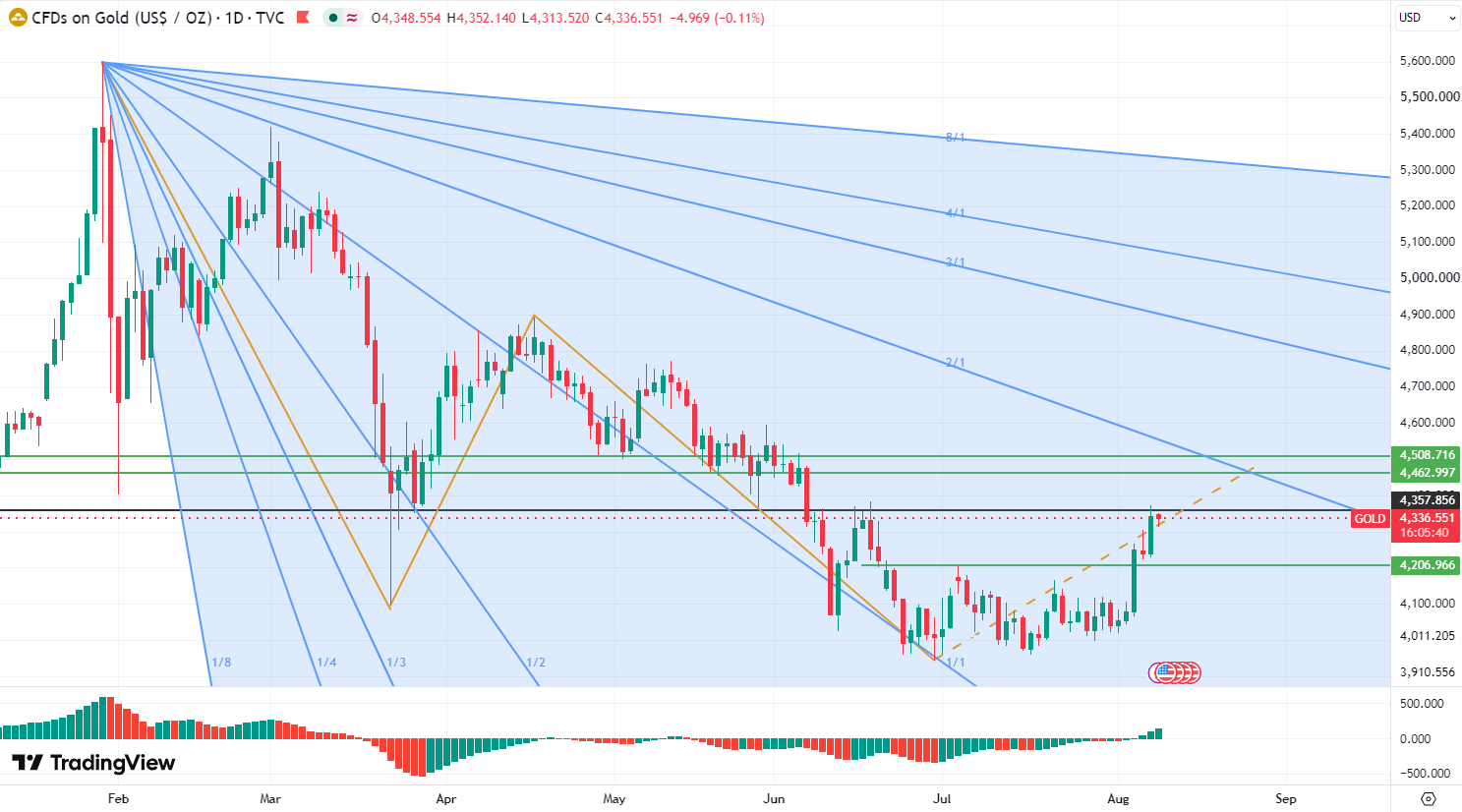
The technical picture has strengthened significantly after gold broke above US$4,200 and then US$4,300. The next major upside zone is now around US$4,400–US$4,500.
Fonte: tradingview
Bullish Scenario: Break Above US$4,400
If XAU/USD can establish a sustained move above US$4,400, the next major target could be US$4,460, followed by the psychologically important US$4,500 level.
A decisive breakout above US$4,500 would strengthen the case for a broader continuation of the current bullish trend.
Base Scenario: Consolidation Above US$4,300
Gold has risen rapidly, so some consolidation would not necessarily invalidate the bullish trend.
If XAU/USD trades between approximately US$4,300 and US$4,400 while maintaining higher lows, the market could simply be building a new base before another breakout attempt.
In this scenario, US$4,300 becomes particularly important.
Bearish Scenario: Break Below US$4,300
The biggest short-term risk is a failed breakout.
If gold falls decisively below US$4,300 and cannot reclaim the level, traders could see increased profit-taking.
The next major support would then be around US$4,200, followed by US$4,100.
A sustained break below US$4,200 would weaken the current bullish structure considerably.
What Should Australian Gold Traders Watch This Week?
For Australian traders, the most important events are now concentrated around US monetary policy expectations.
1. US CPI — August 12
This is likely to be the week's most important macro catalyst.
2. US Treasury Yields
A renewed rise in real yields could limit gold's upside.
3. US Dollar
A weaker US dollar would generally provide a supportive backdrop for USD-denominated gold.
4. Federal Reserve Speakers
Any comments regarding inflation, employment or the timing of future rate decisions could quickly change market expectations.
5. Strait of Hormuz and Oil Prices
Further progress towards reopening the Strait could reduce energy-market risk and potentially influence inflation expectations.
How to Trade Gold CFDs in Australia
Australian traders can gain exposure to gold through physical bullion, ETFs, futures and CFDs.
Gold CFDs can be used to speculate on short-term movements in XAU/USD without taking ownership of physical gold.
Depending on their market view, traders can take a long position when they expect gold to rise or a short position when they expect gold to fall.
For Australian retail clients, CFD trading is regulated by ASIC and subject to product intervention measures, including leverage limits and other protections.
Trade Gold CFDs with Mitrade
If you want to trade gold around major market events such as US CPI, employment data and Federal Reserve decisions, Mitrade provides access to gold CFDs and other global markets through its trading platform.
You can monitor live XAU/USD prices, analyse the market and take positions based on whether you expect gold to rise or fall.
You might be interested in…
Disclaimer: The content presented above, whether from a third party or not, is considered as general advice only. CFD trading involves significant risk of loss. Past performance does not guarantee future results. This article serves informational purposes only and does not constitute financial advice. Consider your risk tolerance before trading.


