


Snowflake Sits 27% Below Its October Peak Even as Growth Speeds Up, With $277.60 the Level to Clear Before Earnings
TradingKey - Snowflake (NYSE: SNOW) closed at $267.72 on Wednesday, November 25, down 1.24%, according to Yahoo Finance data, but the close hides a bigger swing. The stock dropped to $251.08 before buyers lifted it 6.6% off the low.
That leaves Snowflake 27.4% below its 52-week closing high of $368.89 on October 9, even though its last report showed growth speeding up for a third straight quarter. The next test comes on Wednesday, December 2, when the company reports third-quarter fiscal 2027 results after the close.
Growth Is Speeding Up, but the Stock Is Not
In the second quarter, which ended July 31, product revenue, the usage-based fees that make up most of Snowflake's sales, rose 37% to $1.49 billion. Total revenue grew 35% to $1.55 billion. Net revenue retention, which compares what existing customers spend now with a year earlier, was 126%, and customers paying more than $1 million a year rose 27% to 828.
Remaining performance obligations, contracted revenue not yet recognized, rose 30% to $9.0 billion. CEO Sridhar Ramaswamy said on the call that roughly half of the acceleration came from AI products, according to SaaStr.
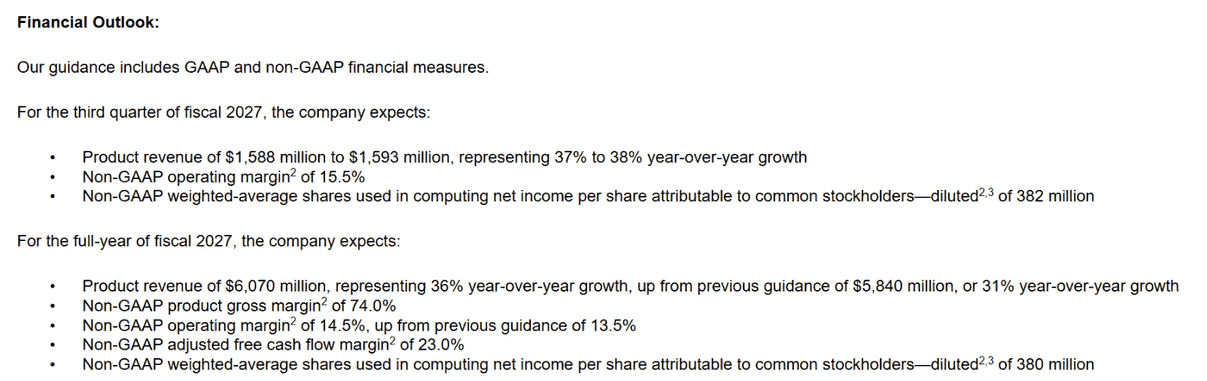
Snowflake also raised its full-year product revenue guide to $6.07 billion, or 36% growth, from $5.84 billion and 31%. It lifted its non-GAAP operating margin target, which leaves out stock pay and some other costs, to 14.5% from 13.5%.
Source: Snowflake Inc. Q2 fiscal 2027 earnings release, Exhibit 99.1 to Form 8-K (sec.gov)
What Snowflake Needs to Show on December 2
For the third quarter, Snowflake guided product revenue of $1.588 billion to $1.593 billion, up 37% to 38%, with a 15.5% non-GAAP operating margin. Analysts expect total revenue of $1.65 billion, up 36% from $1.21 billion, and adjusted EPS of $0.60 against $0.35 a year earlier, according to TipRanks.
Margins are the other test, since Snowflake guides a non-GAAP product gross margin of 74.0% for the year, after 74.7% in the second quarter and 76.4% a year earlier. CFO Brian Robins tied the decline to a larger share of fast-growing AI workloads, which carry lower margins, according to SaaStr.
Cash flow is uneven through the year. The second-quarter free cash flow margin, the share of revenue left as cash after spending on the business, was 5.4%, while the full-year adjusted target is 23.0%, so the company expects most of its cash to come later in the year.
The results will be released after the market closes, with the call at 2:00 p.m. Pacific Time, or 22:00 GMT, according to the company. Earnings have moved this stock hard in 2026, as shares jumped 36.5% the day after the first-quarter report in May and 16.6% on September 3, the day after the second-quarter report.
Analysts Are Trimming Targets, Not Ratings
Notice what did not happen during the fall. Snowflake did not cut its outlook, and analysts did not turn bearish. When the stock fell 7.25% to $269.54 on November 5, Trefis said it moved with technology stocks as a group, and in the month to November 23 it lost 16.6%.
Big swings are nothing new here. From December 3, 2025, Snowflake fell 54.3% to a low close of $121.11 on April 10, according to Trefis. Even after the recent drop, Wednesday's close is still more than double that low, which shows how far the rally ran before October.
Analysts have trimmed price targets rather than ratings. Citi's Tyler Radke kept a Buy rating but lowered his target to $470 from $490, citing lower software valuations. KeyBanc's Eric Heath kept a Buy and trimmed his target to $400, after a survey of 26 Snowflake and Databricks customers showed strong demand and rising spending, according to TipRanks. Heath said adoption of CoCo, Snowflake's AI coding agent, is "trending positively."
TipRanks shows 33 Buy and 3 Hold ratings, with an average target of $435.21, about 63% above Wednesday's close. In my view, the report matters more than usual because the stock still trades at about 17.4 times sales, according to Trefis, so a growth miss would leave little room.
Snowflake Technical Analysis: 4-Hour Close Above $277.60 Could Open $290.77
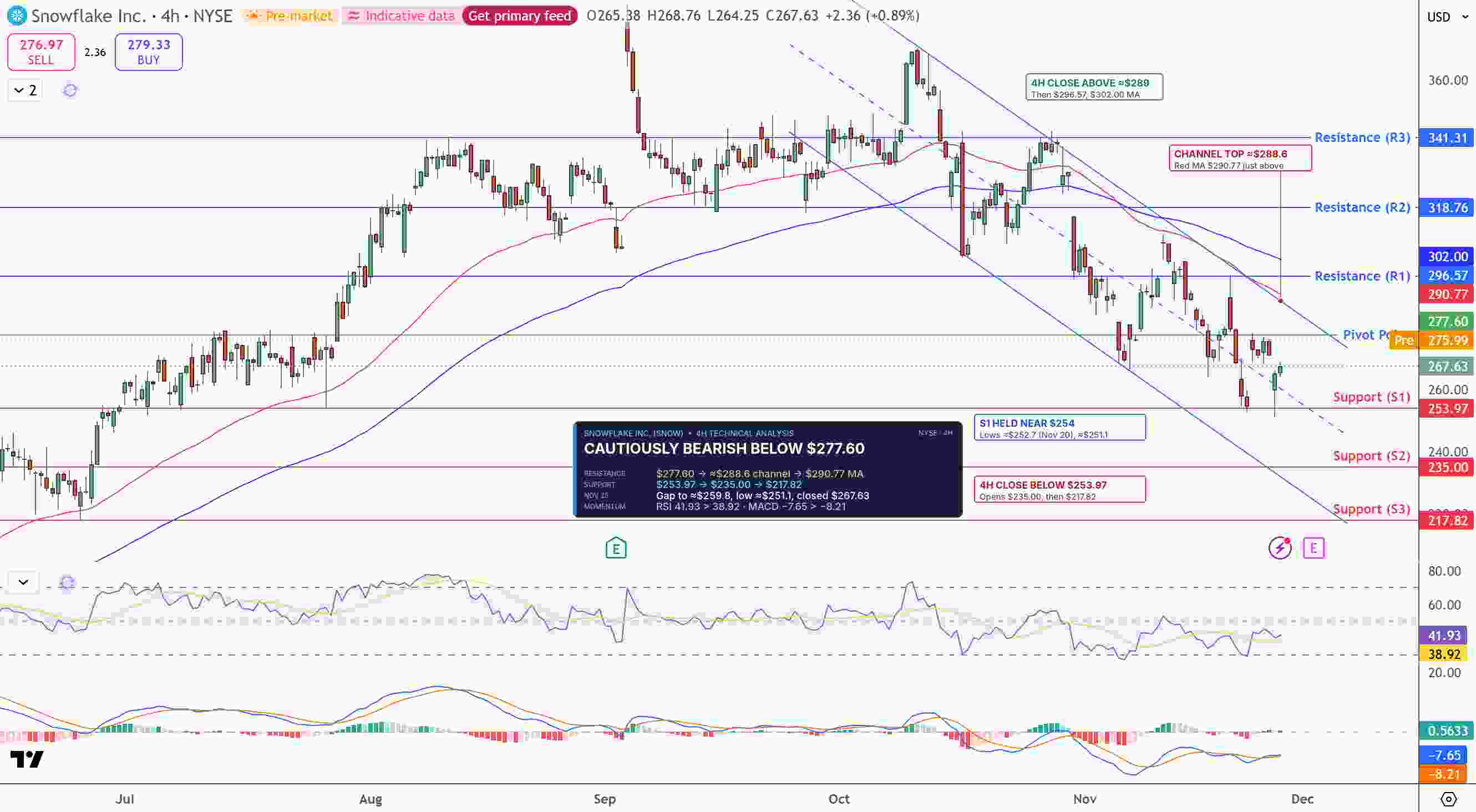
On the 4-hour chart, Wednesday's long lower wick shows buyers pushing back hard after a dip to $251.08, just under the $253.97 support. Even so, the stock is still moving inside a falling channel, two parallel lines that have guided prices lower since mid-October. Price also sits below both moving averages, which track the average price over recent sessions, at $290.77 and $302.00.
RSI, a gauge of buying and selling strength that runs from 0 to 100, has climbed to about 42 and sits above its signal line. The MACD, another momentum indicator, has crossed bullish, a sign that selling pressure is easing.
SNOW Price Chart - Source: Tradingview
A 4-hour close above $277.60 would challenge the channel top and could open $290.77, followed by $296.57. On the downside, a 4-hour close below $253.97 could send SNOW toward $235.00.
I'm cautiously bearish while SNOW stays below $277.60, and a breakout above that level would turn the outlook bullish.
Key Levels
- Earnings: Wednesday, December 2, after the close (call at 22:00 GMT)
- Support: $253.97, $235.00
- Resistance: $277.60, $290.77, $296.57, $302.00
- RSI: 41.93
- Bullish trigger: 4-hour close above $277.60
- Bearish trigger: 4-hour close below $253.97
FAQs
When does Snowflake report earnings?
Snowflake reports third-quarter fiscal 2027 results after the market closes on Wednesday, December 2, with the call at 2:00 p.m. Pacific Time. It guided product revenue of $1.588 billion to $1.593 billion, and analysts expect adjusted EPS of $0.60.
What is the Snowflake stock forecast now?
The bias is cautiously bearish while SNOW stays below $277.60. A 4-hour close above $277.60 could open $290.77 and $296.57, while a 4-hour close below $253.97 could send the stock toward $235.00.
Bottom Line
Snowflake's business is growing faster, but the stock has fallen with software since its October peak. The level that matters is $277.60. I would turn bullish only on a 4-hour close above it, and the December 2 report is the next big catalyst for that move. A 4-hour close below $253.97 would keep sellers in control.
Recommended Articles


