


Nvidia Stock Has Found Its Next Big Catalyst, Making the Stock a Once-in-a-Decade Buying Opportunity.
Key Points
Nvidia noted on its latest earnings call that its physical AI revenue will more than quadruple in the current fiscal year.
The company has solid partnerships in physical AI, which should allow it to sustain its impressive momentum.
Nvidia's emerging catalysts and its attractive valuation suggest that the stock is a smart long-term buy.
- 10 stocks we like better than Nvidia ›
Nvidia (NASDAQ:NVDA) has been hammered on the market lately. Even a strong set of quarterly results from the company earlier this month couldn't change investor sentiment, before the reinstatement of co-founder Jensen Huang as CEO sparked a massive rally earlier this week.
However, investors will do well to look past the noise and focus on the company's financial performance. Nvidia easily beat Wall Street's expectations for the third quarter of fiscal 2027 (which ended Oct. 25). The company's guidance clearly indicates that its incredible growth is sustainable, driven by the data center business that played a central role in boosting its revenue and earnings last quarter.
Missed AI’s "Act 1"? Act 2 Could Be 15x Bigger. Most investors think they missed the AI boat because they didn't buy Nvidia in 2005. But according to our analysts, we’re only at the end of "Act 1"—the R&D phase. "Act 2" is the global rollout. Continue »
However, there is another segment that's starting to move the needle for the company, and I won't be surprised to see this business becoming massive over the next decade.
Let's take a closer look.

Image source: Nvidia.
Physical AI is gradually becoming a key business for Nvidia
Data centers have been at the forefront of the artificial intelligence (AI) revolution so far. However, the technology is now moving from data centers into the real world. Physical AI -- the integration of AI into machines and physical objects such as cars, drones, robots, factory equipment, medical equipment, and other devices -- is emerging as the next big growth driver for Nvidia.
Nvidia notes that its physical AI revenue almost tripled year over year in the previous quarter. What's more, Nvidia expects to generate $25 billion in physical AI revenue in fiscal 2027. That's a huge leap over fiscal 2026, when physical AI added $6 billion to Nvidia's top line. The company is on track to clock almost $424 billion in revenue for fiscal 2027, meaning physical AI will account for nearly 6% of its top line this year.
Nvidia's incredible growth in physical AI isn't surprising, as it has been pushing the envelope in this space. Companies such as Caterpillar, Boston Dynamics, LG Electronics, and other robotics companies are using Nvidia's robotics solutions to develop AI-enabled robots. The semiconductor giant also offers a platform to help customers develop and deploy humanoid robots in healthcare, manufacturing, and retail.
It won't be surprising to see Nvidia's physical AI business become significantly bigger over the coming decade. Counterpoint Research estimates that cumulative physical AI shipments could reach 145 million units by 2035. Barclays estimates that the physical AI market could be worth $1.4 trillion in 2035, which means that Nvidia is scratching the surface of a massive growth opportunity.
As such, there is a solid chance that Nvidia's physical AI revenue will grow at a solid clip over the next 10 years, complementing the growth of the company's data center business.
The valuation and a huge addressable market make Nvidia worth buying
Nvidia stock is down 26% over the past month. As a result, investors can now buy it at just 16.7 times earnings. The forward earnings multiple of 9.3 is even more attractive for a company whose earnings are poised to double this year. Additionally, Nvidia has raised its fiscal 2028 revenue growth estimate by five percentage points to 75%.
Analysts have raised their earnings per share (EPS) expectations for the next couple of years, which isn't surprising considering that the company is already sitting on a lucrative multi-year growth opportunity in AI data center infrastructure.
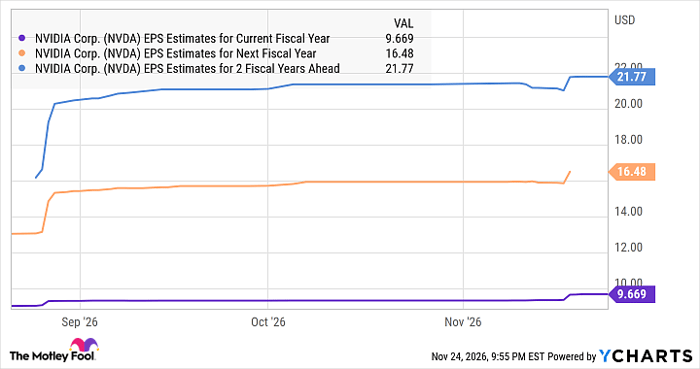
NVDA EPS Estimates for Current Fiscal Year data by YCharts
Nvidia noted on the latest earnings call that the cloud industry's backlog now sits at a whopping $2.5 trillion, up from $2 trillion just three months ago. This huge backlog will ensure that hyperscalers and AI companies continue to invest in more chips, and that's great news for Nvidia considering that it controls 75% of the AI chip market.
The emergence of additional catalysts, such as physical AI, could help Nvidia consistently beat Wall Street's expectations, improving investor confidence in the stock. So, even though Nvidia has taken a beating lately, its growth prospects are still solid. That's why opportunistic investors may consider capitalizing on this AI stock’s recent slide before it becomes a long-term winner.
Should you buy stock in Nvidia right now?
Before you buy stock in Nvidia, consider this:
The Motley Fool Stock Advisor analyst team just identified what they believe are the 10 best stocks for investors to buy now… and Nvidia wasn’t one of them. The 10 stocks that made the cut could produce monster returns in the coming years.
Consider when Netflix made this list on December 17, 2004... if you invested $1,000 at the time of our recommendation, you’d have $320,394!* Or when Nvidia made this list on April 15, 2005... if you invested $1,000 at the time of our recommendation, you’d have $917,381!*
Now, it’s worth noting Stock Advisor’s total average return is 776% — a market-crushing outperformance compared to 199% for the S&P 500. Don't miss the latest top 10 list, available with Stock Advisor, and join an investing community built by individual investors for individual investors.
See the 10 stocks »
*Stock Advisor returns as of November 26, 2026.
Harsh Chauhan has no position in any of the stocks mentioned. The Motley Fool has positions in and recommends Caterpillar and Nvidia. The Motley Fool has a disclosure policy.
Recommended Articles


