


S&P 500 Sell-Off: Here's Why I'm Not Panicking -- and What I'm Doing Instead
Key Points
The majority of the market's best days over the past 30 years have been in bear markets.
Missing just a handful of the best days can have an outsize impact on your portfolio over time.
Here are three things to understand during rough patches to keep you on the right path.
- These 10 stocks could mint the next wave of millionaires ›
Monday was a great example of why investors shouldn't panic sell during a correction or significant market downturn. On Nov. 23, the S&P 500 jumped nearly 5%, the Dow Jones Industrial Average surged 3% and the Nasdaq Composite had one of its best days ever, rising 1,471 points, or 6.5%.
As of Nov. 20, the Nasdaq had been in near bear market territory, down 18% from its all-time high of 27,599 on Oct. 6. But on Nov. 23, with its nearly 1,500-point gain, it surged to 24,089. It is still down 12% from Oct. 6, and there may be volatile days ahead, but days like Monday are one reason you don't want to panic sell during a downturn.
Missed AI’s "Act 1"? Act 2 Could Be 15x Bigger. Most investors think they missed the AI boat because they didn't buy Nvidia in 2005. But according to our analysts, we’re only at the end of "Act 1"—the R&D phase. "Act 2" is the global rollout. Continue »
If you did sell shares in a Nasdaq or tech-focused ETF, or a stock like Nvidia, which gained some 30% on the day alone after CEO Jensen Huang was rehired, you would have lost out on a huge return.
And it's just not a one-off type scenario that won't ever happen again. There are stats to show how much it can negatively impact your portfolio when you miss the market's best days during the correction of a bear market.

Image source: OpenAI (AI-generated illustration).
Missing the market's best days
Earlier this year, the Hartford Funds released a report that examined this very subject. It found that from 1950 through 2025, 76% of the market's best days were either during a bear market or within the first two months of a bull market. Of that, 48% came during a bear market. We're not yet in a bear market, but that could certainly change in the months ahead.
The Hartford report also compiled some numbers on how missing out on the best days would affect a long-term portfolio. It revealed that $10,000 invested in the S&P 500 in 1996 would grow to $192,167 after 30 years, through 2025, based on the average annual total returns of the S&P 500.
If you missed the market's 10 best days, that would bring it down to $85,490. If you missed the best 20 days, the total would be $49,551. If you missed the market's best 30 days, you'd have $31,123 -- 84% less than if you stayed fully invested all 30 years.
Fidelity did a similar study in August, putting a slightly finer point on it. It looks at the impact of missing the market's best days since 1988. A $10,000 investment in the S&P 500 from Jan. 1, 1988 to Dec. 31, 2025 would generate $616,013. Missing just the five best days would result in 38% less in your portfolio, about $380,479.
Three things to do
There are a few things to understand that should help guide you through bear markets and rough patches.
One, understand that bear markets do not last as long as bull markets, nor do they have a bigger net effect on your portfolio. A study by the Hartford Funds also found that there have been 27 bear markets since 1928 and 28 bull markets. The average length of a bear market is 289 days, while the average bull market lasts 988 days. Further, the Hartford Funds research showed that stocks lose 35% on average in a bear market and gain 112% on average in a bull market.
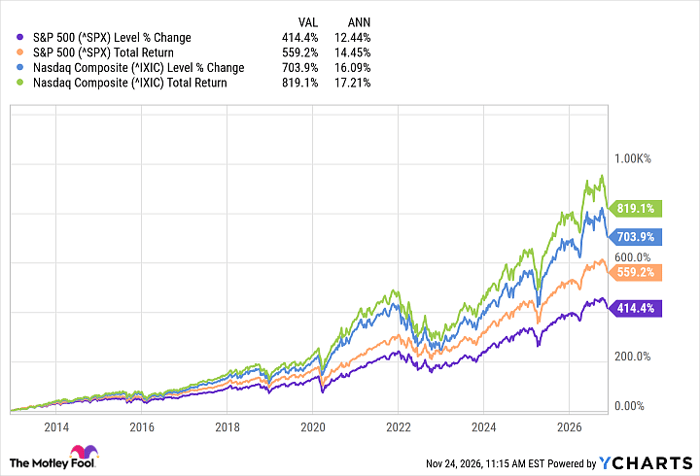
^SPX data by YCharts
Two, over the past 30 years, the S&P 500 has averaged a 14.4% annualized total return, while the Nasdaq has averaged a 17.2% return. That's through the dot-com bust, the Great Recession, the COVID bear market, and the 2022 bear market. So, patience has been rewarded over the years.
And three, downturns and bear markets are a great time to buy, not sell. Many good companies with strong fundamentals in market-leading positions get caught up in negative waves. When that happens, it is time to buy these great stocks at discounts.
In general, downturns are an opportune time to review your holdings. While there may be great buys out there in a bear market, you may also see some stocks that are still overvalued, may be overleveraged, and may be facing industry or economic headwinds.
The best thing to do is check their P/E ratios and valuation metrics, as well as their earnings outlooks. You may find the money invested in those stocks is put to better use in a broad ETF that tracks the Nasdaq or S&P 500 or one of the discount stocks you identified. This is how I approach downturns.
Missed Nvidia in 2009? This Rare Signal Is Flashing Again
In 2009, a "Double Down" signal flashed for a little-known chipmaker called Nvidia. If you’d invested $5,000 then, you’d be sitting on $1,940,746 today.*
Now, for the first time in years, that same "Total Conviction" signal is flashing for a company 1/100th the size of Nvidia. It’s a key player in the $1.8 trillion space race, and with the stock recently sitting 20% off its highs, the window to get in early is closing fast.
Continue »
*Stock Advisor returns as of November 26, 2026.
Dave Kovaleski has no position in any of the stocks mentioned. The Motley Fool has positions in and recommends Nvidia. The Motley Fool has a disclosure policy.
Recommended Articles


