


Warren Buffett Told Savers to "Rejoice When Markets Decline." After the 2000-2002 Bear Market, the S&P 500 Doubled in 5 Years.
Key Points
Although nerve-wracking at the time, pullbacks are long-term buying opportunities.
Even some of the recent exaggerated sell-offs are great buying opportunities, setting up prolonged bullish periods.
Just don’t hold out for what looks like the absolute bottom. Nobody knows they’re in for sure until well after the fact.
- 10 stocks we like better than S&P 500 Index ›
At first blush the suggestion is counterintuitive. A falling market is certainly nothing for investors to celebrate.
As has been the case so often since taking the helm at Berkshire Hathaway (NYSE:BRKA)(NYSE:BRKB) back in 1970, however, this bit of advice first dished out by Warren Buffett in his 1997 letter to Berkshire shareholders was eventually vindicated.
Missed AI’s "Act 1"? Act 2 Could Be 15x Bigger. Most investors think they missed the AI boat because they didn't buy Nvidia in 2005. But according to our analysts, we’re only at the end of "Act 1"—the R&D phase. "Act 2" is the global rollout. Continue »
Granted, it was three years too early. The tech-driven rally underway at the time carried on and even accelerated into the early 2000s. That's when it all unraveled. From that year's peak to 2002's trough, the S&P 500 (SNPINDEX:^GSPC) fell on the order of 40%. Then five years following that multiyear low, the index had reclaimed everything it lost, rewarding those investors with enough forethought to celebrate the opportunity by diving into beaten-down stocks.
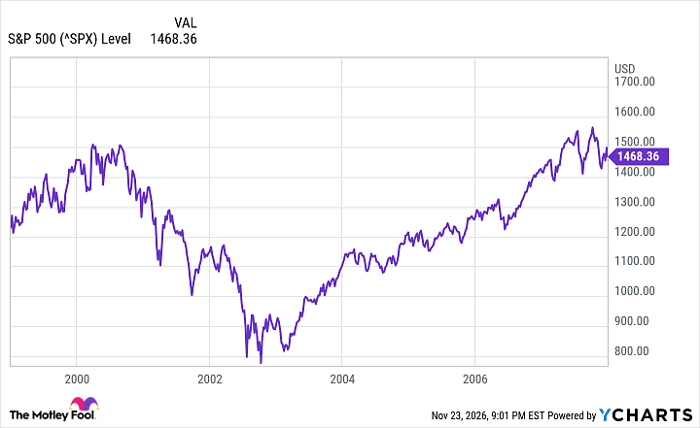
^SPX data by YCharts
It certainly wasn't the first time something like this had happened either.
A proven pattern
The irony? By the time the S&P 500 had doubled its 2002 low by mid-2007, the next cyclical headwind -- led by the subprime mortgage meltdown -- was already underway. Less than two years later, the index had lost a little more than half of 2007's peak value. And once again it was destined for a major recovery. Only this time, the S&P 500 would only need four years to recover, and would ultimately go on to quadruple its 2009 low before the onset of the COVID-19 pandemic finally brought the rally to a screeching halt in early 2000.
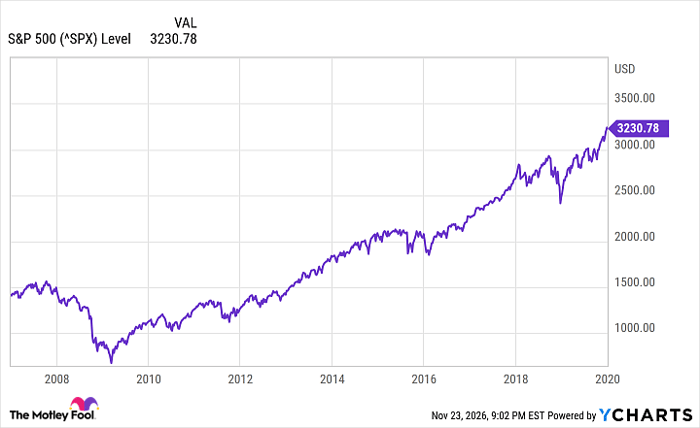
^SPX data by YCharts
Even then, though, the pandemic-prompted bear market that pulled the S&P 500 down by one-third of its value would erase that loss before the end of the same year, en route to what would be a bull market worth 90% in less than two years. The 2022 bear market also dialed the index back by more than 20%, but the bull market since then is up more than 100% from the late-2022 bottom.
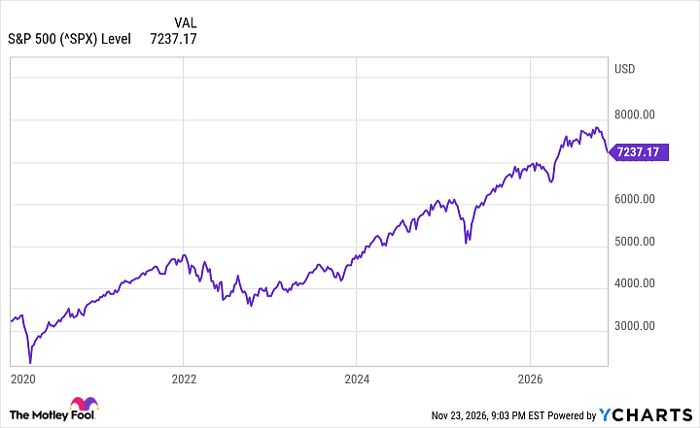
^SPX data by YCharts
The point is, every major and minor setback the stock market has suffered so far has eventually been recouped, and then surpassed.
It's not like Buffett doesn't take his own advice either. He famously bought a stake in then-deeply-discounted Goldman Sachs back in 2008, and locked in a 60% gain on this position in 2020. Berkshire added a bunch of now-privately-held construction materials companies between 2000 and 2002 as well, positioning it for a couple of waves of housing booms that would materialize in the meantime.
Don't risk overthinking it
The point is, while corrections and bear markets feel pretty miserable at the time they're happening, Warren Buffett is right -- they're a reason to rejoice, particularly if you missed out on most of the bull market that preceded them. Dips are a second chance to step in at a discounted price regardless of how big or small they are.
Image source: Getty Images.
Just don't get too cheeky or clever when this window of opportunity opens. No one knows exactly when or where a bottom is going to be made, and plenty of investors have missed out because they were holding out for slightly better prices that never materialized. Any decent dip that offers an entry price you can live with in the long run is more than good enough.
Should you buy stock in S&P 500 Index right now?
Before you buy stock in S&P 500 Index, consider this:
The Motley Fool Stock Advisor analyst team just identified what they believe are the 10 best stocks for investors to buy now… and S&P 500 Index wasn’t one of them. The 10 stocks that made the cut could produce monster returns in the coming years.
Consider when Netflix made this list on December 17, 2004... if you invested $1,000 at the time of our recommendation, you’d have $317,482!* Or when Nvidia made this list on April 15, 2005... if you invested $1,000 at the time of our recommendation, you’d have $954,740!*
Now, it’s worth noting Stock Advisor’s total average return is 784% — a market-crushing outperformance compared to 199% for the S&P 500. Don't miss the latest top 10 list, available with Stock Advisor, and join an investing community built by individual investors for individual investors.
See the 10 stocks »
*Stock Advisor returns as of November 26, 2026.
James Brumley has no position in any of the stocks mentioned. The Motley Fool has positions in and recommends Berkshire Hathaway and Goldman Sachs Group. The Motley Fool has a disclosure policy.
Recommended Articles


