


Warren Buffett’s Record Cash Pile Is Sending Investors a Message About AI Stocks
Key Points
Warren Buffett's former company, Berkshire Hathaway, holds huge positions in AI.
With regard to AI stocks, Buffett and his team invested the way they always have.
- Motley Fool Issues Rare "Total Conviction" Buy Alert ›
Despite a bull market, Warren Buffett spent his last years at Berkshire Hathaway (NYSE:BRKA) (NYSE:BRKB) selling stocks and stockpiling cash. The company's $377 billion in liquidity is close to a record and exceeds its approximate $346 billion in stock holdings. Many investors found this move perplexing, with Buffett selling stocks at a time when most other investors were buying.
However, the cyclically adjusted P/E (CAPE) ratio of 41 is near an all-time high, so Buffett may have merely been reacting to that metric or similar ones. I believe Buffett is telling us something that may seem surprising but really is not, and it has nothing to do with hating artificial intelligence.
Missed Nvidia in 2009? This Rare Signal Is Flashing Again. In 2009, a "Double Down" signal flashed for a little-known chipmaker called Nvidia. For the first time in years, that same "Total Conviction" signal is flashing for a company 1/100th the size of Nvidia. Continue »
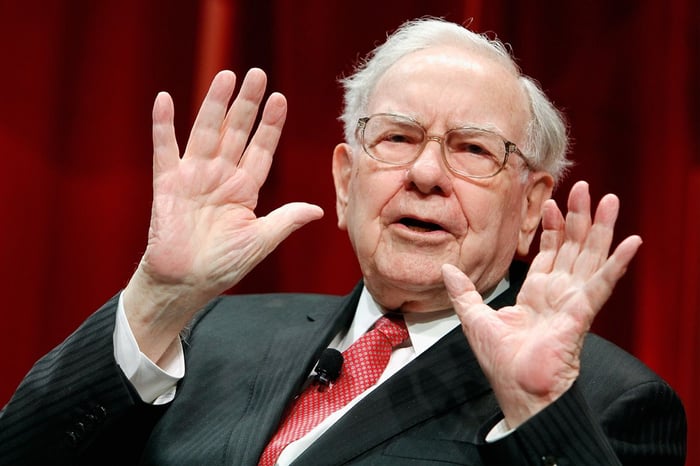
Warren Buffett. Image source: Getty Images.
Berkshire Hathaway and AI investing
Make no mistake, technology has long been part of Berkshire’s portfolio.
Berkshire's largest investment has long been Apple (NASDAQ:AAPL). Despite the reduction in that position, it still accounts for around 23% of the company's holdings.
Moreover, both Buffett and his successor, Greg Abel, bought shares of Google's parent company, Alphabet (NASDAQ:GOOGL) (NASDAQ:GOOG). They made aggressive purchases in late 2025 and 2026, adding $10 billion of this AI stock in June alone. This is meaningful as Berkshire has made few aggressive buys in recent years. Between Alphabet's two tickers, it accounts for an additional 8% of Berkshire's holdings.
Furthermore, until early 2026, Berkshire held a position in Amazon (NASDAQ:AMZN), a cloud pioneer and longtime AI innovator.
Among these holdings and connections, AI accounts for around 31% of the Berkshire portfolio, so Buffett clearly wasn't avoiding it.
Then what message is Berkshire sending?
The message Berkshire is sending about AI stocks is that they should be treated just like any other investment.
Admittedly, Buffett was a longtime opponent of technology investing. But once he became convinced of its importance and likely permanence, he sought out tech investments and applied many of the same principles that led him to buy stocks such as American Express (NYSE:AXP) and Coca-Cola (NYSE:KO).
Apple was one of the more notable investments. Apple consistently traded at P/E ratios below 20 when Berkshire did the bulk of its buying in the second half of the 2010s. This likely means Buffett bought the stock below its intrinsic value. Additionally, the economic moat built around its core product, the iPhone, and the company's strong free cash flows, probably also influenced the decision to buy.
Many of the same characteristics appear to apply to Alphabet. It has often traded below 20 times earnings in recent years and maintains offerings with AI-supported moats like Google Advertising, Google Cloud, and the Android operating system. Alphabet has also stood out for strong free cash flows, even though its recent AI-related capital expenditures have led to outflows in recent quarters.
Altogether, both Apple and Alphabet are, by most accounts, wonderful companies Buffett and his team bought at fair prices, and Greg Abel seems to be carrying that philosophy forward. Hence, little has changed with Berkshire's investment style; it just happens to be applied to AI in this case.
Buffett's message about AI
Buffett's message about AI is that there is no AI message. Although he and now Abel have taken large positions in leading technology companies, the Buffett investment philosophy remains the driving force behind Berkshire's stock purchases.
The truth is he employed the same philosophy to buy Apple and Alphabet that he applied to his other major holdings earlier in his career. Fortunately for Berkshire, some AI stocks became the wonderful companies at fair prices that Buffett liked to find, and he made sure Berkshire capitalized on those opportunities.
Knowing that, I believe the lesson here is that if one applies Buffett's philosophy to stocks across a multitude of industries, they have a better chance of earning market-beating returns. That approach is likely more important than whether a holding is an AI stock.
Should you buy stock in Berkshire Hathaway right now?
Before you buy stock in Berkshire Hathaway, consider this:
The Motley Fool Stock Advisor analyst team just identified what they believe are the 10 best stocks for investors to buy now… and Berkshire Hathaway wasn’t one of them. The 10 stocks that made the cut could produce monster returns in the coming years.
Consider when Netflix made this list on December 17, 2004... if you invested $1,000 at the time of our recommendation, you’d have $305,941!* Or when Nvidia made this list on April 15, 2005... if you invested $1,000 at the time of our recommendation, you’d have $771,325!*
Now, it’s worth noting Stock Advisor’s total average return is 719% — a market-crushing outperformance compared to 192% for the S&P 500. Don't miss the latest top 10 list, available with Stock Advisor, and join an investing community built by individual investors for individual investors.
See the 10 stocks »
*Stock Advisor returns as of November 24, 2026.
American Express is an advertising partner of Motley Fool Money. Will Healy has positions in Berkshire Hathaway. The Motley Fool has positions in and recommends Alphabet, Amazon, American Express, Apple, Berkshire Hathaway, and Microsoft. The Motley Fool has a disclosure policy.
Recommended Articles


